Case study
OMRON Corporation streamlines global trade compliance with ONESOURCE
Industrial automation leader centralizes Harmonized System (HS) code classification across more than 60 global bases, reducing compliance risks and improving transparency with ONESOURCE
Navigating a complex trade landscape
OMRON Corporation, a global leader with an annual revenue exceeding $5.5 billion, recognized the need to transform its trade compliance approach after shifting tariff policies introduced new complexities and compliance risks. With over 60 import/export bases, maintaining a competitive advantage and operational efficiency was becoming increasingly difficult.
$5.5
billion in revenue
60
import/export bases
5
primary business segments
The compliance gap: A black box of Harmonized System codes
OMRON Corporation previously managed Harmonized System (HS) codes locally using spreadsheets across its global operations. With five primary business segments, this decentralized approach created significant visibility challenges, making it difficult for headquarters to monitor classifications and ensure consistency across regions.
HS code interpretation varies by country, especially for complex products like industrial electronics. The lack of centralized oversight meant that local teams were operating independently, creating inconsistencies and potential compliance risks. As tariff barriers increased with changing trade policies, OMRON recognized that this fragmented system could no longer support its global operations effectively.
The company needed to centralize HS code management to reduce compliance risks, improve transparency, and ensure consistent classification practices across all its international bases.
Building a centralized, expert-driven classification system
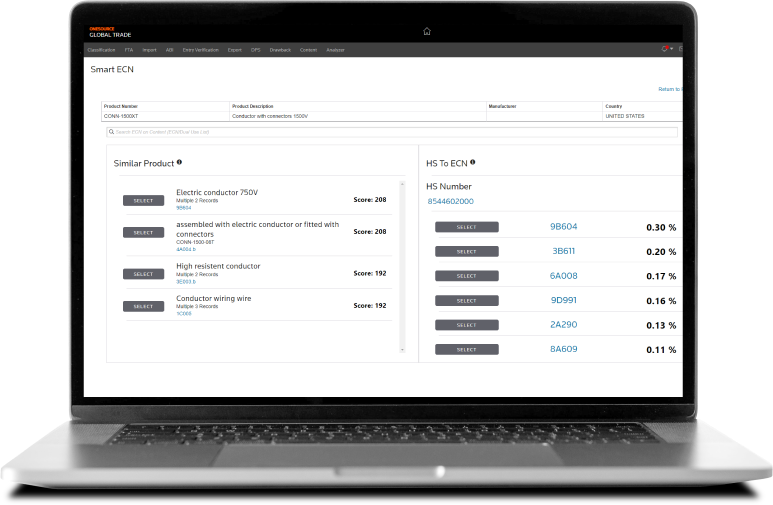
To address these challenges, OMRON formed a central team of classification experts in Japan, working closely with regional customs teams to build a comprehensive global HS code database. Using ONESOURCE Global Classification, OMRON then documented classification logic and made it accessible across all import bases. The powerful platform enabled:
- Consistent classification across regions: Standardized processes ensure alignment with headquarters' policies while accommodating local requirements.
- Centralized master data management: This centralization creates a single source of truth for HS code data across the organization.
- Expert oversight to reduce errors: A central team of specialists validates classifications before implementation.
- Improved operational efficiency: Automated processes replace manual spreadsheet management.
Among several providers, OMRON ultimately chose Thomson Reuters for its strong reputation in the United States and its ability to provide consistent support across the Americas, Southeast Asia, Japan, China, Middle East, North Africa, India, and Hong Kong.
“The competitive pricing and the cross-regional support unique to Thomson Reuters were decisive factors for implementation.”
Rauno Giffhorn
OMRON Corporation, Logistics Management Division, Customs Management Dept. Assistant Manager
Additionally, the ability to proactively identify discrepancies and ensure the correct HS code is used, especially when leveraging free trade agreements (FTAs), was a huge selling point.
Outcomes: Maintaining global competitiveness
Using Global Classification, OMRON now collaborates closely with regional customs teams, especially in the United States and China, to stay ahead of regulatory shifts. Integrated, real-time updates on tariff changes and regulatory content dramatically improve the overall data accuracy.
OMRON has also been able to improve transparency across the organization by enabling the storage of supporting documentation for classification decisions and tracking changes — who made them, when, and why.
As for next steps, OMRON plans to integrate ONESOURCE Global Classification with its core enterprise systems. Doing so will embed trade compliance directly into business processes, enhancing efficiency and reducing risk across the organization. The company is also exploring additional Thomson Reuters solutions — such as export control and security trade-management systems — to further strengthen its compliance framework and maintain competitive advantage in the global marketplace.
At a glance

Industry
Legal
HQ region
Kyoto, Japan
Solutions
ONESOURCE Global Classification
ONESOURCE Global Trade Content
Year founded
1933
Additional case studies

Resonac Corporation unifies global export management with ONESOURCE

How Shimano boosts FTA compliance with ONESOURCE

JGC strengthens trade compliance with ONESOURCE
ONESOURCE Global Classification powered by CoCounsel
Explore how Global Classification will enable your business to compete confidently in an evolving global trade environment
.png)
