Highlights
- AI now compresses HS code classification research that used to take compliance teams hours into just minutes.
- ONESOURCE Global Classification and Global Trade Research combine to deliver accurate codes plus cited regulatory context instantly.
- Built to Fiduciary-Grade AI standards, both tools help trade teams stay audit-ready and defend classification decisions.
Jump to ↓
Why does HS code classification take so long?
How does AI support HS code classification?
Is accurate HS classification enough for trade compliance?
How do Global Classification and Global Trade Research work together?
Is AI-powered trade compliance software secure?
Step into the future of global trade with AI HS code classification
 |
|
Why does HS code classification take so long?
Global trade and compliance professionals know that product classification is both essential and increasingly complex. What should be a straightforward process, assigning the correct Harmonized System (HS) code to a product, regularly becomes a significant operational bottleneck. The reason isn’t one problem. It’s three that compound.
A 6-digit international HS code expands to 8, 10, or even 13 digits depending on the country. Each additional digit reflects regional regulations and product-specific nuances, layering complexity onto the base classification. What should take minutes stretches into hours, distracting from other tasks, increasing compliance risk, and sometimes leading to incorrect tax payments.
It is important to understand that classification and duty rates are two distinct steps that do not always change together. Classification means determining the correct HS code, a process governed by a globally standardized system to six digits, with countries extending to 8, 10, or more. These codes are updated on a five-year revision cycle. Duty rates, by contrast, can change at any time, independently of the code structure, and vary by factors such as most-favored-nation (MFN) status, penalized-country designations, trade agreement programs like USMCA, and additional tariffs such as Section 301 and Section 232 duties, some of which may not appear directly in the standard duty table.
Getting the right code is only the first step; knowing which duty rates apply to that code today requires a separate and continuous lookup.
In June 2026, U.S. Customs and Border Protection (CBP) indefinitely suspended the $800 de minimis exemption for all modes of importation. Every shipment now requires a 10-digit HTS classification regardless of value, dramatically expanding the classification workload for businesses that previously moved low-value goods duty-free with minimal paperwork.
Where does the product data even live?
The work begins before any classification can happen. Modern businesses often operate with a patchwork of enterprise resource planning (ERP) systems, Oracle, SAP, and even simple spreadsheets. Each business unit may run its own platform, leading to disconnected databases and inconsistent product information. Acquisitions only magnify the problem, as newly acquired companies bring their own legacy systems and data structures.
For compliance teams, the first step, discovering the correct range of HS codes for a product, is daunting. Without a unified view, teams must manually search for product details across multiple platforms before classification even begins. This “range discovery” is the foundation of accurate classification, but it is slow and error-prone when done by hand.
- ERP fragmentation crisis: Multiple, unconnected systems make it hard to gather complete product data, resulting in scattered and inconsistent records.
- Range discovery challenge: Finding the starting point for classification requires manual investigation, often with incomplete or conflicting information.
- Time drain reality: Manual research across different government websites intensifies the bottleneck.
Teams spend hours hunting through Federal Register notices, CSMS messages, and agency publications to answer a single question. Junior staff lack the expertise to interpret complex regulations. Senior experts get overwhelmed with research requests. And the cost of getting it wrong has climbed sharply. In FY2025, CBP audit collections doubled to $235.5 million, and the agency issued 137% more liquidated damages than the year before. A June 2026 executive order directed CBP to increase audits further, impose maximum penalties for repeat offenders, and establish a minimum penalty floor for customs violations.
When a VP of Supply Chain asks about the impact of new China tariffs on automotive parts imports, it is not always an easy task for compliance managers to research multiple sources and government sites in order to provide an answer.
Why don’t traditional classification methods catch up?
Relying on manual comparison of product descriptions against the complex and evolving HS schedule is no longer viable. Each country’s regulations add layers of detail, making it nearly impossible to keep up with all the variations. Traditional methods can’t learn from previous classifications, meaning every new product feels like starting from scratch. Compliance teams are left guessing whether their chosen code is correct or if further review is needed.
- Manual comparison: Human review of product descriptions is slow and prone to oversight.
- Country-specific complexity: Local regulatory changes can quickly make existing knowledge obsolete.
- No learning from history: Previously classified products do not inform future decisions.
What looks like multiple problems is really one compounding bottleneck. The fix isn’t to chip away at each piece manually: it’s to bring AI to both the classification work and the research that surrounds it.
How does AI support HS code classification?
ONESOURCE Global Classification powered by CoCounsel addresses the classification bottleneck, enabling faster and more consistent human decision-making. The tool is designed to support and accelerate that validation, not replace it. the tool delivers:
- Industry context: The system understands the nuances that can arise when products from different industries have similar names. For example, that “disk” or “disc” can mean a music CD or an automotive brake disc, which helps to reduce misclassification.
- Improved accuracy over time: The system adapts to your previous decisions, internal terminology, and product history.
For organizations running multiple systems (SAP, Oracle, spreadsheets), inconsistent classifications across platforms are a known risk. Global Classification consolidates those disparate records into a single workflow, flagging inconsistencies so they can be reviewed and resolved. The system also creates a documented audit trail of every classification decision, helping companies demonstrate reasonable care and maintain defensible compliance records in the event of a customs inquiry.
But the right HS code is only half the answer. The other half is knowing what that code actually means under today’s regulations, and that’s where classification ends and research begins.
Is accurate HS classification enough for trade compliance?
Even a correct classification is only as good as the regulatory context behind it. Article description changes, scope rulings, and country-specific obligations shift the answer attached to otherwise correct classification. ONESOURCE Global Classification powered by CoCounsel answers what the code is. The regulatory compliance manager still needs to answer what that code means today, and that research happens upstream of, and continuously alongside, every classification decision.
ONESOURCE Global Trade Research powered by CoCounsel: The upstream complement
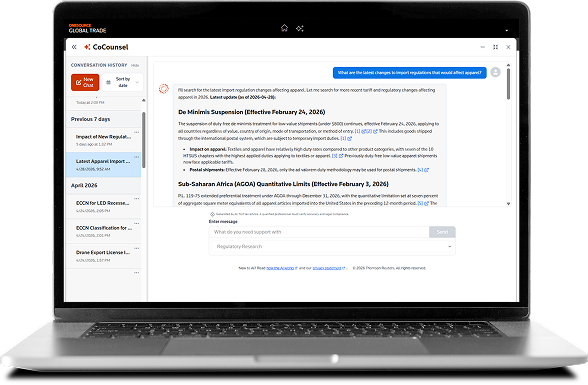
ONESOURCE Global Trade Research powered by CoCounsel, embedded within ONESOURCE Global Trade Content, tackles the research bottleneck by delivering instant, cited answers to complex compliance questions. This natural language research assistant synthesizes information from a vast collection of vetted trade documents, including Federal Register notices, CBP guidance, and executive orders.
This tool passed the last 6 U.S. Customs and Border Protection Licensure Exams demonstrating professional-grade regulatory knowledge. Where manual research takes hours, Global Trade Research powered by CoCounsel returns synthesized answers with citations in seconds.
What AI-powered trade research looks like in practice
For the regulatory compliance manager, the value shows up in the questions that used to consume an entire afternoon. Three examples of how Global Trade Research powered by CoCounsel reshapes day-to-day research work:
- Section 301 / tariff-action lookup: A new USTR action raises a question about whether a Section 301 exclusion still applies to a given HTS subheading. Manually, this means scanning Federal Register notices and the latest USTR exclusion lists for matches. Global Trade Research returns a cited answer in seconds, with the underlying notices linked for audit defense.
- Country-specific scope and ruling checks: A borderline product — say, a dual-use item that could read as industrial or consumer — needs a CROSS ruling or CBP guidance check before classification is finalized. Manually, this means cross-referencing the CROSS database against recent CSMS messages. Global Trade Research returns a synthesized answer with linked citations from both sources.
- Duty drawback and FTA eligibility: A product line is being re-sourced, and the regulatory compliance manager needs to confirm whether drawback eligibility or FTA preference rules apply. Manually, this means stitching together excerpts from multiple agency publications. Global Trade Research returns a direct answer with the relevant statutory citations.
Why this matters for the regulatory compliance manager
Classification accuracy is judged after the fact: in audits, penalties, and delayed shipments. Global Trade Research lets the regulatory compliance manager verify the regulatory ground before the classification is finalized, not after a CBP inquiry. When ONESOURCE Global Classification and Global Trade Research run together, the regulatory compliance manager gets both the code and the context in a single workflow.
How do Global Classification and Global Trade Research work together?
Powered by CoCounsel and working together, ONESOURCE Global Classification and Global Trade Research form a complete trade compliance workflow: code assignment and regulatory context in a single loop. Global Classification handles the technical process of assigning codes. Global Trade Research provides the regulatory context needed to make informed decisions about tariffs, duties, and compliance requirements.
This integrated approach allows trade teams to shift from reactive researchers to proactive strategic advisors. Instead of spending most of their time on manual research and classification, professionals can focus on strategic analysis and executive guidance.
Is AI-powered trade compliance software secure?
Data security and privacy remain paramount in these AI solutions. The classification tool’s comparison logic is strictly compartmentalized, ensuring no customer data is shared between different users. Global Trade Research is trained exclusively on vetted government publications rather than open internet sources, ensuring accuracy and reliability.
Both systems continuously improve through real-world feedback and regular content updates. Global Trade Content updates on average in less than one business day from government publication, so AI responses reflect the latest regulatory environment. When tariffs change overnight or executive orders reshape supply chains, the content reflects those changes immediately.
Both tools are built to the Thomson Reuters Fiduciary-Grade AI™ standard, the bar the company holds its AI to whenever the stakes are too high for “close enough”: content you can trust, expertise built into the system itself, and answers you can actually verify. For trade professionals who have to stand behind every classification and research decision if CBP comes calling, that’s the difference that matters.
Step into the future of global trade with AI HS code classification
The integration of AI-driven classification and research tools marks a significant advance for global trade management and compliance. By adopting these systems, trade professionals can achieve greater accuracy, improve operational efficiency, and reduce compliance risks while positioning themselves as strategic partners within their organizations.
Trade teams using these AI tools report faster decision-making, reduced workload stress, and increased ability to provide real-time strategic guidance to executives and procurement teams. Georgia-Pacific, an American pulp and paper manufacturing company, reduced their time spent on product classification by 50% with ONESOURCE Global Classification.
The result for these companies is a fundamental shift from time-consuming manual processes to strategic advisory roles that add measurable value to the business.
Transform your trade compliance workflow: See how AI enables faster, more confident classification decisions.
 |
|
When classification and research run together, your team spends less time hunting for answers and more time advising the business. Ready to see it in action? Explore ONESOURCE Global Classification powered by CoCounsel and ONESOURCE Global Trade Research powered by CoCounsel to discover how AI-driven trade compliance can transform your workflow.
 |
|