
The hidden costs of free AI tools in tax research, from costly rework and compliance risks to increased liability exposure
Highlights
- Free AI can create costly rework when tax research must be manually verified.
- Unverified AI results may increase compliance and liability risks for firms.
- Tax-specific AI delivers authoritative answers, reducing review time and improving efficiency.
Your junior associate runs a tax research question through ChatGPT and the answer looks solid. But then your supervisor review catches an error: the citation’s outdated, the ruling was withdrawn. Three hours of rework later, you’ve got the right answer, and that’s the hidden cost of inexpensive AI.
Free and cheap AI tools promise speed and savings. What they don’t tell you is the price you pay in rework, liability exposure, and lost team efficiency. For tax professionals, that math doesn’t add up.
Jump to ↓
The liability shadow for tax and accounting firms
Why specialized AI for tax matters
The conversation firm leaders should have
See the difference AI built for tax work makes
The AI rework tax
Free AI tools are highly effective for consumer-grade tasks, but they aren’t built for tax work. Generic AI is trained on public web data, not authoritative tax content, IRS code, or case authority. That means every response from ChatGPT, Copilot, or similar tools requires validation.
Here’s the workflow you probably recognize:
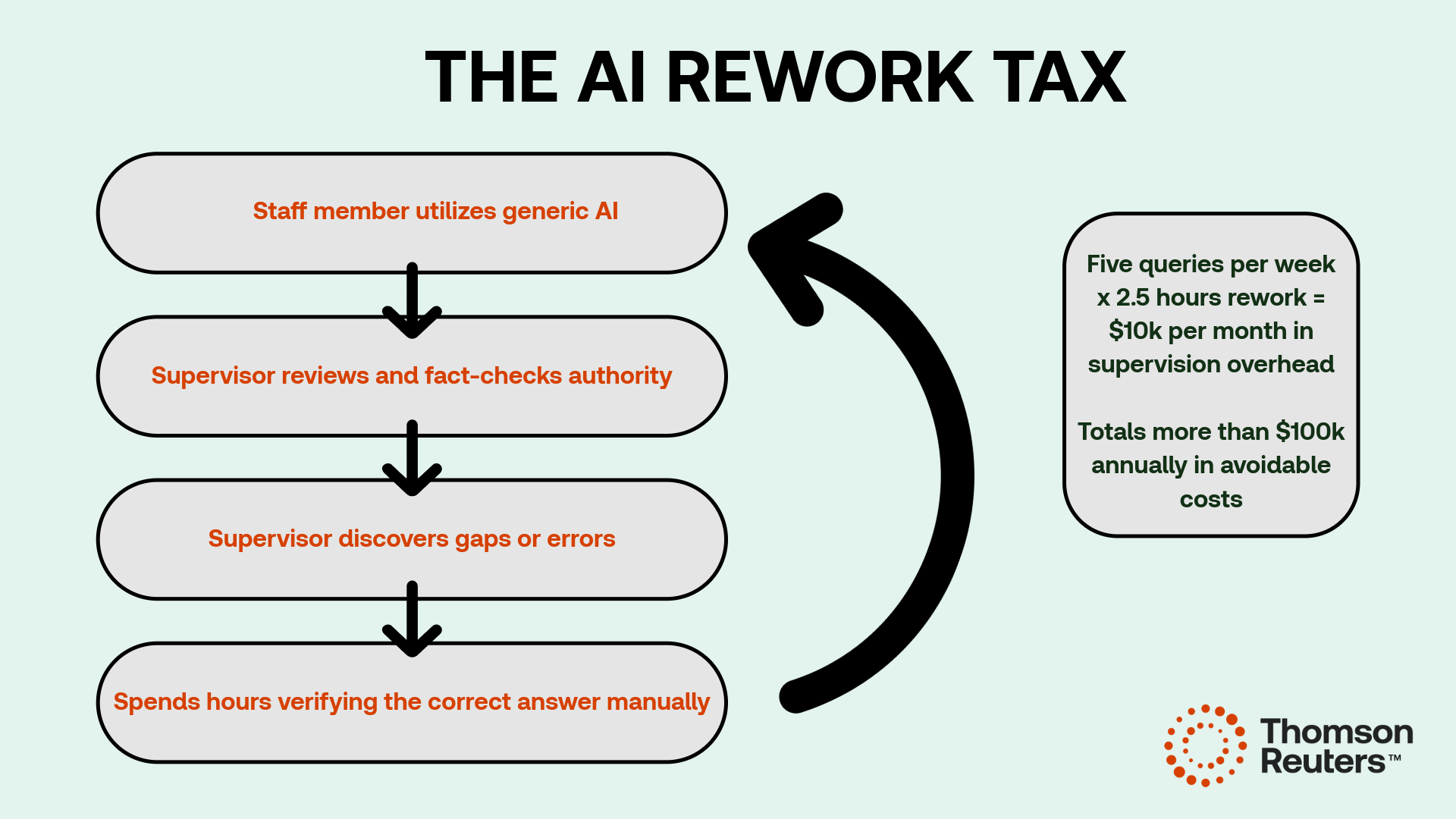
The AI didn’t save time; it created work.
Do this five times a week across your team and the cost compounds quickly. A blended hourly rate of $150 across five professionals running five queries per week with 2.5 hours of rework each: that is nearly $10,000 per month in supervision overhead alone. Annually, you’re paying more than $100,000 to catch mistakes a specialized AI tool wouldn’t have made in the first place.
And that’s just the visible rework. The invisible cost is harder to measure: delayed client deliverables, more tedious review cycles, and junior staff losing confidence and development opportunities because their work keeps getting sent back.
The liability shadow for tax and accounting firms
According to the Thomson Reuters 2026 Future of Professionals Report, 34% of professionals use AI tools their organization hasn’t sanctioned. This is a sign that adoption is outpacing governance, and it is a quiet liability for the organizations where it’s happening.
When an associate cites an AI-generated answer without verifying it (and that citation turns out to reference a withdrawn position or a misinterpreted ruling) your firm’s reputation can come into question. Now your insurance carrier has to ask hard questions about your AI controls and policies.
Fiduciary duty doesn’t disappear because you used AI. As the IRS has stated, your firm is still responsible for the quality and authority of the research you provide. Outsourcing that verification to an unvetted tool doesn’t transfer the risk; it concentrates it.
Cheap AI tools can’t distinguish between leading authority and a dismissed opinion. They can’t track when regulations change or when an IRS position is reversed. They’re not designed specifically for tax work; they’re designed for everything, which means they’re optimized for nothing specific.
The knowledge silo problem
Every time a team member uses unvetted AI and doesn’t document their approach, you lose institutional knowledge.
Junior staff relying on ChatGPT for research don’t develop the tax reasoning skills they need to advance. There’s no shared process, no quality gate, no feedback loop. When a staff member discovers an error, that person alone learns from it and the mistake is destined to be repeated by someone else in the firm.
Responsible tax professionals end up doing the research themselves because they can’t trust the first draft. That defeats the entire purpose of having junior staff in the first place.
Why specialized AI for tax matters
Thomson Reuters CoCounsel Tax is built differently. It’s trained on authoritative tax law, IRS guidance, and case authority — not web data. Every citation is cited and verified; every response is grounded in sources your firm can trust. That changes the equation entirely.
- Junior staff produces research you can spot-check, not redo
- Senior professionals get several hours per week back to focus on client strategy and firm growth
- Your team develops real tax reasoning skills because AI is supporting their work, but not replacing their judgment
The liability surface shrinks because you’re no longer outsourcing authority verification to a tool that can’t do it

CoCounsel Tax, Audit, & Accounting ROI Calculator
Discover how much time your firm may save by using agentic AI to answer questions and autonomously complete tasks and workflows
Try the ROI Calculator ↗The conversation firm leaders should have
Before you commit to another year of cheap AI rework, ask yourself:
- What’s our actual rework rate on AI-assisted research? (Track it for four weeks, the answer may surprise you.)
- If we saved 32% of your firm’s time with trusted content and authoritative citations, what would we do with that time?
- How are we documenting our AI governance for client engagements and insurance purposes?
- What’s our appetite for liability exposure in exchange for free tools?
The answer to that last question usually clarifies everything else.
See the difference AI built for tax work makes
Cheap AI has its place; tax work isn’t it. Professionals who move their firms forward don’t choose between speed and confidence, but they demand both.
CoCounsel Tax delivers both. It’s Fiduciary-Grade AI™ that cites verified authority. Workflows that support junior staff development while freeing senior experts for higher-impact work. Compliance and governance built in; no surprises.
See how CoCounsel Tax can transform your research process and what this ROI means for your firm.
Thomson Reuters empowers tax professionals to work faster while knowing their work is built on authority they can trust.