
Why advisory breaks down when context lives outside the system
Highlights
- Tax software captures data, but the client context often lives in emails, conversations, notes, and institutional knowledge.
- Advisory opportunities are frequently missed because they lack shared visibility into clients' goals, plans, and business circumstances.
- Firms that capture and share judgment-level insights can scale advisory beyond individual partners, turning client context into a repeatable, firmwide process.
Most accounting firms have invested heavily in organizing data but what about the context? They have tax software, document portals, workflow systems, practice management tools, and client folders. In theory, the information the team needs should be easier to find than ever. But in reality, the firm that may have the documents but not the perspective they truly require.
Some of the most important client knowledge still lives outside the system — in emails, meeting notes, call summaries, hallway conversations, partner memory, and small observations that never make it into the file.
Jump to ↓
Tax software captures answers, not always meaning
The context gap is where advisory gets lost
The partner’s brain is not a tax knowledge management system
Emails are not a strategy for good knowledge management
Advisory requires shared situational awareness
The bottom line: turning context into a repeatable advisory process
Tax software captures answers, not always meaning
Tax software is very good at collecting numbers and placing them where they belong. It can organize income, deductions, depreciation, credits, schedules, and forms. It can help produce a technically complete return, but tax software usually does not explain why something matters to the client.
A tax return may show growing profits and increasing taxable income, but it does not necessarily reveal that the owner hopes to sell the business within the next three years. That single piece of context could completely shift the advisory conversation.
The context gap is where advisory gets lost
Many advisory opportunities are missed because the team does not lack talent. They lack context.
A staff member may complete the work accurately based on what is in the file. The return may be correct. The financial statement may tie. The workflow may move forward. But if no one knows the broader story, the firm may miss the chance to ask the better question.
For example, a client requests help setting up payroll in a new state. The immediate task is administrative, but if the team knows the company plans to hire 20 employees in that state over the next year, the better question becomes whether state tax obligations and growth planning should be part of a broader advisory discussion.
Advisory often begins where the compliance data stops.
The partner’s brain is not a tax knowledge management system
In many firms, the partner still functions as an unofficial tax knowledge management system. The partner remembers the client history, the family dynamics, and which conversations have already happened.
That knowledge is valuable. But when it stays in one person’s head, it becomes difficult to scale. The firm cannot consistently deliver advisory if the most important context has to be reconstructed every time someone new touches the client.
Consider what happens when a long-time partner takes an extended vacation. A client calls with questions about a pending acquisition. The information exists, but the reasoning behind prior recommendations is buried in old emails and personal notes. The team spends valuable time reconstructing conversations instead of helping the client move forward.
A strong firm does not depend on memory alone. It creates ways for judgment-level information to move.
Not all tax information is the same
Firms often treat all information as if it belongs in the same category. It does not. There are three types of client information:
System-level information
- Tax returns
- Financial statements
- Documents
- Deadlines
Process-level information
- Work status
- Assigned team members
- Outstanding tasks
- Review stages
Judgment-level information
- Owner plans to retire
- Family succession concerns
- Expansion goals
- Cash flow worries
- Acquisition opportunities
Two firms may have identical tax returns in their systems yet arrive at completely different advisory conversations because one firm understands what the client is trying to accomplish next. If a firm only stores and relies upon system-level information, it may still be blind to the advisory reality of the client.
Emails are not a strategy for good knowledge management
Important context often gets trapped in email because email feels easy. A client mentions a major purchase, then a partner replies and someone forwards the message. The issue is technically communicated but not truly integrated into the firm’s knowledge base. That creates risk.
Without shared context, different team members may provide technically correct guidance that points the client in different directions. One advisor focuses on immediate tax savings, while another would have emphasized long-term succession goals. The issue isn’t technical accuracy but incomplete context.
Advisory requires shared situational awareness
Good advisory work depends on situational awareness — knowing what has happened, what is changing, what the client is worried about, and where the next meaningful decision may appear.
That does not mean every team member needs to know everything. It means the firm needs a reliable way to filter the right information to the right people at the right time. When situational awareness is shared, staff members ask better questions, managers review more effectively, and partners spend less time reconstructing context and more time applying judgment.

What if your partners could share advisory expertise across the entire team?
Advisory demand is growing. But for most firms, the ability to deliver is still limited to one or two senior professionals. View our webinar to get a clearer vision of your firm's advisory potential.
Watch the webinar ↗The bottom line: turning context into a repeatable advisory process
The most valuable information in your firm may not be in your tax software. It could be in the client’s comment that explains the transaction, the meeting notes that reveals the real concern, or the partner’s memory of a conversation from six months ago.
Firms that want advisory to scale must treat context as an asset by capturing it, organizing it, and making it available to the people responsible for serving the client. Advisory does not begin with more data. It begins with better understanding.
This is precisely the gap that Thomson Reuters Ready to Advise was built to close. Rather than leaving judgment-level insight trapped in a partner’s memory or a scattered email thread, the solution synthesizes client data then provides straightforward, step-by-step guidance and supporting authoritative knowledge resources — connecting the dots so staff at any level can act on it.
In other words: it helps turn the context that used to live in one person’s head into a shared, repeatable advisory process across your whole team.
Read how a small CPA firm standardized research and advisory workflows in practice. The 12-person Jacksonville CPA firm adopted CoCounsel Tax and Ready to Advise, standardizing research and advisory workflows, helping staff contribute sooner without relying solely on partner experience. As Linda Forde, Managing Partner, explained, “Ready to Advise allows me to help my staff understand better the options that are available without having to have my 35 years of experience.”
Practical takeaway for firm owners about tax knowledge management
If advisory depends on context, then context must be managed like an asset. Firms need habits and systems that capture judgment-level information before it disappears into inboxes, memory, or disconnected notes. Curious what this looks like in action? Watch our webinar, Advisory for Everyone, to see how firms are capturing context and scaling advisory beyond the partner’s desk.
This is part two of Christopher C. Papin‘s latest blog series, Advisory for All, for Thomson Reuters, read part three next: Advisory is an emotional business disguised as a technical one. Part four, Advisory has never been a knowledge problem and part one, How to build client trust across your accounting advisory team, are also available on the Thomson Reuters Tax blog.
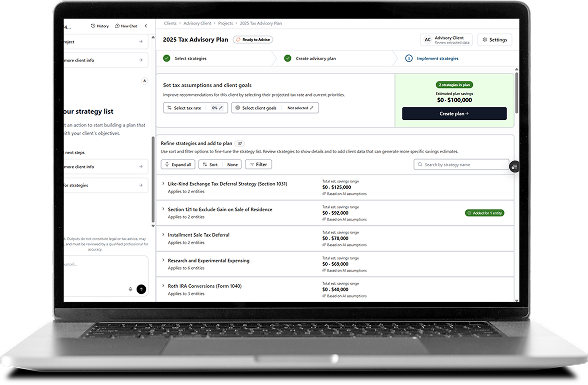
Take your firm from reactive to proactive with Ready to Advise
Ready to Advise ranks opportunities by relevance and potential impact, eliminating hours of manual analysis.
Request a demo ↗