
Straightforward answers for applying AI across the audit lifecycle
Highlights
- AI enhances audit efficiency by automating routine confirmation tasks and surfacing deeper insights
- Successful adoption depends on strong data governance, controls, and human oversight
- Auditors who leverage AI can improve risk detection and deliver more strategic value
Picture this: You’re three hours into manually reviewing board minutes, knowing there’s a stack of revenue agreements waiting for analysis and a client meeting tomorrow that needs prep work. Sound familiar? You’re not alone. Audit professionals across firms of all sizes are asking the same question: “How can I use AI in audit workflows to reclaim my time without sacrificing quality?”
The answer isn’t theoretical anymore. It’s practical, accessible, and happening right now. According to the 2026 AI in Professional Services Report from Thomson Reuters Institute, 40% of organizations are now using GenAI, which is nearly double the 22% from last year. Only 19% say their organizations have no plans to use GenAI at all.
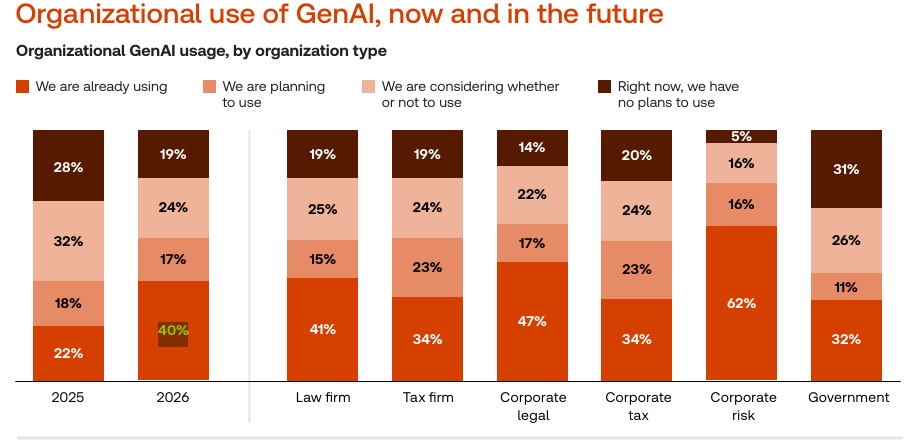
The momentum is unmistakable: More than half of professionals now use publicly available GenAI tools for work purposes, and 87% believe GenAI will be a central part of their workflow within the next five years.
Let’s address your most pressing questions about integrating AI into your audit workflows.
Jump to ↓
What are the key benefits of incorporating AI into the audit process?
How to use AI in audit workflows: The practical framework for getting started
How can auditors use AI for document analysis?
How can AI assist in planning and risk assessment for auditors?
How can AI improve client service?
Can AI be beneficial for a small audit firm?
Ready to lead the AI transformation in audit?
What are the key benefits of incorporating AI into the audit process?
AI can automate routine tasks, analyze data and perform verification, take notes and summarize internal meetings and client interviews, explain complex accounting issues to clients, summarize complex and lengthy documents, and draft memos and emails.
Key benefits include:
- Enhanced audit quality
- Time savings
- Improved risk identification
- Increased efficiency
- The ability to handle larger volumes of data
But here’s what matters most: AI allows you to shift your focus from repetitive tasks to high-value work — strategic insights, client advisory, and complex judgment calls that truly leverage your expertise.
How to use AI in audit workflows: The practical framework for getting started
Getting started doesn’t require a complete technology overhaul. Here’s a proven framework that works for firms of all sizes:
- Start with the basics: Familiarize yourself with acceptable use policies, learn about AI tools via free courses, validate the knowledge cutoff date, and understand your firm’s technology stack and data security requirements.
- Identify your biggest time drains: Develop a list of time-consuming tasks and ask colleagues what repetitive work consumes their day. Find out if AI can help with any of them. Common culprits include document analysis, board minutes review, lease agreement summarization, and routine correspondence.
- Pick at least one problem to solve and test it: Choose a specific use case, run parallel processes (AI-assisted vs. traditional), and validate results with your professional skepticism intact. Craft an effective prompt, ask the model to cite its sources, and document what works.
- Scale successful processes firm-wide: Once you’ve proven value, create templates, share best practices, and build institutional knowledge across your team.
This approach works whether you’re a five-person firm or a 500-person practice. The key is starting small and scaling what delivers results. Among professionals currently using GenAI, 82% report using the tools at least weekly, with many integrating AI into their daily workflows.
What are some basic tips for auditors using AI?
- Trust but verify
- Document the source
- Be aware of potential bias and inaccuracies
- Protect client confidentiality
Professional skepticism remains essential — you should validate AI outputs, document your verification procedures, and maintain the same standards of evidence you’d apply to any audit procedure.
Does garbage in, garbage out apply for AI?
Absolutely. Whether it’s the data you provide or the quality of the prompt, “garbage in garbage out” is definitely applicable. The quality of your inputs directly impacts the usefulness of AI outputs.
How can auditors use AI for document analysis?
Document analysis is where AI delivers immediate, measurable value. Consider these specific applications:
- Board minutes summarization: Instead of spending hours reading through lengthy board minutes, AI can quickly summarize items of audit significance — new debt agreements, related party transactions, significant changes in operations, or litigation matters that require disclosure consideration.
- Lease agreement review: AI can analyze lease agreements and debt covenants, extracting key terms, conditions, and compliance requirements. This helps you assess proper accounting treatment with greater speed while maintaining consistency across engagements.
- Revenue agreement analysis: For complex revenue contracts, AI can identify and summarize the five steps of ASC 606, helping you assess proper revenue recognition methodology efficiently.
What is CoCounsel and how does it help auditors?
CoCounsel is a purpose-built AI solution that leverages the editorial expertise from Thomson Reuters and a closed circuit of credible sources to analyze documents, generate insights, and assist with tasks such as creating tables and citations.
The platform comes with baseline training and built-in templates, though most firms customize workflows and develop prompting skills to get the most value from the tool. with tasks such as creating tables and citations. CoCounsel comes with baseline training and built-in templates, though most firms customize workflows and develop prompting skills to get the most value from the tool.
How can AI assist in planning and risk assessment for auditors?
AI excels at pattern recognition and data analysis; core components of effective risk assessment. It can analyze client ratios, financial statement data, and industry benchmarks, identify potential risks, and provide insights for more informed planning and risk assessment.
This doesn’t replace your professional judgment; it enhances it. AI handles the computational heavy lifting, allowing you to focus your expertise on interpreting results, understanding client context, and making informed decisions about audit scope and procedures.
Addressing auditors’ accuracy, data security, and regulatory concerns
Every innovative technology brings legitimate questions about security, accuracy, and compliance — and AI is no exception. The good news? The audit profession has established frameworks for evaluating and implementing AI tools that address these concerns head–on. Here’s what you need to know to move forward with confidence.
What are the primary considerations when evaluating audit automation software?
Primary considerations include:
- Integration options
- Client technology/policies/procedures
- Accuracy and reliability
- Security and data privacy
- Firm policies and procedures
- Cost/benefit analysis
- Training requirements
- Copyright considerations
When evaluating AI audit automation software, request evidence of accuracy rates and ask about built-in verification mechanisms. Look for solutions with SOC 2 compliance, encryption protocols, and role-based permissions that align with your firm’s governance requirements.
How are the PCAOB and AICPA responding to AI?
PCAOB amendments to AS 1105 and AS 2301 clarify how auditors must evaluate and document technology-assisted analysis to obtain sufficient appropriate evidence, while QC 1000 requires firms to ensure engagement documentation—whether created manually or using technology — meets all professional and legal requirements.
From the AICPA, AU-C 500, Audit Evidence now states that audit procedures on information used as audit evidence may be performed manually or using automated tools and techniques, such as data analytics, artificial intelligence, machine learning, remote observation tools, and robotic process automation.
There are also several task forces that have been formed to address the use of AI. For now, fundamental best practices still hold: reperformability, professional skepticism, validity, accuracy, and completeness.
How can AI improve client service?
AI allows auditors to provide more strategic insights, identify operational inefficiencies, and offer recommendations for improving controls, thus enhancing the overall value you deliver to your clients. When you reclaim hours previously spent on manual document review, you gain capacity for proactive client consultation and forward-looking advisory services that strengthen relationships and drive retention.
Can AI be beneficial for a small audit firm?
Absolutely. Whether it’s streamlining processes, analyzing data, assisting with research, summarizing agreements, or reviewing board minutes, AI helps firms both large and small. Smaller firms often see faster implementation because they have fewer stakeholders and can move more nimbly.
How can firms successfully adopt AI tools?
Firms can adopt AI tools successfully by involving a diverse group of stakeholders early in the process, identifying specific problems to solve, testing solutions thoroughly, and scaling successful processes. Firm leaders should share what works through templates and standardized approaches. Staff can then build institutional knowledge that makes AI adoption sustainable rather than dependent on individual champions.
Ready to lead the AI transformation in audit?
Understanding how to use AI in audit workflows isn’t just about efficiency gains today. It’s about positioning your firm for the evolution happening across the profession. Agentic AI — systems that can handle complex, multi-step workflows with minimal human intervention — represents the next frontier in audit technology.
Currently, 15% of organizations use agentic AI tools, but an additional 53% are in the planning or consideration phase, with 77% expecting it to be central to their workflow by 2030.
Ready to explore the strategic potential of agentic AI for your audit practice? Download our in-depth white paper: The power of agentic AI for modern tax and audit firms. Discover practical strategies, evaluation frameworks, and real-world applications that forward-thinking firms are using to stay competitive.
Exclusive white paper
Ready to see how your firm can work smarter? Download the white paper to explore a practical framework for putting agentic AI to work. The shift from task execution to workflow orchestration starts here.
Access white paper ↗