
If your company sells into international markets, e-invoice management is no longer just an IT responsibility — it is a core operational requirement for indirect tax compliance.
For U.S. corporations, the challenge is specific. Domestic tax compliance is already complex, and international e-invoicing obligations layer on top, often without dedicated international resources. Each jurisdiction where you sell may require a different invoice format, transmission network, clearance process, and archiving timeline. Managing that across multiple jurisdictions is a full-time operational responsibility, not a one-time implementation project.
What e-invoice management involves for U.S. corporations selling internationally
E-invoice management is the end-to-end process of generating, transmitting, receiving, and archiving invoices in compliance with each jurisdiction’s legal requirements. For a U.S. corporation selling into international markets, that process typically includes:
- Generation. Produce invoices in the format each jurisdiction requires — XML, UBL, or a jurisdiction-specific schema — and ensure the required fields are populated correctly for that market.
- Clearance and transmission. Submit invoices through government-mandated platforms or networks for real-time or near-real-time approval before they reach your trading partner. In many jurisdictions, invoices must be cleared by a government platform or an authorized network before they are legally valid.
- Receipt and validation. Receive and validate inbound invoices from suppliers in markets where accounts payable (AP) compliance is also mandated, not just accounts receivable (AR).
- Archiving. Retain invoice records for the legally required period in each jurisdiction, in formats and storage configurations that satisfy local audit requirements. Requirements vary significantly by jurisdiction in both duration and whether local or cloud storage is permitted.
- Regulatory monitoring. Track mandate changes, format updates, and deadline shifts across every jurisdiction where you operate, and ensure your systems reflect current requirements before penalties apply. The risk of being the last to know about a mandate change is one of the least visible and most consequential gaps in a fragmented compliance approach.
For a U.S. tax team managing two or three international markets, this process is manageable. As your international footprint grows, the management burden scales with it. Unless the architecture underneath it is built to absorb that complexity centrally, your team absorbs it instead.
Why e-invoicing architecture determines your team's workload
The way your e-invoicing infrastructure is built affects how much work your team does manually versus how much is handled automatically.
In a point-to-point model, where each jurisdiction has its own direct integration, each of the five responsibilities above must be managed separately for every jurisdiction. If Italy updates its e-invoicing format, that connection will require a bespoke fix. If France follows with its own mandate change, that is another fix. When your company enters a new market, you build, test, and maintain a new integration from scratch.
Each connection is independently fragile. A certificate expiration, a format change, or a regulatory update in any one jurisdiction requires intervention in that specific integration. During that time, invoices queue, compliance deadlines continue to apply, and trading partners wait.
See how those costs accumulate across a fragmented vendor landscape.
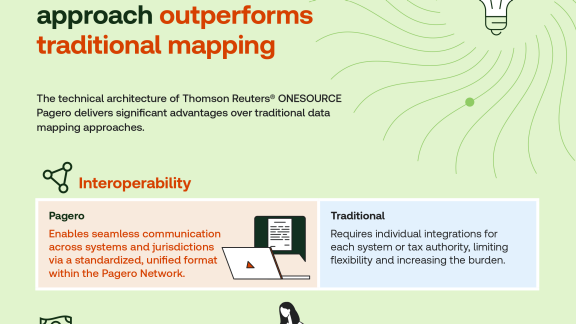
A network-based, hub-and-spoke model delivered through a unified, centralized platform changes the equation. A standardized connection to your enterprise resource planning (ERP) system can handle format translation, support regulatory compliance, and streamline transmission across jurisdictions centrally. When a mandate changes, the platform can be updated once rather than market by market. Your team monitors a single system, maintains just one vendor relationship, and operates from a single source of truth, even as the number of markets you sell into grows.
What this means for international expansion
The architecture question matters most when your company is growing. Every new international market your company enters is either a manageable addition to a centralized system or another independent integration to build and maintain.
That distinction has direct operational consequences. In a point-to-point model, entering a new market means negotiating with a new vendor, building a new integration, and adding another connection to monitor and maintain indefinitely. With a centralized platform, market expansion is closer to an activation — a prebuilt connection brought online rather than a project scoped from scratch.
For U.S. tax teams managing international obligations alongside domestic responsibilities, that difference determines whether your compliance function scales with the business or holds it back.
FAQs about international e-invoice management
What does e-invoice management involve for U.S. corporations selling internationally?
E-invoice management covers the full life cycle of compliant invoicing across jurisdictions, including generating invoices in each market’s required format, and then transmitting them through mandated networks; receiving clearance where required; archiving records for the legally required period; and monitoring regulatory changes as they occur.
For U.S. corporations, this work must be managed separately for each market unless the underlying architecture centralizes it.
How do companies manage e-invoicing when selling into markets with different requirements?
In a point-to-point architecture, each jurisdiction’s requirements are managed through its own integration, which means more systems to monitor, more maintenance work, and more remediation whenever requirements change.
With a centralized hub, you manage requirements through one platform that translates formats, routes transmissions, and rolls out mandate updates across the network in a coordinated way.
How often do international e-invoicing requirements change?
International e-invoicing requirements change frequently and at an increasing pace. The EU's ViDA package, formally adopted in March 2025, mandates structured e-invoicing and Digital Reporting Requirements for cross-border business-to-business (B2B) transactions across EU member states by July 2030, with full rollout continuing through 2035.
Individual member states can now introduce domestic e-invoicing mandates before that date without EU authorization, meaning some markets may accelerate on their own timelines. Across Europe, Latin America, and parts of Asia-Pacific, mandates and technical specifications have been updated repeatedly in recent years — for example, changes to clearance workflows, invoice schemas, validation rules, and reporting timelines. For a U.S. tax team managing international obligations, monitoring mandates is an ongoing operational responsibility, not a periodic review.
Which archiving requirements apply to international e-invoices?
Archiving requirements vary significantly by jurisdiction, both in duration and permitted storage formats. Some markets require local storage; others permit cloud storage under specific security configurations. In a point-to-point model, each connection must handle archiving independently, creating multiple data repositories that must be maintained, secured, and audited separately. A unified platform can help standardize archiving processes across markets by centralizing records where permitted and supporting market-specific retention and storage rules through a common, audit-ready framework.
Your next step to managing e-invoicing for your organization
Managing e-invoicing across international markets is an ongoing commitment rather than a one-time implementation. Mandates change, new markets bring new requirements, and your compliance team must stay current across all of it — typically without additional headcount. The architecture you have in place today will either make scaling manageable or hinder it as your company grows.
Assess whether your current e-invoice management setup supports international growth by asking these five questions to evaluate readiness.
If a change is required, start with our 8-step e-invoicing implementation roadmap.



.png)
