AI can generate more work than ever. Can your team review it?
Highlights
- The next AI bottleneck isn't generating work. It's reviewing it.
- Professional judgment, skepticism, and validation are becoming essential AI-era skills.
- Firms that build strong AI review processes can improve efficiency without compromising quality.
For years, professional services firms have focused on a familiar challenge: how to complete more work with fewer resources. Artificial intelligence appears to offer a compelling answer. Today, tax, accounting, and audit professionals can use AI to summarize regulations, draft client communications, identify risks, generate workpapers, and accelerate research in a matter of seconds.
But as AI capabilities continue to advance, a new bottleneck is emerging. It’s no longer generating the work but reviewing it.
Many firms are investing heavily in AI tools, training employees on prompting techniques, and experimenting with new workflows. Yet far less attention is being paid to the equally important skill of evaluating AI outputs. The professionals who thrive in the next phase of AI adoption won’t necessarily be the ones who can generate the most content. They’ll be the ones who can quickly determine whether that content is accurate, complete, defensible, and appropriate for a client engagement. In other words, the future belongs not only to AI users, but to AI reviewers.
Jump to ↓
Why AI review skills matter for accountants
The shift from creator to editor
Four AI review habits accounting firms should teach now
Building an AI review culture for accountants
The future belongs to critical thinkers
Why AI review skills matter for accountants
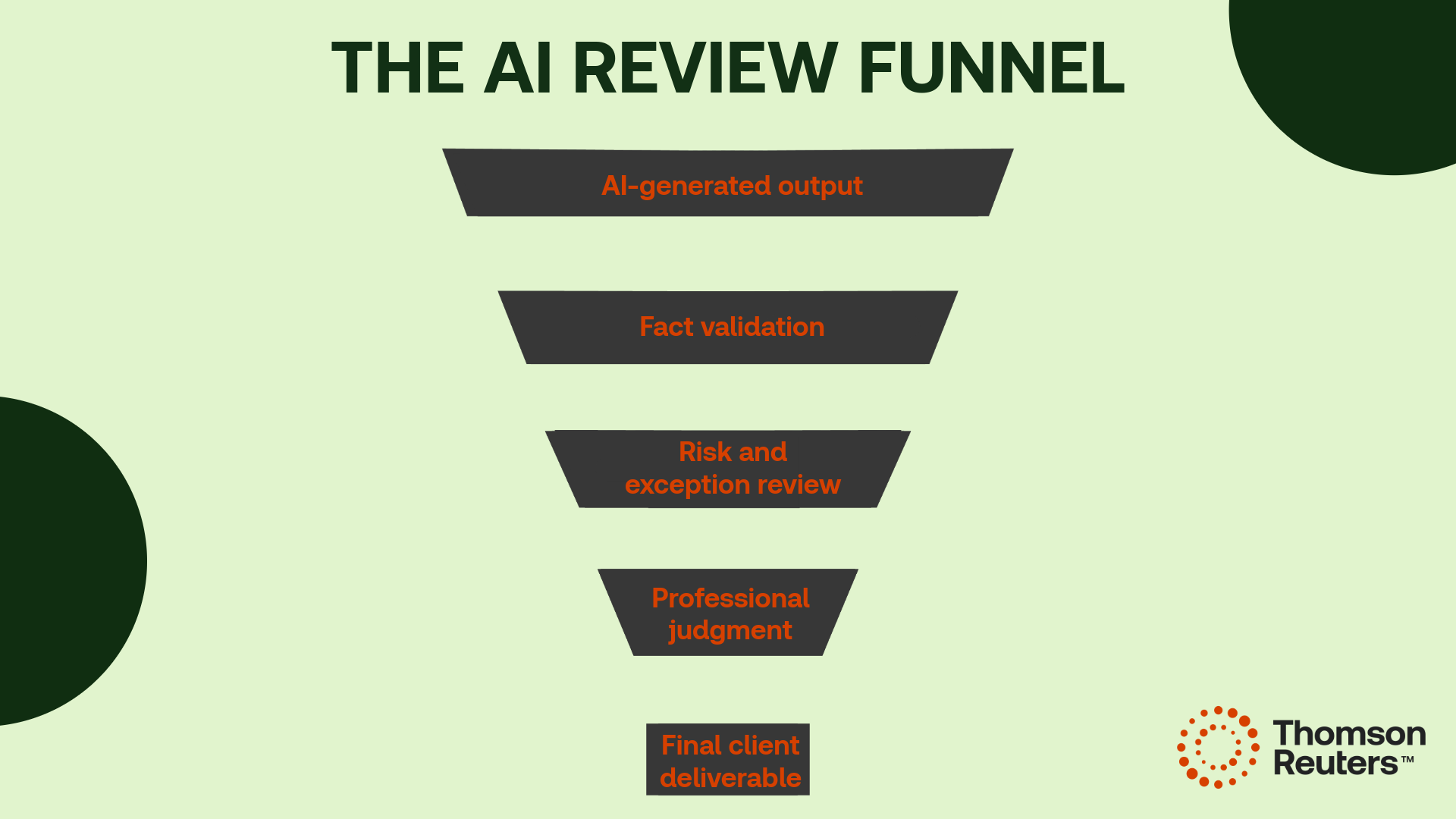
Accounting professionals have always been reviewers. They review returns, financial statements, supporting documentation, research conclusions, and client communications. Professional judgment is foundational to the profession, and while AI changes the source of the work, it does not change the responsibility.
The challenge is that AI often produces outputs that appear confident, polished, and authoritative, even when they’re incomplete or incorrect. An answer may look right at first glance while missing a key exception, overlooking a recent regulatory change, or making an unsupported assumption. This creates a new risk for firms.
When professionals accept AI-generated information too quickly, errors can move through workflows faster than ever before. Conversely, when professionals know how to effectively review AI outputs, they can realize productivity gains while maintaining quality standards.
The goal should not be to trust AI blindly or reject it outright. The goal is to create professionals who can act as effective quality control experts for AI-assisted work.
The shift from creator to editor
Historically, expertise was often measured by the ability to create work from scratch. Increasingly, expertise will be measured by the ability to evaluate work generated by AI.
Think of it this way: if AI can generate a first draft of a tax memo in minutes, the professional’s value shifts toward assessing the logic, validating the conclusions, identifying gaps, and ensuring the recommendation aligns with the client’s specific facts and circumstances. This changes the nature of professional work.
Rather than spending hours building a first draft, professionals may spend more time asking questions like:
- What assumptions did the AI make?
- What information might be missing?
- Are there alternative interpretations of the rules?
- Have recent regulatory changes been considered?
- Does this conclusion align with authoritative guidance?
- Would I be comfortable defending this recommendation to a client, regulator, or partner?
These are not technology skills but judgment skills. And they may become some of the most valuable skills in the profession.
Four AI review habits accounting firms should teach now
1. Verify before using
The first rule of AI review is simple: treat every output as a draft, not a final answer.
Professionals should be trained to verify key facts, citations, calculations, and conclusions before incorporating them into client deliverables. The higher the risk level of the engagement, the greater the need for independent validation.
The question should never be, “Did AI provide an answer?” But it should be, “Can I substantiate this answer?”
2. Look for what’s missing
Many AI errors do not come from incorrect information but omitted information. A generated response may accurately address the primary issue while failing to identify exceptions, risks, related considerations, or alternative approaches.
Effective reviewers learn to look beyond what AI provided and ask what AI may have overlooked. This is particularly important in tax and audit environments, where nuance often matters more than broad principles.
3. Challenge conclusions, not just details
Professionals often focus on checking specific facts or calculations. While important, AI review should also include evaluating the overall reasoning.
- Does the conclusion logically follow from the facts?
- Were assumptions clearly stated?
- Could another professional reasonably reach a different conclusion?
The strongest reviewers challenge the thought process behind the output, not just the output itself.
4. Document human judgment
As AI becomes more integrated into workflows, documenting professional review becomes increasingly important. Firms should establish clear expectations regarding when AI is used, what human review steps are required, and how professional judgment is applied.
This not only supports quality control but also reinforces the value that human expertise continues to bring to the engagement.
Building an AI review culture for accountants
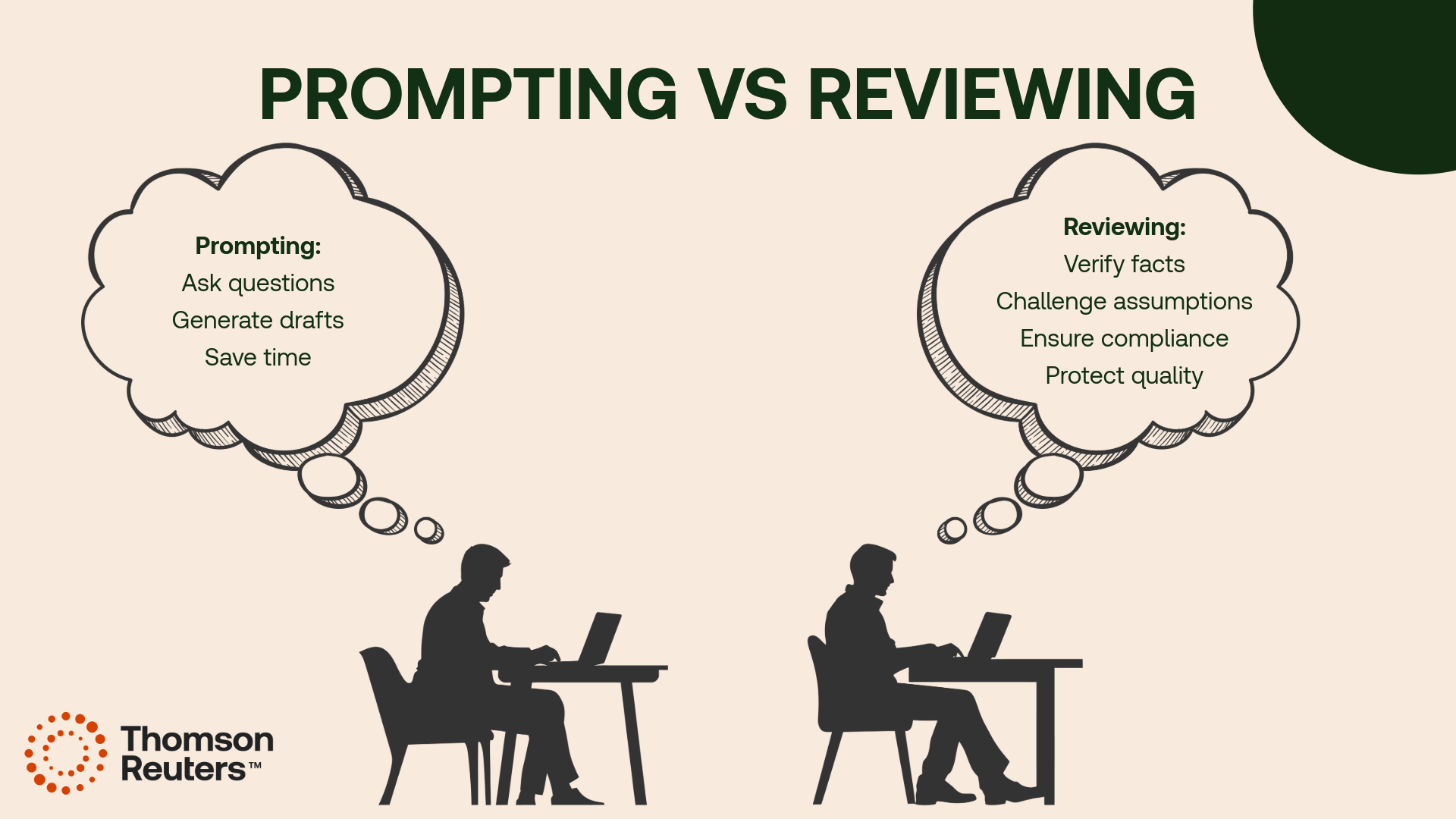
Teaching AI review is not simply a training initiative but a cultural shift.
Many firms currently celebrate speed and efficiency gains from AI. Those benefits are real, but they should be balanced with an equal emphasis on quality assurance.
Leaders can help by:
- Including AI review skills in training programs
- Sharing examples of AI mistakes and lessons learned
- Encouraging healthy skepticism toward AI outputs
- Creating review checklists for common AI-assisted tasks
- Recognizing professionals who identify risks and errors
The message should be clear: finding an AI mistake is not a failure but evidence that professional judgment is working exactly as intended.
The future belongs to critical thinkers
The conversation around AI often focuses on what machines can do while a more important question may be what humans must continue doing.
As AI becomes increasingly capable of generating content, research, analyses, and recommendations, the differentiating skill for accounting professionals will not be typing better prompts. It will be applying the expertise, skepticism, and judgment necessary to evaluate what AI produces.
That is the skill clients will continue to trust, and regulators will continue to expect. And that may be the most important AI skill accounting firms can develop in the years ahead.
The next AI bottleneck is not generating work; technology is getting better at that every day. The real challenge is ensuring the work is right.
Professionals who learn how to review AI effectively won’t just use AI more confidently. They’ll help their firms capture the benefits of innovation while upholding the quality, accuracy, and trust that define the tax and audit profession.
See why accounting firms rely on CoCounsel
CoCounsel Tax, Audit & Accounting helps firms spend less time on manual audit work and more time applying professional judgment. The CoCounsel agent analyzes documents and data, identifies risks, and creates review-ready outputs.
See for yourself ↗