
Industry experts discuss workforce challenges, practical applications, and the path from skepticism to trust.
Highlights
- Audit firms face a critical workforce crisis, making AI adoption essential for economic viability and operational efficiency.
- Experts emphasize the need for fiduciary-grade AI, hands-on evaluation, and a cautious approach to integrating agentic workflows.
- 2026 may mark a tipping point as firms balance skepticism with urgency, preparing for transformative AI-driven change in audit.
The audit profession stands at a critical inflection point. With 75% of partners scheduled to retire within the next decade and declining interest from entry-level candidates, firms face an unprecedented human capital crisis. At the same time, AI capabilities are maturing rapidly, offering solutions that address both workforce challenges and operational efficiency.
We sat down with Stuart Cobbe, Head of Product for the Audit Portfolio at Thomson Reuters, and Corey Wells, GM of the Audit Workflow Business, to discuss where AI in audit stands today, where it’s headed, and what firms should be doing now to prepare.
Jump to ↓
1. Why is AI adoption becoming so urgent for audit firms right now?
2. What makes audit work particularly well-suited for AI assistance?
3. How do you ensure AI is accurate enough for audit work where there’s no room for error?
4. What should audit firms look for when evaluating AI solutions?
5. What’s the difference between how firms are using generative AI today versus agentic workflows?
6. Why has AI adoption been slower than expected in the audit profession?
7. Are we approaching a tipping point for AI adoption in audit? What should we watch for in 2026?
1. Why is AI adoption becoming so urgent for audit firms right now?
Unlike other industries where AI drives incremental efficiency gains, the audit profession faces an existential workforce challenge that makes AI adoption critical to economic viability.
“75% of audit partners are scheduled to retire in the next 10 years… combined with very low adoption of entry level auditors coming out of university… the profession has really declined in terms of entrance into the industry and so it’s really creating this human capital chasm,” explains Wells.
This convergence of mass retirements and declining entry-level interest creates what Wells describes as a “very serious human capital deficit” that threatens the economic model of how audit firms operate. The urgency has fundamentally changed how firms think about technology investment.
“Investments in AI are now spanning not only technology budgets but human capital budgets as they’re trying to figure out how to solve this massive human capital chasm,” Wells notes.
For the first time, AI investments are being evaluated not just as technology upgrades, but as workforce solutions — a fundamental shift in how firms approach return on investment.
2. What makes audit work particularly well-suited for AI assistance?
AI’s sweet spot aligns perfectly with the nature of audit work: tasks that require handling significant variety while managing high volumes of repetitive analysis.
“Much of audit work is at the same time really varied, but also very repetitive and boring. And that’s a great set of use cases for these powerful AI assistants. They’re flexible enough that they can handle a wide variety of different client files, Excel documents, contracts, whatever it might be,” says Cobbe.
He offers a concrete example: “You’re checking 100 leases and 15 of them are slightly different. AI is capable of actually doing a lot of that work today.”
The result is a fundamental shift in how professionals allocate their time. Rather than spending hours on document review, auditors can focus on analysis, judgment, and client relationships — the work that requires human expertise and builds long-term value. “The profile of where the professional spends their time is changing rapidly,” Cobbe observes.
3. How do you ensure AI is accurate enough for audit work where there’s no room for error?
In audit, accuracy isn’t negotiable. A single error can have serious compliance, financial, and reputational consequences for both the firm and its clients.
“We are selling to professionals that can’t afford to be wrong… there’s very little room for error when it comes to how our AI supports producing information for our customers… we call it fiduciary grade AI,” Wells explains.
This concept, fiduciary grade AI, represents a fundamental difference from consumer AI tools. It’s built on authoritative, trusted data sources specifically designed for professional use where accuracy is paramount.
But even sophisticated AI systems face challenges. As Cobbe explains: “These AI systems can use client documents and knowledge to automate work… but they still have a tendency to fail in hidden ways. Relying on providers that know how to build agentic systems for specific use cases with high accuracy and trust is critical.”
The solution lies in partnering with providers who understand these professional requirements and have proven experience building high-accuracy systems for high-stakes environments.
4. What should audit firms look for when evaluating AI solutions?
As AI options proliferate, firms need systematic approaches to evaluate which solutions deliver real value versus hype.
“Audit firms need to develop a muscle for how to evaluate and test these systems themselves… finding some way for an audit partner or a managing partner to build their own trust in the relative performance of different systems is critical right now,” Cobbe advises.
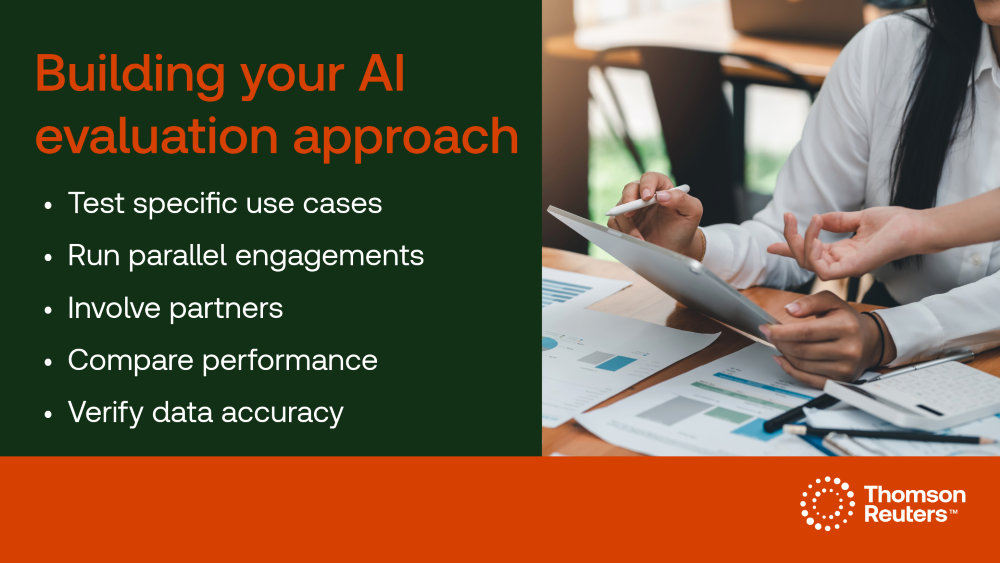
This evaluation muscle develops through hands-on testing. Leading firms are using two primary approaches: creating standardized use case tests that allow apples-to-apples comparison of different AI systems, and running AI solutions in parallel on live engagements to observe real-world performance without risking quality.
The key is moving beyond vendor demonstrations to direct experience. When partners and managing partners personally evaluate AI performance on their firm’s actual work, they build the trust necessary to scale adoption confidently. This firsthand evaluation proves far more valuable than relying solely on external recommendations or marketing materials.
5. What’s the difference between how firms are using generative AI today versus agentic workflows?
There’s a significant gap between firms’ current comfort level with AI and where the technology is headed.
“There’s a big chasm between comfort leveraging generative AI and moving to agentic workflows… it’s this fear of replacing humans… ensuring that you have humans in the loop… and this whole concept around AI can’t replace professional judgment,” Wells observes.
Today’s generative AI tools function as assistants — professionals use them to draft, research, or analyze, but always review the output. Agentic workflows represent the next evolution: AI systems that can complete entire processes with autonomy, escalating to humans only when needed.
The boundary question keeps firms cautious: where should we delegate wholly, and where must humans review every output? Most firms remain firmly in the assistant phase, getting comfortable with AI-generated work before considering automation of complete workflows. Professional judgment remains firmly human territory, and firms are still determining where that boundary sits in an AI-augmented world.
6. Why has AI adoption been slower than expected in the audit profession?
“Auditors by nature tend to be more conservative and adverse to change… there’s a lot of general excitement and interest in AI, but the level of adoption has not been at the pace that many expected,” Wells acknowledges.
But he’s quick to reframe this caution as a strength: “There’s skepticism, which is inherently part of an auditor’s DNA and what makes them good at their job… there’s a little bit of ‘prove it first’ before we go all in.”
The profession is splitting. Early innovators are experimenting aggressively, testing agentic workflows and pushing boundaries. Meanwhile, the vast majority of firms are taking a cautious, measured approach — dipping their toes in generative AI before diving into more autonomous systems.
This “prove it first” mentality, combined with change management challenges in firms operating with established processes for decades, means adoption will be methodical. And that’s not necessarily a problem — it’s professional skepticism applied to technology evaluation.
7. Are we approaching a tipping point for AI adoption in audit? What should we watch for in 2026?
The ingredients for rapid acceleration are in place, even if the timing remains uncertain.
“Despite the change management concerns and reticence… there is massive incentive for firms to figure this out quickly and massive investments that are happening… at some point you kind of hit that hockey stick curve,” Wells notes.
He draws a parallel to cloud adoption in the early 2000s — initial resistance eventually gave way to rapid, industry-wide transformation. “I’m interested to see if it happens towards the end of 2026 or whether it keeps getting delayed.”
Beyond workflow automation, Cobbe sees AI removing barriers that have historically limited auditors: “AI is great at removing boundaries, letting people learn technical skills more quickly… whether it’s automation of the mundane work, but also picking up and leveraging new techniques like writing code to solve particular problems, creating mini apps or data analytics.”
Technical skills like data analytics and coding are becoming democratized. AI helps auditors learn and apply these capabilities without years of technical training, fundamentally expanding what individual professionals can accomplish.
The future of audit is bright
The audit profession’s AI journey balances urgency with caution, moving deliberately toward a transformed future. As firms build their evaluation capabilities and test AI solutions in controlled environments, they’re preparing for an inflection point that may arrive in 2026 or may take longer. Either way, the firms investing now in building trust and expertise will define what comes next.
Ready to build your firm’s AI evaluation muscle?
Discover how Thomson Reuters AI-powered audit solutions deliver the fiduciary-grade accuracy your firm demands. See real-world applications designed specifically for audit workflows.