
When quick fixes become the norm, hidden compliance and operational risks grow
Highlights
- Frequent last‑minute payroll fixes often signal weak processes, poor documentation, or overreliance on key individuals.
- Reactive workflows increase the chance of compliance errors, missed deadlines, and audit exposure.
- Standardized processes, better controls, and automation reduce reliance on “superheroes” and create more resilient payroll operations.
Payroll teams are often judged by a simple outcome: whether employees are paid accurately and on time. When a late file arrives, an approval stalls, or a pay-affecting issue surfaces just before payroll closes, the team that pulls the cycle back from the edge can look like the hero.
But in a discussion with Checkpoint News, Ian Giles — Global Payroll Strategist, Advisor, and industry voice ranked among Favikon’s Top 50 HR Industry Creators worldwide — argued that those moments should not be romanticized as a routine operating model. Giles, who spoke at PayrollOrg’s 44th Annual Payroll Congress in Nashville in May 2026, said the topic took shape after conversations with payroll professionals who described how often they are asked to rescue problems that began well before payroll itself.
That question lands at a time when payroll execution risk is getting more attention from regulators and advisers. The U.S. Department of Labor’s Wage and Hour Division said it recovered more than $259 million in back wages for nearly 177,000 employees in fiscal year 2025, the highest total since 2019, and specifically highlighted overtime and minimum wage enforcement along with the relaunch of its Payroll Audit Independent Determination (PAID) program for self-auditing and resolving certain wage-and-hour violations.
KPMG, in its May 2026 employment tax reporting, said that as payroll rules mature, “execution risk increases,” with federal, state, and local developments tightening payroll compliance expectations. KPMG separately reported that payroll often represents 40% to 60% of total operating expenses, yet only 33% of organizations in its global research operate a truly standardized payroll model.
Jump to ↓
What the “payroll save” often means
Where the payroll control process usually starts to fail
Why a successful payroll rescue can still leave significant risk behind
How leaders can address payroll control gaps
Speaking to executives in business terms
Checklist: What to review after a payroll “save”
What the “payroll save” often means
Giles said the “superhero” framing misses the more important issue: why the rescue was needed in the first place.
“I’ll be honest: I’m not entirely comfortable with the ‘payroll superhero’ label. A superhero cape might be nice for LinkedIn. It is not a sustainable control framework,” Giles said. “And it’s not because payroll professionals aren’t brilliant under pressure; they absolutely are. Some of the best operational minds I’ve ever worked with sit in payroll teams. But when payroll has to ‘save the day,’ what we’re usually seeing is not heroism as a business model. It is operational failure being absorbed by the last team in the chain.”
He said payroll often inherits the consequences of upstream failures: late data, incorrect approvals, unresolved terminations, bad time reporting, broken interfaces, unclear policy interpretation, or decisions that sat too long with someone else. Payroll then does what payroll has always done — protect the employee experience and try to get the run completed. But, Giles said, organizations too often stop the analysis there.

Where the payroll control process usually starts to fail
Asked what typically goes wrong before payroll is forced into a rescue role, Giles did not describe a narrow payroll problem. He described an operating model problem — one where payroll control gaps accumulate quietly across functions before surfacing at the worst possible moment.
“Late, incomplete, incorrect, and even missing data is probably the biggest culprit,” he said. “Payroll depends on accurate inputs from multiple stakeholders and functions. When those inputs arrive late, wrong, or not at all, payroll is left trying to reconcile reality against system data, often under impossible deadlines.”
He also pointed to ownership failures and bypassed controls. In his view, payroll is frequently asked to process something that is not fully approved, not fully understood, or not fully compliant. That, in turn, encourages exception handling.
“Emergency fixes often require manual intervention. Manual intervention is not automatically the wrong thing, but uncontrolled manual intervention is where the gremlins live,” Giles said. “If approvals, audit trails, segregation of duties, or validation checks are skipped ‘just this once,’ risk is being introduced into the pay cycle. And, ‘just this once’ has a nasty habit of becoming an operating model.”
That concern matches the current compliance climate. The IRS states that employers must deposit and report employment taxes on time and in the correct amount and manner. Its Failure to Deposit Penalty is 2% for deposits one to five calendar days late, 5% for six to 15 days late, 10% for more than 15 days late, and 15% if the amount remains unpaid more than 10 days after the first IRS notice or after an immediate payment notice.
Why a successful payroll rescue can still leave significant risk behind
One of Giles’s strongest points is that a payroll run can finish successfully and still leave the organization exposed to payroll execution risk. He described a common scenario: a large file for an hourly-paid population arrives late, fails, or cannot be reconciled shortly before payroll commit. Payroll may have to compare prior-period averages, isolate missing populations, apply emergency approvals, make manual adjustments, and run extra validations to get people paid on time. The visible outcome looks successful. The underlying process may not be.
“There may be wage and hour compliance risk if hours worked are understated or overtime is missed. There may be tax and social security risk if payments are misclassified, paid in the wrong period, or adjusted incorrectly later. There may be financial reporting risk if labor cost accruals are materially wrong. There may be audit risk if manual corrections are not properly evidenced,” Giles said. “So yes, the payroll team saved the day. But the more important question is: what did the organization nearly get wrong, and how close did it come to becoming visible failure?”
Government enforcement shows how expensive those issues can become. In May 2026, the DOL said it recovered $171,897 in back wages after finding a Hawaii rehabilitation services employer denied 32 employees full overtime pay. In April 2026, the DOL said a California contractor case involved $468,505 in back wages and damages for 137 workers after findings that included missed payroll, minimum wage failures, and unpaid overtime.
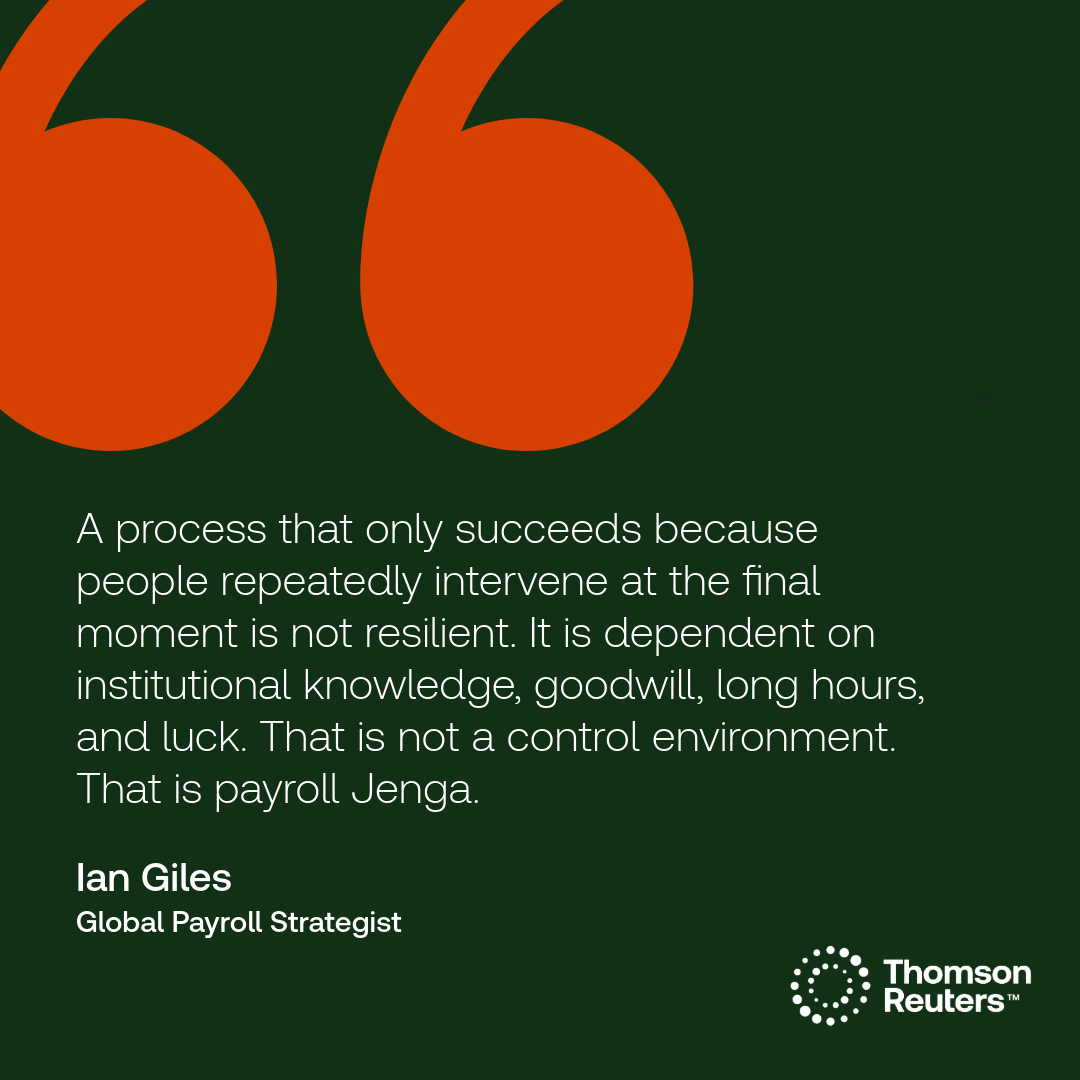
Giles’s conclusion is that repeated rescues should never be mistaken for proof that the process works.
How leaders can address payroll control gaps
Giles said the most important step comes after the immediate emergency is over. In his view, payroll leaders should resist the temptation to move straight into the next cycle without structured review. Addressing payroll control gaps requires that discipline — a willingness to treat each close call as data rather than a story to move past.
“The first thing is to resist the temptation to simply move on. Document, document and document again,” he said. “Payroll teams are often so busy getting through the next cycle that yesterday’s emergency becomes today’s memory and tomorrow’s repeat incident. That cycle has to be broken.”
He recommends a post-cycle review built around a practical set of questions: What happened? Where did it originate? When was the issue first identified? What controls failed or were bypassed? What manual interventions were required? What prevented the issue becoming worse? What needs to change before the next cycle? Who owned the input, decision, or approval? What was the employee, financial, and compliance exposure?
That review, he said, should not default to the easy answer that payroll needs to be “more careful.”
“That classification matters because not all payroll failures are solved by telling payroll to ‘be more careful.’ In fact, that is often the laziest and least useful response,” Giles said. “If the same issue happens again, it is no longer an incident. It is a control failure wearing a fake moustache.”
Speaking to executives in business terms
Giles also argued that payroll leaders need to sharpen how they explain these incidents to senior management. In his view, executives are less likely to respond to operational jargon than to quantified business risk.
“Payroll leaders need to stop translating payroll errors and problems as payroll errors and problems,” he said. “Executives do not always respond to ‘we had to do 300 manual adjustments.’ They are more likely to respond to what those adjustments mean in business language. Frame the issue in terms of risk, cost, control, confidence, employee retention, and business impact.”
He offered a simple contrast. Instead of saying a late file was fixed, payroll leaders should explain that an incident affected a defined employee population, required manual intervention outside standard controls, and exposed weaknesses in approvals, monitoring, and audit evidence. That framing moves the conversation from congratulating the team for getting through the cycle to deciding what should be fixed before the next one.
In a year when payroll execution risk is rising and regulators are emphasizing both enforcement and self-audit options, that may be the more important leadership skill.
“The executive message should be clear: payroll ultimately saved the outcome, but the control environment needs attention,” Giles said. “The goal is not to eliminate every exception. That is fantasy. Payroll operates in the real world, and the real world has sharp edges. The goal is to make sure exceptions are visible, controlled, understood, and reduced over time.”
Key takeaways
- A last-minute payroll “save” may protect employees, but it can also signal earlier failures in data, approvals, systems, ownership, or communication — and often points to deeper payroll control gaps that have gone unaddressed.
- Wage-and-hour and employment tax consequences can be significant when those failures affect overtime, pay timing, or tax deposits.
- KPMG’s 2026 reporting frames payroll as both financially material and increasingly exposed to payroll execution risk.
- Repeated emergency intervention should be treated as a governance signal, not as proof that the process is working.
Checklist: What to review after a payroll “save”
- Document what happened and when it was first identified.
- Identify where the issue originated and which controls failed or were bypassed.
- Record all manual interventions, approvals, calculations, and affected populations.
- Assess wage-and-hour, tax deposit/reporting, audit, and financial reporting exposure.
- Classify the failure: data, process, technology, governance, vendor, policy, or training.
- Translate the issue for leadership in terms of risk, cost, confidence, and business impact.
- Track recurrence; if the same issue returns, treat it as a control failure, not a one-off event.
For more up-to-date insights and expertise-backed resources, subscribe to Checkpoint Newsstand, and check out our payroll content hub.
Stay up to date with the latest tax and accounting news, featuring exclusive content from Checkpoint.
Subscribe to our newsletter!
Stay in the know with the latest news and insights from Thomson Reuters and Checkpoint.
Want more payroll content?
© 2026 Thomson Reuters/Tax & Accounting. All Rights Reserved.