
Every tax technology pitch right now promises to make your department AI-ready. Few say what that means.
Highlights
- Only 9% of corporate tax teams actively use AI, and expectations are moving faster than readiness.
- AI-ready means four conditions: connected data, defensible outputs, a strategy people can follow, and measures that show results.
- Start this quarter without a budget request: map your data, list your AI tools, and baseline one process.
Jump to ↓
What does AI-ready mean for a corporate tax department?
Is your tax data connected enough to be AI-ready?
What makes AI output defensible in corporate tax?
Does your AI strategy reach the people doing the work?
How do you measure whether your tax team is AI-ready?
Where does your corporate tax department stand on AI readiness?
 |
|
What does AI-ready mean for a corporate tax department?
AI-ready doesn’t mean you’ve bought a tool or launched a pilot. An AI-ready corporate tax department has four conditions in place: connected data, defensible outputs, a strategy people can follow, and measures that show results. Together they make AI safe to rely on, and they depend more on your data, controls, and people than on the software.
In the 2026 Corporate Tax Department Technology Report from the Thomson Reuters Institute and Tax Executives Institute (TEI), a survey of 170 U.S. corporate tax professionals, 81% said their departments are still considering or exploring AI. Only 9% are active users. Yet the most common estimate for when AI becomes central to daily work has dropped from three to five years to one to two. Expectations are moving faster than readiness.
Those expectations are specific. In the same survey, 69% of respondents put further automation of routine compliance processes among the most valuable uses of AI, and 61% put faster technical research and analysis there. Both depend on what the AI is given to work from: connected, consistent data for compliance work, and sources you can verify for research.
Is your tax data connected enough to be AI-ready?
The same report places departments on a five-stage technology maturity curve. 55% are in the reactive stage: some automation, but nothing connected to enterprise data or to other departments. Another 9% still run on email and spreadsheets. Only 7% have reached the optimized or predictive stages.
That matters because AI works with what it can see. If provision figures sit in one place, compliance data in another, and someone re-keys the trial balance between them, AI inherits every inconsistency. The report’s advice for moving up the curve is practical: connect your systems and data, automate tax work, and coordinate with other departments.
That’s where Thomson Reuters ONESOURCE direct tax products start. ONESOURCE Tax Provision works with your books, calculates the provision, and logs each step. That record is what makes AI output checkable later. Shared data gives any AI, and any reviewer, one version of the facts to work from.
What makes AI output defensible in corporate tax?
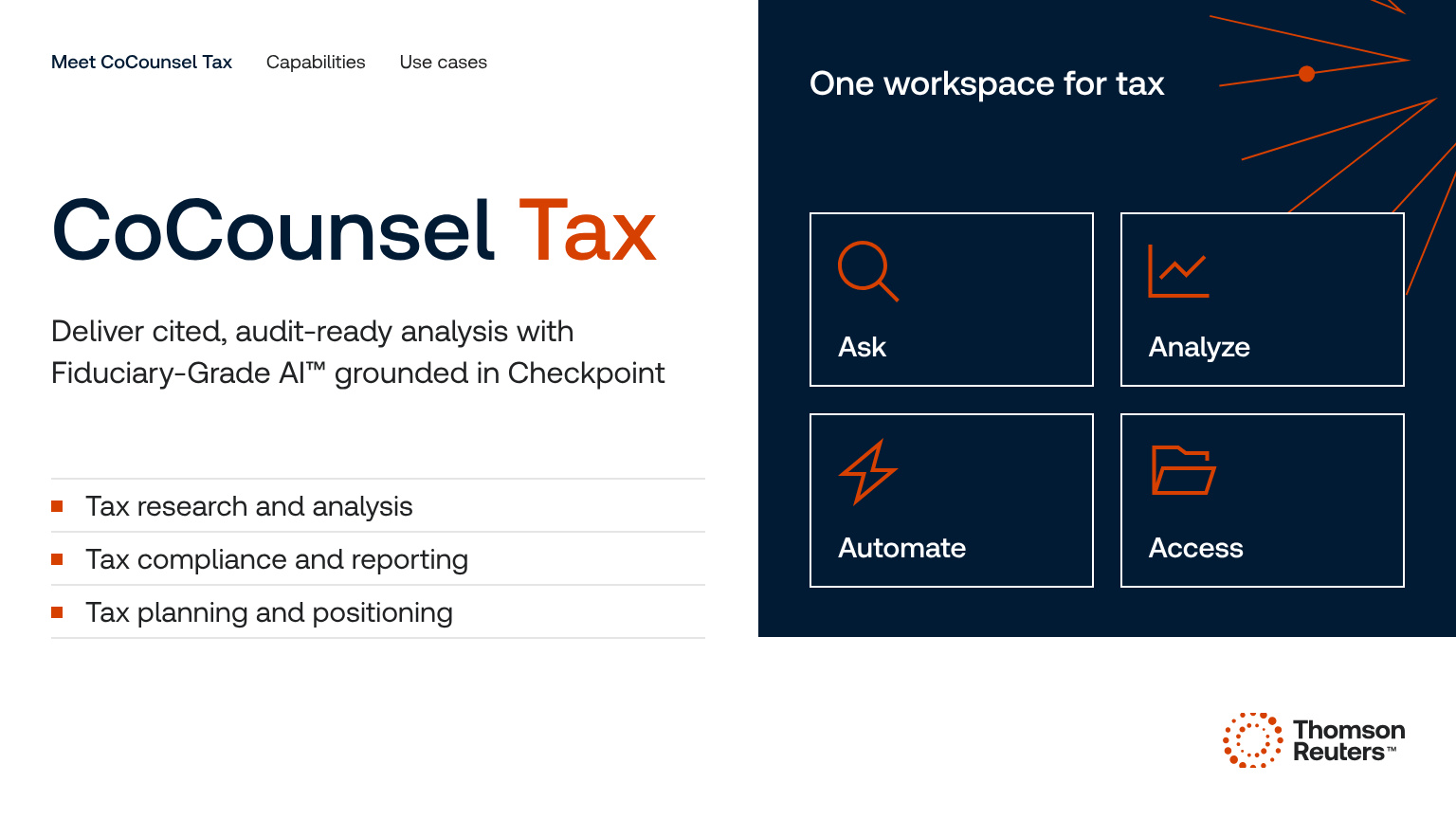
Tax answers have to survive an auditor. The Thomson Reuters Future of Professionals Report 2026 surveyed 1,816 professionals across law, tax, audit, accounting, compliance, and risk about what their AI tools must do. 96% said safeguard confidential data. 94% said ground outputs in authoritative content. 90% said produce reasoning they can explain and defend. We treat those as the minimum conditions for Fiduciary-Grade AI™. If your data is connected, you can trace each figure back to its source when an auditor asks.
Governance is where many teams are exposed. In the Future of Professionals Report, 34% of professionals use AI tools their organization hasn’t sanctioned, in ways it can’t see. The 2026 State of the Corporate Tax Department report from the Thomson Reuters Institute finds that 84% of respondents say AI should be off-limits in some areas, even with controls in place. The areas they name most are complex technical analysis and tax planning, and final decision-making and sign-off.
So test every AI claim you hear, including ours. Much of the language in tax technology sounds alike: “intelligent,” “AI-powered,” “copilot.” Labels like those don’t answer four questions:
- Where does the AI get its data, and is that data connected to your systems of record?
- Can a reviewer trace each output back to its source?
- Who can see your data, and where does it go?
- How will you know whether it worked?
Ask them of vendors, and of the AI tools your team already uses on its own.
Does your AI strategy reach the people doing the work?
A named AI strategy matters. In the Future of Professionals Report, among professionals whose organization has one, 66% say AI is meeting or exceeding expectations for value. Where there’s no active strategy, that falls to 22%. But strategy alone isn’t enough. Of those who say their strategy and daily practice don’t match, 43% say people aren’t equipped or trained to work the intended way.
Tax departments have made progress on ownership: 88% now have someone leading tax technology strategy, up from 51%. Training is moving the other way. Only 50% provide it, down from 59%. The report calls training one of the most cost-effective levers available. The skills gap shows: only about one in ten respondents call their colleagues very competent with technology. The report argues that cross-training is now a heavier burden.
How do you measure whether your tax team is AI-ready?
Of the departments that track technology performance, 66% measure time savings and efficiency, 55% measure accuracy and error reduction, and 41% measure ROI and cost savings. Another 22% don’t track results at all.
Time saved is the easiest number to collect and the weakest one in front of a CFO. Add audit readiness: how long does it take to support a figure when an auditor asks? That measure connects a technology investment to risk.
Measurement works best with a baseline. Record how long a process takes today, how many people touch the data, and how often figures get reworked. Then measure again after you change something. Without a before number, an improvement is just an impression.
Where does your corporate tax department stand on AI readiness?
AI readiness isn’t a switch. It’s a position on a path, and most corporate tax departments are earlier on it than they’d like. The 2026 State of the Corporate Tax Department report finds that 62% of respondents say their department has made only limited or no progress on automation or AI over the past 12 months. Budget is also a common chokepoint: one in five respondents from under-resourced departments did not request more budget because they did not expect it to be approved. The useful question isn’t whether to adopt AI. It’s which condition to build next.
You can start this quarter without a budget request. Map where your tax data lives, list the AI tools your team already uses (sanctioned or not), and record a baseline for one process, such as hours per return.
 |
|