Highlights
- Knowledge held by one or two people puts tax compliance continuity at risk when staff retire, move roles, or leave.
- Sumitomo Corporation of Americas uses ONESOURCE DataFlow audit trails to see who changed what and why, even after team turnover.
- A connected, traceable record from data collection through filing keeps compliance season moving and strengthens team communication despite staffing changes.
Every direct tax team carries a quiet risk into compliance season: institutional knowledge that lives in one or two people’s heads. The workaround for an odd subsidiary schedule, the reason a certain entity’s numbers always need a second look, the answer to why a field is formatted the way it is. None of that lives in a manual. It lives with whoever has done the work long enough to remember it.
Compliance season is exactly the wrong time to find out what happens when that person retires, changes roles, or leaves mid cycle. For Sumitomo Corporation of Americas (SCOA), the answer used to involve a scramble. Today, it involves a lookup.
Jump to ↓
Who is SCOA?
The old risk: Undocumented knowledge under deadline pressure
The fix: An audit trail that remembers so people don’t have to
The season level payoff: Continuity and stronger working relationships
Season-proofing checklist for your tax team
Season insurance, not just faster tools
 |
|
Who is SCOA?
Sumitomo Corporation of Americas is the U.S. based arm of Sumitomo Corporation, a Japanese parent company that ranks among the oldest and largest general trading companies in the world. SCOA operates across a wide range of industries, including metals, chemicals, automotive, and energy, and has recently expanded into consumer products. Its tax department functions as a service center for the U.S., handling tax compliance, audit, planning, consulting, and oversight across the Americas, including Canada, Mexico, and South America.
The old risk: Undocumented knowledge under deadline pressure
Before SCOA moved its direct tax processes onto ONESOURCE, tracking who changed a number, and why, depended largely on memory, or on the right person still being around to ask. That is a fragile system in any department. In a tax function built on Excel workbooks passed between a handful of people, it becomes especially fragile during the exact weeks when the calendar leaves no room for guesswork.
Nicole Ciampanelli, Tax Specialist at SCOA, has watched that fragility play out over time as the team has grown and changed.
“As you grow with the product, and granted you have turnover rates or different people retire, it’s not always so easy to see who did what or how it was done.”
Nicole Ciampanelli, Tax Specialist, Sumitomo Corporation of Americas
The fix: An audit trail that remembers so people don’t have to
An audit trail is table stakes for most tax platforms at this point. What matters for a compliance season is whether that record actually follows the data through every handoff, not just who logged in. ONESOURCE DataFlow gives SCOA’s tax team a built in record of who touched a piece of data, and when. That record travels with the data itself, through every handoff between DataFlow, Tax Provision, and Income Tax modules, not only the point where it first enters the system. It removes the guesswork, and the awkward conversations, that used to follow every round of staff turnover.
“It’s not a question anymore as to who did it or who made that change, or why is it like that. This kind of helps directly give you an access point instead of me just questioning where this came from.”
Nicole Ciampanelli, Tax Specialist, Sumitomo Corporation of Americas
Eva Faurholt, Tax Manager at SCOA, sees the same value from a different vantage point: keeping track of a high volume of requests as compliance season accelerates.
“The audit trail in DataFlow is really great. The history of who went in, and when, is very useful when tracking a lot of requests.”
Eva Faurholt, Tax Manager, Sumitomo Corporation of Americas
The season level payoff: Continuity and stronger working relationships
An audit trail is not only an accountability feature. For SCOA, it is what lets a new or returning team member pick up a thread mid season with confidence, instead of waiting on someone else’s memory or availability. It has also changed how the team works together day to day.
“It helped build stronger relationships and communication between our own team. And it’s easy to send reminders as well as check the history and see where people are on their projects.”
Eva Faurholt, Tax Manager, Sumitomo Corporation of Americas
Season-proofing checklist for your tax team
Turnover is not something a tax department can prevent. What it can do is put a system in place before the next departure, not after. A few places to start:
- Document critical compliance processes before turnover happens, not after someone has already left.
- Implement an audit trail that records every data change by user and timestamp, not just a final total.
- Integrate data collection through to filing with ONESOURCE DataFlow, so the record stays connected end to end.
- Cross-train team members and track requests during peak periods, so no single person is the only path to an answer.
- Use rollover capabilities to carry standardized templates and history into the next season instead of rebuilding them each year.
Season insurance, not just faster tools
Direct tax teams need more than speed during compliance season. They need continuity that holds up when someone leaves, retires, or moves into a different role mid cycle. For SCOA, ONESOURCE DataFlow’s audit trail and history tracking have become exactly that: a record that keeps compliance season moving even when the people who know it best are not the only ones who can answer for it. Alongside ONESOURCE Income Tax and ONESOURCE Tax Provision, it gives the team one continuous, traceable record from data collection through filing, no matter who is on the team when the next deadline hits.
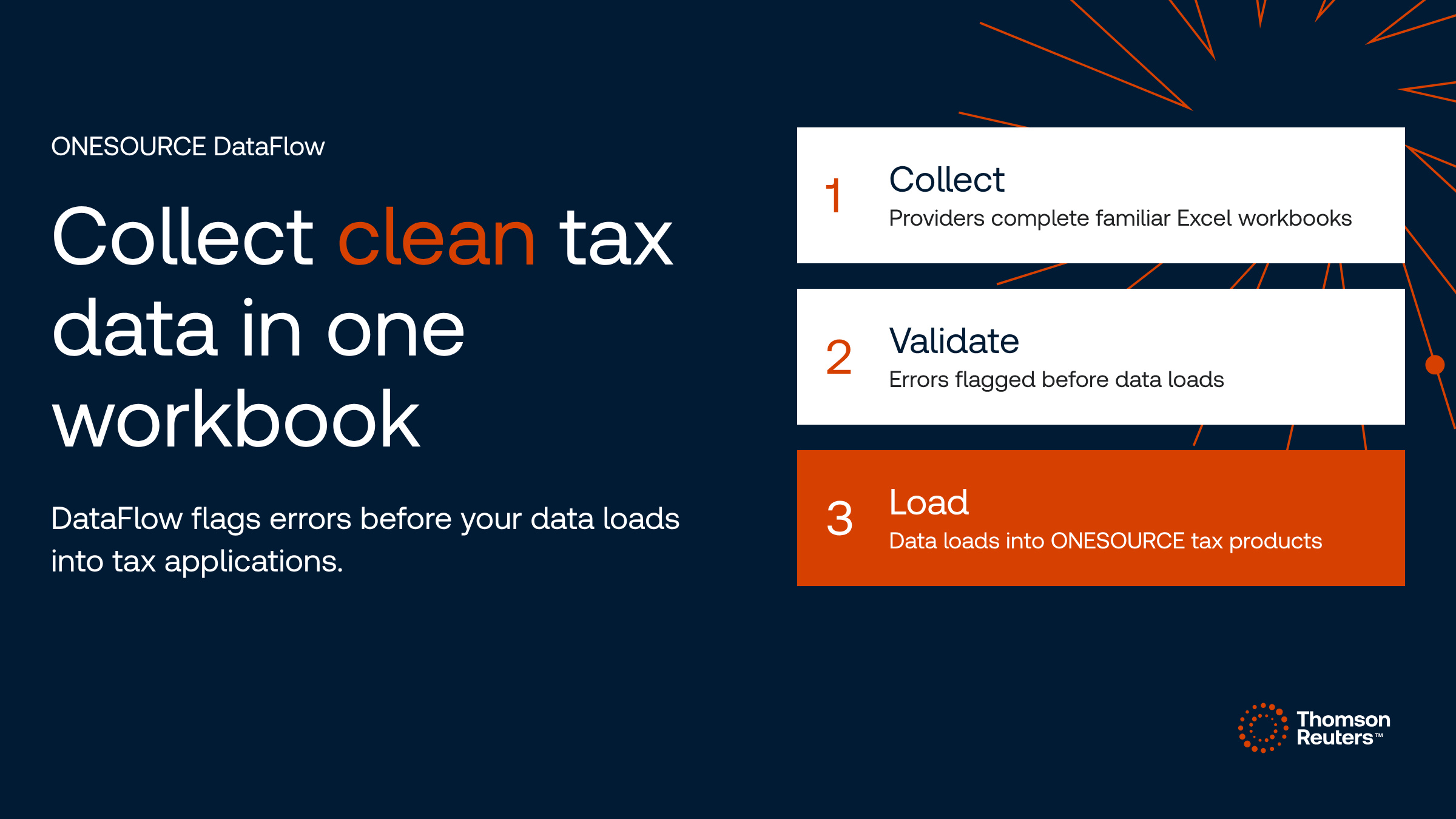
See how ONESOURCE DataFlow can help your team build the same continuity into your own compliance season.
 |
|
Frequently asked questions
How can tax teams maintain compliance during staff turnover?
The most reliable way is to make the process less dependent on any one person’s memory in the first place: document key steps, keep a running history of changes, and give more than one team member visibility into where things stand. ONESOURCE DataFlow builds that history in automatically, so a new or returning team member can pick up a return mid season without starting from scratch.
How do you document tax compliance processes?
Documentation works best when it lives with the data itself rather than in a separate file that goes stale. Standardized templates, a shared record of who touched what, and consistent workpapers across entities all reduce the amount that has to be explained by hand when someone new joins a return.
How can you prevent knowledge loss in a tax department?
Knowledge loss usually happens when a process only exists in one person’s head. Building a system of record, an audit trail, standardized workpapers, and cross-trained coverage, means that knowledge stays with the department instead of leaving with any single employee.
Why does tax compliance often break down when staff leave?
It usually is not the technical tax work that breaks. It is the context around it: which entity is behind, why a number was adjusted last quarter, who to ask about a subsidiary’s data. When that context lives only in someone’s memory, it leaves the building with them. An audit trail keeps that context attached to the data instead.