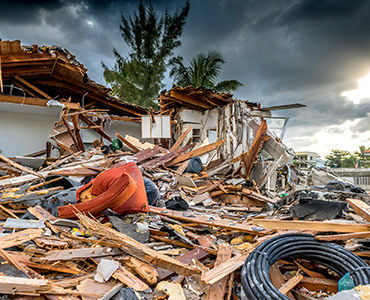
For taxpayers navigating the aftermath of a natural disaster like storms or wildfires, the path to recovery is a multi-year “saga” marked by complex tax outcomes where initial losses may unexpectedly result in taxable gains, according to Armanino Partner Noah Flores.
An Emotional Process
When advising clients who have lost their homes and possessions, the first priority for any practitioner is empathy. “It’s a very emotional time for clients,” Flores told Checkpoint, explaining that long after the initial shock wears off, families are forced to confront a cascade of complex financial issues, particularly on their tax returns.
The recovery process is often painfully slow, he added, marked by a “mix of emotions” and frustrating delays with everything from insurance claims to local permitting for reconstruction.
Practitioners must prepare clients for a process that unfolds not over months, but over several years. Flores warned that “the reporting is not going to be done in one year.” He noted that insurance reimbursements and other payouts can progress over two, three, or even four years.
Such a protracted timeline means that a tax position taken in one year may need to be amended in a subsequent year based on new information or settlements. This reality underscores the need for both patience and a long-term strategic perspective. The practitioner’s role often extends beyond mere tax preparation to that of a trusted advisor, helping clients during one of the most difficult chapters of their lives.
Common Misconceptions
According to Flores, the most widespread misconception among disaster victims is the assumption that they will automatically have a large, deductible tax loss. “They’ve lost everything. How is it possible that they would have a gain from a disaster loss?” he said, describing a common reaction among clients. The harsh reality is that for taxpayers who have owned their homes for many years, a low tax basis in the property compared to a high insurance payout often results in a substantial, and taxable, casualty gain.
Another common point of confusion is the tax treatment of various insurance proceeds, which are not all handled in the same way. Flores stresses that practitioners must help clients meticulously track and categorize these funds. Payouts for the dwelling and other structures form the core of the primary casualty gain or loss calculation. Insurance payouts for general personal property, or contents, are typically not taxable in the context of a federally declared disaster, as they fall under a specific personal contents exclusion.
It is critical, however, to distinguish these from payouts for specifically scheduled items, such as valuable jewelry, collectibles, or art. “That would include things like jewelry, art, things that are specifically listed in an insurance policy,” Flores explained. “[A]ny insurance payouts received for scheduled property would be taxable. It does not fit under … the personal contents exclusion.”
While the prospect of a taxable gain is daunting, Flores notes that powerful tax mitigation strategies are available. Taxpayers can defer the gain by reinvesting the proceeds into a suitable replacement property under the involuntary conversion rules of IRC § 1033. This allows victims to postpone the tax liability, giving them crucial time and flexibility to rebuild. The gain may also be partly or fully excluded under the principal residence exclusion of IRC § 121, which can shield up to $250,000 ($500,000 for joint filers) of gain.
These two provisions can often be used in conjunction, providing a strategic path to substantially reduce or even eliminate a client’s tax burden from the disaster.
Best Practices for Documentation and Substantiation
Given that the IRS has a several-year window to audit returns related to a disaster, Flores emphasized that robust and contemporaneous documentation is the key to being “well-positioned” for a potential examination. Taxpayers must “do whatever they can to substantiate their losses immediately,” Flores urged, despite how overwhelming or daunting that may be in the moment.
This process starts with gathering extensive visual records. Practitioners should advise clients to compile a comprehensive collection of “before and after photos” of their property and its contents. Flores encouraged taxpayers to scour photo albums and records for any pictures that show the home, major improvements made over the years, or valuable personal items that were lost.
Alongside visual evidence, collecting financial records is essential for establishing the property’s tax basis, which is the cornerstone of the entire casualty gain or loss calculation. This should include any permits for home improvements.
It is crucial to track every dollar received, and Flores recommends using a detailed spreadsheet to log all insurance proceeds and other relief payments. The spreadsheet should always provide a clear description, whether it be for the dwelling, personal contents, or scheduled property. “You really have to track that information,” he said, adding that it is important to document what the settlements are “earmarked for.”
For more on casualty loss deductions, see Checkpoint’s Federal Tax Coordinator 2d ¶ M-1601.
Take your tax and accounting research to the next level with Checkpoint Edge and CoCounsel. Get instant access to AI-assisted research, expert-approved answers, and cutting-edge tools like Advisory Maps and State Charts. Try it today and transform the way you work! Subscribe now and discover a smarter way to find answers.