
Where AI adds value in tax preparation, and where professional judgment still matters
Highlights
- AI adoption among tax professionals nearly doubled, rising from 22% to 40% year over year.
- AI could save professionals 240 hours annually, worth roughly $19,000 per person.
- 70% of accountants worry about AI data security, and 62% are concerned about AI errors.
Somewhere between the sensationalist headlines about AI taking over world and solving every problem known to man, there’s a more practical question that accountants are asking: “Can you trust AI with tax returns?”
The answer isn’t a simple yes or no. AI is doing real, meaningful work in tax workflows right now with even greater capabilities coming. But it’s also generating real anxiety. According to a 2025 Karbon report, 70% of accounting professionals are concerned about data security in AI. And 62% worry about errors in AI-generated outputs according to MIT Sloan. Those concerns aren’t irrational; they’re appropriate, and for good reason.
Let’s look at where AI earns your trust, where it still needs a watchful eye, and what trustworthy AI for accounting firms actually looks like.
Jump to ↓
Where AI delivers in the tax workflow
Where a tax professional’s eye still matters
What trustworthy AI for accounting firms looks like in practice
AI is a tool. You’re still the expert.
Where AI delivers in the tax workflow
AI in accounting has grown fast. According to the Thomson Reuters Institute’s 2026 AI in Professional Services Report, generative AI use among tax, accounting, legal, and other professionals has nearly doubled year over year, rising from 22% to 40%, with only 19% saying their organizations have no plans to adopt it. But fast adoption doesn’t automatically answer whether you can trust AI with tax returns; it just raises the stakes on getting the implementation right.
Here’s where AI shows up and delivers:
Document collection and organization
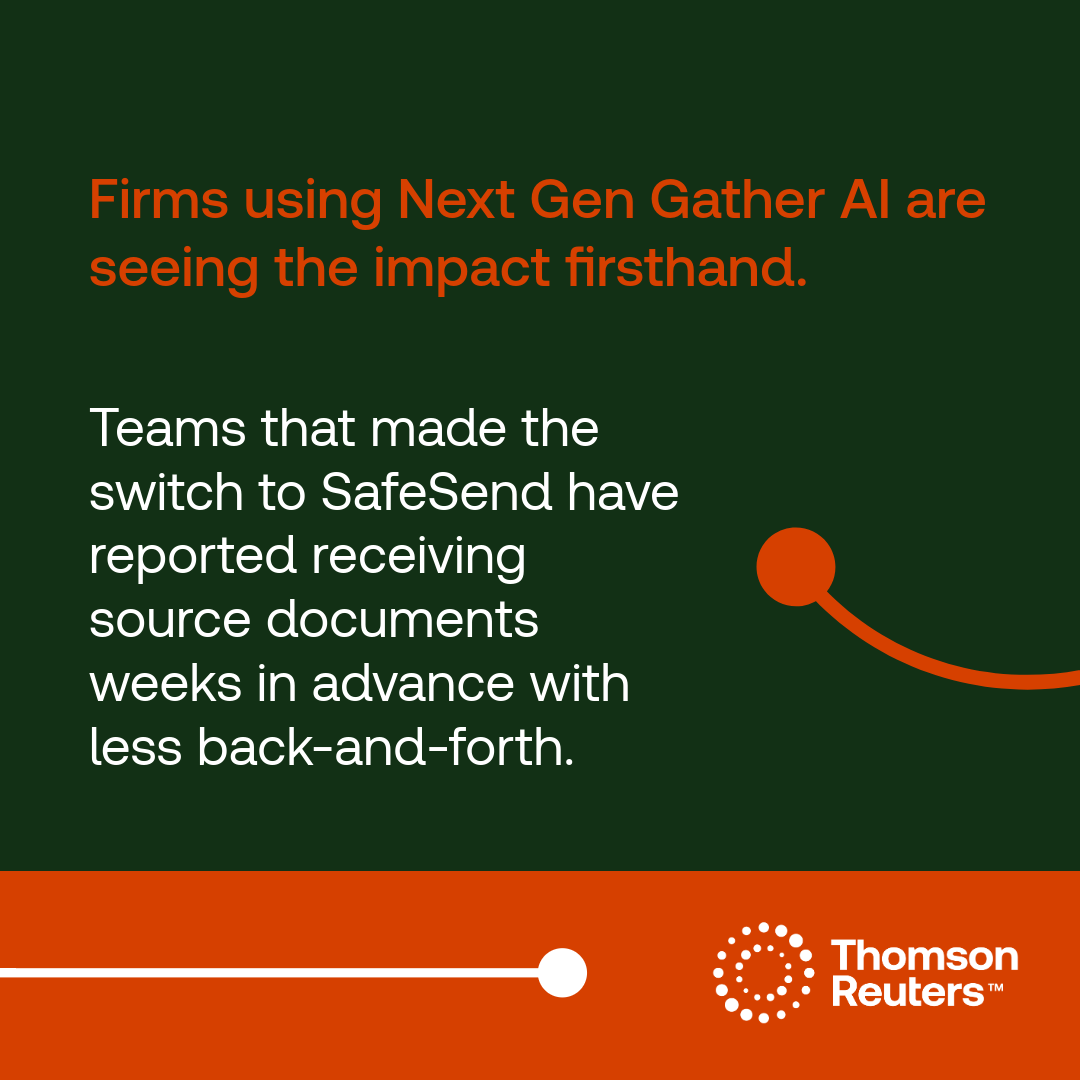
This is the part of tax season that quietly eats away at time, energy, and morale: chasing down W-2s, 1099s, K-1s, brokerage statements, and organizers before the deadline clock runs out. AI can automatically collect, categorize, and organize incoming documents, flagging what’s missing before staff have to play detective.
Data extraction and mapping
Once documents are in, AI reads them and maps values directly into tax software. What used to take hours of manual data entry can happen in minutes now, with fewer transcription errors from staring at the same 1099 for too long.
Client follow-up automation
Automated reminders for missing documents, unsigned forms, and outstanding items mean your team spends less time composing “just checking in” emails and more time doing worthwhile work.
Anomaly detection
AI can flag inconsistencies before a return ever goes to review, catching things humans miss when they’re buried in a 400-client queue during the height of busy season.
Did you know that, according to Thomson Reuters Institute’s 2025 Future of Professionals Report, AI is predicted to save professionals an average of five hours per week (that’s 240 hours per year!), representing roughly $19,000 in annual value per professional? That’s real capacity being returned to firms that put it to good use. And we don’t know many CPAs who would turn up their noses at that kind of time (and monetary) savings.
Where a tax professional’s eye still matters
AI is excellent at tasks that follow a clear formula. Tax work, especially at the complex end, doesn’t always cooperate. This is where the question of whether you can trust AI with tax returns gets real, rather than theoretical. But you have to remember, much like humans, AI isn’t perfect. And if you’re waiting for it to never make a mistake, you may be waiting for a lifetime.
That isn’t to say that AI can’t be trusted. It just means you need to be discerning where it matters.
Accuracy isn’t guaranteed
AI is only as good as the data it’s given. Feed it incomplete or incorrect information, and it’ll confidently hallucinate incomplete or incorrect results. That’s why AI isn’t a replacement for people.
It’s a productivity tool that helps professionals do their work better. The machine can accelerate analysis, surface patterns, and handle repetitive steps, but it supports the process rather than owning it.
Human expertise remains essential
A skilled preparer can sense when something’s off, ask the right follow‑up questions, and apply professional judgment in ways AI can’t replicate. AI still can’t read between the lines the way a seasoned CPA can (not yet, at least). In tax work especially, what’s missing from a document can be just as important as what’s included. And it takes a human expert to recognize, validate, and ultimately stand behind the final result.
Data security and client confidentiality
Client tax data is among the most sensitive information that exists, and how a vendor handles it is often the first real test of trustworthy AI for accounting firms. Before adopting any AI tool, firms need to ask the hard questions:
- Where does client data go once it’s processed?
- How is it stored?
- Who has access to it?
- Is it being used to train a model?
“You need to understand what a vendor can and can’t do with your data. And also what agreement is in place between your software provider and their AI model provider when it comes to that data.”
Head of Product Engineering, Thomson Reuters
If a vendor can’t answer those questions clearly, that’s your answer. Section 7216 compliance adds another layer: firms need to understand whether using certain AI tools requires explicit client consent before sharing tax return information.
Accountability gaps
This is another place where the answer to whether you can trust AI with tax returns comes down to process, not technology. The IRS holds preparers responsible for the returns they sign.
AI doesn’t sign returns, and it doesn’t take the call when something goes wrong. That accountability still falls on you, which means any AI-assisted output needs documented human review before it goes anywhere near a client or a filing. When something goes wrong, “the AI did it” isn’t a defense.
Complex returns require judgment, not pattern recognition
Multi-entity structures, gray-area positions, multi-jurisdiction planning: these require the kind of strategic reasoning and contextual understanding that current AI isn’t equipped to handle independently. AI is reactive by nature. It doesn’t properly identify opportunities or apply the kind of nuanced thinking that sets great CPAs apart.
What trustworthy AI for accounting firms looks like in practice
Building trustworthy AI for accounting firms isn’t about blind faith. It’s about choosing the right tools and using them the right way. Here’s what that looks like:
Purpose-built beats general-purpose
This is where a lot of firms get tripped up. Generic AI tools operate across an enormous universe of information, which is exactly the problem.
“When you think about software or generative AI capabilities that are purpose-built for an accountant, they are grounded in data and information that’s been vetted and is relevant to an accountant. You’re dealing with information that’s more relevant, meaning it has fewer opportunities to produce hallucinations or misinformation.”
Head of Product Engineering, Thomson Reuters
Tools designed specifically for accounting (trained on tax content, vetted for accuracy, and integrated with your existing tax software) are a different category entirely, and it’s usually the starting point for trustworthy AI for accounting firms. The bar is higher, and it should be.
This higher bar is embodied in Fiduciary-Grade AI™, the Thomson Reuters standard for high-stakes professional work, which requires AI to be grounded in authoritative content, shaped by subject-matter experts, protected by rigorous privacy and security safeguards, and designed to produce transparent, verifiable outputs.

AI built for professionals, not consumers
See how Fiduciary-Grade AI™ provides the level of authority and scrutiny that tax firms need.
Learn more ↗An audit trail is non-negotiable
Any AI tool worth using should show its work. Being able to verify, validate, and override AI outputs is an absolute requirement.
“Any software out there that’s just saying ‘we’re going to automatically do it for you’ and has no information about what decisions AI took, and that’s a red flag. You need to have that audit trail to understand what decisions were made and why.”
Head of Product Engineering, Thomson Reuters
Human review is baked in, not bolted on
The best AI implementations treat automation as a first draft, not a final product. AI drafts, flags, and organizes, while humans validate and decide.
“It’s not replacing the accountant and their domain knowledge and all of their experience. It’s intended to be a junior member of the accounting staff that the accountant can delegate work to.”
Head of Product Engineering, Thomson Reuters
Don’t wait for perfection
Sekhon is clear about this: “AI is advancing at a rate that I don’t think any of us expected. If you wait until it’s perfect, you’re behind the ball by six months…and you’ll continue to be behind the ball.”
The firms seeing the strongest results aren’t waiting for a flawless system. They’re adopting intentionally, building confidence incrementally, and getting their teams up to speed while the technology continues to improve around them.
Firms with an AI strategy are 3.5x more likely to see a return on investment than firms with no strategy in place. But remember, a strategy isn’t just automating everything, crossing your fingers, and hoping for the best. It means being intentional about what you adopt, how you use it, and what you expect from it.
AI is a tool. You’re still the expert.
AI can collect your documents, extract your data, flag your anomalies, and automate the follow-ups that used to steal precious time from your team. That’s real. That’s happening. And for the firms that use it well? It translates into hundreds of reclaimed hours every year.
But it can’t assess audit risk. It can’t navigate a gray-area position on a complex return. It can’t answer for a mistake. And it won’t be the one on the phone with a client when something goes sideways. Those things still belong to you, and honestly, that’s the point.
The firms seeing the strongest results aren’t the ones that handed everything to AI and hoped for the best. They’re the ones who paired smart technology with sharp professionals and got both working together.
AI handles the grind. You handle the judgment. That’s the combination your clients are paying for; and it’s what trustworthy AI for accounting firms looks like when it’s working the way it should.
To see Fiduciary-Grade AI™ in action and learn how it fits with your day-to-day workflow, check out CoCounsel page for proof points, testimonials, and a free ROI calculator.
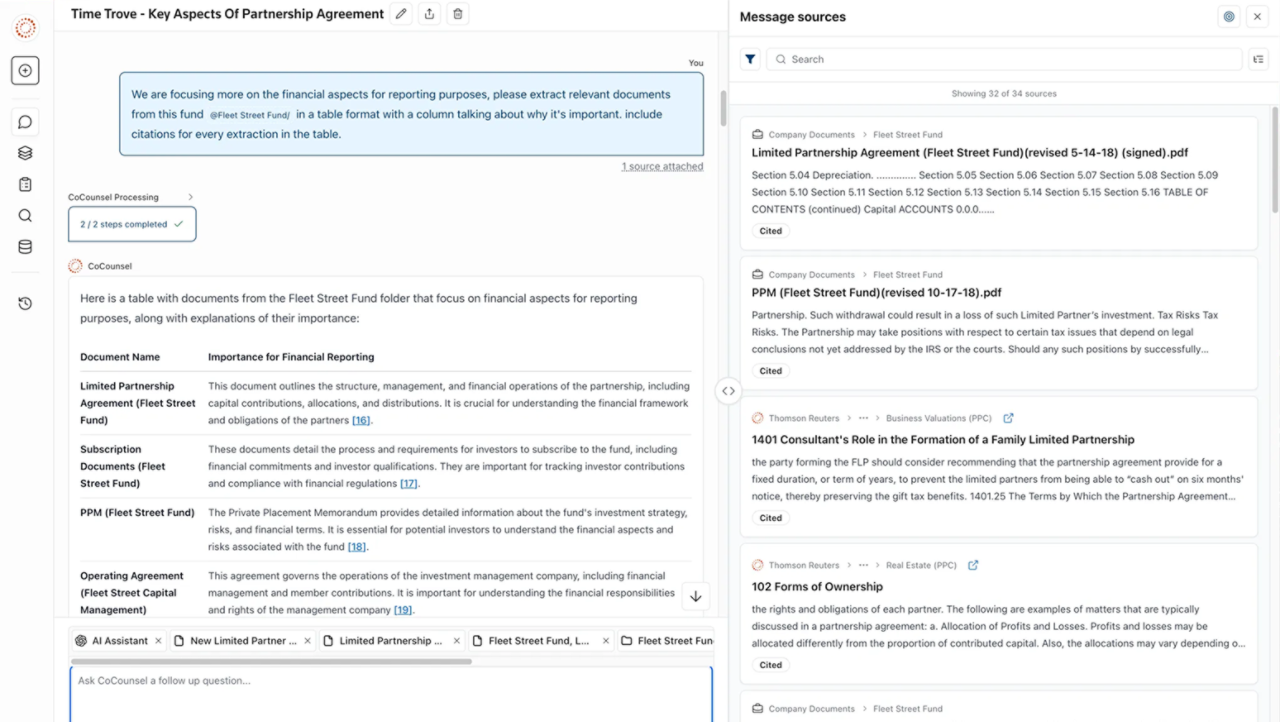
See how CoCounsel goes to work for you
Transform your work with capabilities across CoCounsel Tax and CoCounsel Audit & Accounting that reduce time-to-answer, improve consistency, and supercharge productivity.
See for yourself ↗