
ASU 2023-09 is in effect, the One Big Beautiful Bill Act has reshaped key provisions, and tax teams are expected to deliver more with the same resources. Getting your data and technology right isn’t a future priority — it’s the work in front of you now.
Highlights
- Tax teams face mounting pressure from ASU 2023-09 disclosures and evolving tax legislation.
- Corporate tax provision software accelerates processes by 30% to 50% while strengthening controls.
- Clean data infrastructure enables scenario modeling and strategic tax planning for leadership.
The 2025 year-end close made something clear for a lot of corporate tax teams: the job has changed. New disclosure requirements are rewriting how provisions must be reported. A reshaped tax code is forcing a fresh look at deferred positions and international structures. And the C-suite wants answers, not just filings. All of that landed at once.
The teams handling it well have one thing in common: they stopped relying on spreadsheets and disconnected systems before the pressure peaked. Here’s what that looks like in practice.
Jump to ↓
What challenges does your tax department face?
Keeping up with regulatory changes
Use corporate tax provision software to mitigate key risks
Gain the capabilities of a robust corporate tax provision software solution
 |
|
What challenges does your tax department face?
Tax departments today operate in an increasingly complex landscape where manual processes create significant exposure to costly errors and compliance failures. When your team relies on spreadsheets and disconnected systems to calculate your corporate tax provision, track changes in tax law, or manage multiple jurisdictions, the margin for error grows exponentially.
Resourcing remains a persistent problem. According to the Thomson Reuters 2025 State of the Corporate Tax Department report, produced in collaboration with the Tax Executives Institute (TEI), 58% of corporate tax departments say they are under-resourced — up from 51% the prior year. And 59% lack confidence in their ability to upgrade technology over the next two years, even as more than half plan to introduce automation or machine learning tools.
Beyond resourcing, most tax teams don’t fully control the systems they depend on. As Accounting Today notes, key data lives in accounting, payroll, procurement, or overseas subsidiaries where formats differ and documentation standards vary. When rules change, tax teams must scramble to connect dots that were never meant to be connected. A single miscalculation or overlooked regulation can trigger penalties, interest charges, and unwanted scrutiny — risks that multiply when staff turnover occurs and institutional knowledge walks out the door.
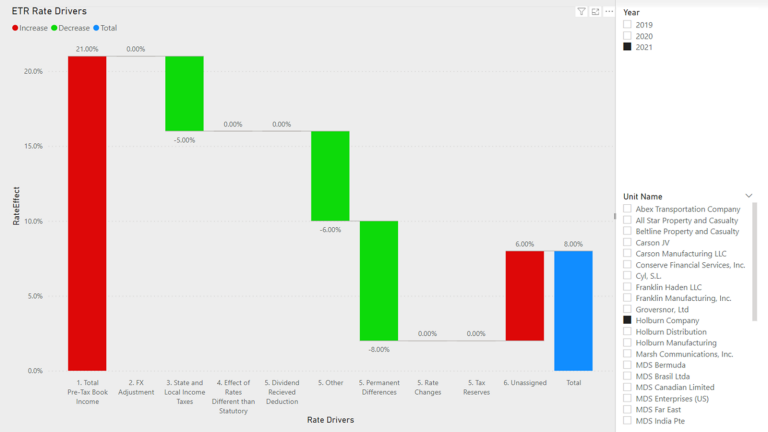
The stakes of getting it wrong have risen further. ASU 2023-09 is now in effect for public business entities, requiring detailed, eight-category disaggregated rate reconciliations and jurisdiction-level taxes-paid disclosures — data many organizations have never systematically collected before. Non-public entities follow in 2026.
Adding to that complexity, many large multinationals have historically used a blended state approach when calculating their provision. But as individual states become material, tax teams are being forced to pivot to a state-by-state or hybrid approach. In a spreadsheet-driven environment, that kind of mid-process pivot is exactly where errors creep in. The model wasn’t built for it, and retrofitting it under deadline pressure is a recipe for mistakes.
When processes aren’t standardized and documentation is scattered across files and systems, problems tend to surface at the worst possible time — during the close, or worse, during an audit. The goal is to find issues before the deadline, not because of it. Tax departments that have the right workflow controls and technology in place are the ones that get there.
How to make use of clean data
Easy access to clean data is the key to meeting these challenges, and corporate tax provision software can deliver. With the right solution, you can collect data once, aggregate it, and format it for use across your provision and compliance workflows from a single repository — giving your team a repeatable process and data that’s ready for compliance and reporting.
A few practices tend to separate the teams that close cleanly from those that don’t:
Map your data sources before year-end, not during it. Identify upstream systems feeding your provision — ERP, payroll, intercompany transactions, foreign subsidiaries — and document exactly where jurisdiction-level cash tax data will come from.
As Centri Consulting notes, companies should assess and enhance their accounting systems now to capture the granular data required by the new ASU 2023-09 disclosure requirements. That work needs to start well before the close window opens.
Standardize inputs, not just outputs. Tax data management solutions, like ONESOURCE DataFlow, lets you standardize existing tax packages and workpapers while validating data and flowing it into your chosen tax applications at prescheduled times. Enforcing consistent chart-of-accounts mapping and entity naming conventions upstream means your data is accurate and consistent before it ever reaches your provision workflow — not something you’re fixing at the end.
Build the audit trail by design. Many companies haven’t refreshed their income tax controls since initial SOX implementation.
As MGO CPA observes, a single overarching management review control is unlikely to cover all areas of a tax provision at the specificity now required. Every rate reconciliation item should be traceable to a source document before the close, not after.
Tax professionals who use corporate tax provision software report accelerating processes by 30% to 50% while strengthening internal controls and improving linkages between tax and compliance — freeing up capacity for analysis and planning work that drives real business value.

Keeping up with regulatory changes
Corporate tax provision software will also help you prepare for regulatory change at every level. Three significant developments are running in parallel right now, and each one has direct implications for how your provision process needs to work.
ASU 2023-09 is effective for public business entities for fiscal years beginning after December 15, 2024, and for all other entities for fiscal years beginning after December 15, 2025. The update expands rate reconciliation and cash taxes paid disclosures, requiring disaggregation by jurisdiction and by nature when items meet the 5% threshold. Disclosures are annual only and apply prospectively, though entities may elect retrospective application — a decision worth making early, since it drives comparative-period data collection. Provision processes and tax software should be evaluated now; discovering a data gap in Q4 leaves no runway before year-end.
The One Big Beautiful Bill Act (OBBBA), signed into law on July 4, 2025, extends or makes permanent several business-friendly provisions from the 2017 Tax Cuts and Jobs Act and significantly reshapes the international tax landscape. Key changes include immediate expensing for domestic R&D costs, the restoration of 100% bonus depreciation, and revisions to interest limitation rules — each affecting current and deferred tax computations. For teams managing R&D tax credits, solutions like Neo.Tax can help ensure those newly expensed domestic R&D costs are being captured and calculated accurately as the rules evolve. For multinationals, the shift from GILTI to Net CFC Tested Income (NCTI) and the renaming of FDII to Foreign-Derived Deduction Eligible Income (FDDEI) take effect in 2026, making scenario modeling a near-term priority, not a future one — and international tax calculators like Orbitax are built specifically for that kind of cross-border modeling and analysis.
For multinationals, the OECD’s global minimum tax framework adds another dimension to the ASC 740 provision. Under FASB guidance, Pillar Two taxes are treated similarly to alternative minimum taxes, meaning deferred taxes are generally not recognized for future Pillar Two effects — but the current exposure still needs to be measured, monitored, and disclosed. That requires the same jurisdiction-level data infrastructure that ASU 2023-09 demands, making it one more reason to get your data architecture right before year-end.
Taken together, these changes mean the tax function is being asked to do more substantive work: advising on corporate structure, modeling the tax implications of near-shoring decisions, assessing what expansion into a new market actually costs on an after-tax basis. That work only becomes possible when the compliance and reporting side is running smoothly.
Use corporate tax provision software to mitigate key risks
To mitigate current and emerging risks, tax teams need to provide transparency into their processes — to auditors, to finance leadership, and to the C-suite. Corporate tax provision software enables near-real-time analytics and reporting on large data sets, so you can clarify your current and expected tax obligations across every jurisdiction you serve.
You can also use your data to model different scenarios: exploring the tax implications of shifting operations from one geography to another, assessing the effects of OBBBA changes on deferred tax positions, or stress-testing your effective tax rate under varying regulatory assumptions. That kind of analysis is what CFOs and general counsel actually need from their tax teams right now — and it only happens when the provision process isn’t consuming every available hour.
The 2025 Thomson Reuters/TEI survey captures where most departments actually are: more than half plan to introduce automation or AI tools, yet most are still waiting for practical, tax-specific applications. ONESOURCE Tax Provision is where that gap gets closed — software built specifically for the provision process, not adapted from something adjacent to it.
Gain the capabilities of a robust corporate tax provision software solution
Thomson Reuters ONESOURCE Tax Provision gives tax teams a single place to manage data capture, aggregation, and extraction — with the controls and audit trail that auditors and finance leaders expect. The calculation engine handles tax entries with integrated review and approval workflows built in, so nothing moves forward without the right sign-offs. Reports and scenario analyses come out of the same system, which means the numbers your team presents to the C-suite tie directly back to the provision.
Regulatory updates are delivered automatically through the subscription — no separate upgrade cycles, no scramble when a new rate or rule takes effect mid-year.
Ready to see what a cleaner close looks like?
Learn how Thomson Reuters ONESOURCE Tax Provision can help your team manage data complexity, stay current with regulatory change, and go into every close with confidence.
Tax provision software
Automate your corporate financial close with ONESOURCE Tax Provision
Learn more ↗