
As agentic AI matures, firms have a chance to redesign work, strengthen review processes, and accelerate the shift to advisory services
Highlights
- AI adoption is accelerating, but many firms are still using it to support one-off tasks rather than revamping their workflow.
- Agentic AI can handle complex, multi-step work, helping professionals move beyond research and toward advisory services.
- Successful AI transformation depends on strong review processes, trusted data sources, and thoughtful workflow redesign.
More than 90% of professionals already using generative AI expect it to become a central part of their workflow within the next five years, according to the Thomson Reuters 2026 AI in Professional Services Report. Agentic AI is on a similar path: by 2030, 77% expect it to play a central role too.
- 40% of organizations now use generative AI, almost double the year before, according to Thomson Reuters 2026 survey data
- Only 15% currently use agentic AI tools, the kind of system that can plan and execute multi-step work on its own
- Many firms that have adopted AI are still applying it to existing processes instead of rethinking how the work gets done in the first place
The gap between adoption and use is where Stuart Cobbe, Senior Director of Product Management at Thomson Reuters, said the biggest opportunity lies in a sit down with Accounting Today. Here’s how workflow transformation for accounting firms should really be approached.
Jump to ↓
What’s the difference between GenAI and agentic AI?
Tax research is just the starting point for AI
AI trust depends on the review step more than the output
The cultural shift behind AI accounting firm workflow transformation
What comes next: AI-powered research firms won’t have to ask for
How to evaluate AI tools without getting lost in the hype
What’s the difference between GenAI and agentic AI?
AI has become a blanket term for a wide range of technologies, but not all solutions are created equal. GenAI and agentic AI have considerably different implications for professionals.
What sets them apart:
- Generative AI LLMs that are pre-trained on huge, varied data sets, which makes them broadly capable but too generalized for many complex, multi-step responsibilities
- Agentic AI builds on that capability by giving the system room to plan its own steps and check its own work over an extended task, rather than answering a single prompt
As Cobbe put it, “These agentic systems are much, much better … at reading these documents and editing them and creating them,” referring to the Excel files, Word documents and PDFs that make up the bulk of tax, accounting and audit work.
Tax research is just the starting point for AI
Thomson Reuters survey data shows tax research is the top current use case for AI in firms. But Cobbe argues that it’s a narrow read of what agentic platforms can accomplish.
Here are some of the ways he’s seeing that scope expand:
- Professionals using Thomson Reuters CoCounsel Tax and Ready to Advise are increasingly bringing in full client fact patterns instead of narrow questions
- They’re asking the AI to work out the answer, rather than doing the research themselves and checking it against a tool
- What starts as research increasingly resembles advisory work.
- “That engagement is starting to look a little bit more like an advisory engagement than a research engagement,” Cobbe said.
AI trust depends on the review step more than the output
The widespread AI tools you’re probably most familiar with are well suited for everyday tasks. But professional tax and accounting work carries a higher standard of scrutiny
How Fiduciary-Grade AI™ meets the mark
The market for tax AI tools has exploded over the past few years. However, most of these models use generic LLM platforms repackaged with a tax sheen. Fiduciary-Grade AI applies a higher standard of accuracy and rigor.
- Trained on decades of expert knowledge and editorial guidance
- Reliable and accurate enough to support complex, judgment-heavy work
- Built for the moments when the stakes, and the risk, are highest
The cultural shift behind AI accounting firm workflow transformation
AI can’t transform an accounting firm on its own. Well-planned implementation is just as critical to the success of a new solution. Going forward, partners and managers will have to better train junior staff for review-based tasks instead of inputting data and indexing workpapers.
“The review stage becomes the critical bottleneck,” Cobbe said, adding that firms will need new habits for checking what an AI system used as its source material and how it arrived at an answer. He expects that shift to play out across firms over the next two years.
What comes next: AI-powered research firms won’t have to ask for
Cobbe walked through how the workflow itself is changing in stages:
- 2022: professionals asked a tool a narrow question, such as the personal property tax rate for a boat in Virginia
- 2026: people paste in the full client context and let the agent figure out what to ask
- 2030: Cobbe expects that research step to happen automatically within compliance work, triggered by the system itself rather than by a person
That frees up professionals for the conversations that matter more: where a client can save on taxes, or how they might restructure something more efficiently. Cobbe sees this accelerating the long-discussed shift from compliance to advisory work in tax.
How to evaluate AI tools without getting lost in the hype
Cobbe pointed to two things accounting firms should prioritize:
- Fit over flash. Look at what the system was built for and who it targets. A tool designed for tax professionals will naturally fit their workflows better than a general-purpose one.
- Test with real problems. Build an internal library of hard, real client problems firms already know the answers to, and use them to test any system under consideration.
Real AI workflow transformation for accounting firms looks beyond automating what professionals already do. It redesigns how the work gets done and builds the review habits that make trusting the output possible.
Want the whole conversation? Listen to the full podcast with Stuart Cobbe and Accounting Today host Lisa Joyce to dig deeper into the industry shift.
See what agentic AI can do for your firm. Explore CoCounsel Tax from Thomson Reuters and bring full client fact patterns to work, not just narrow questions.
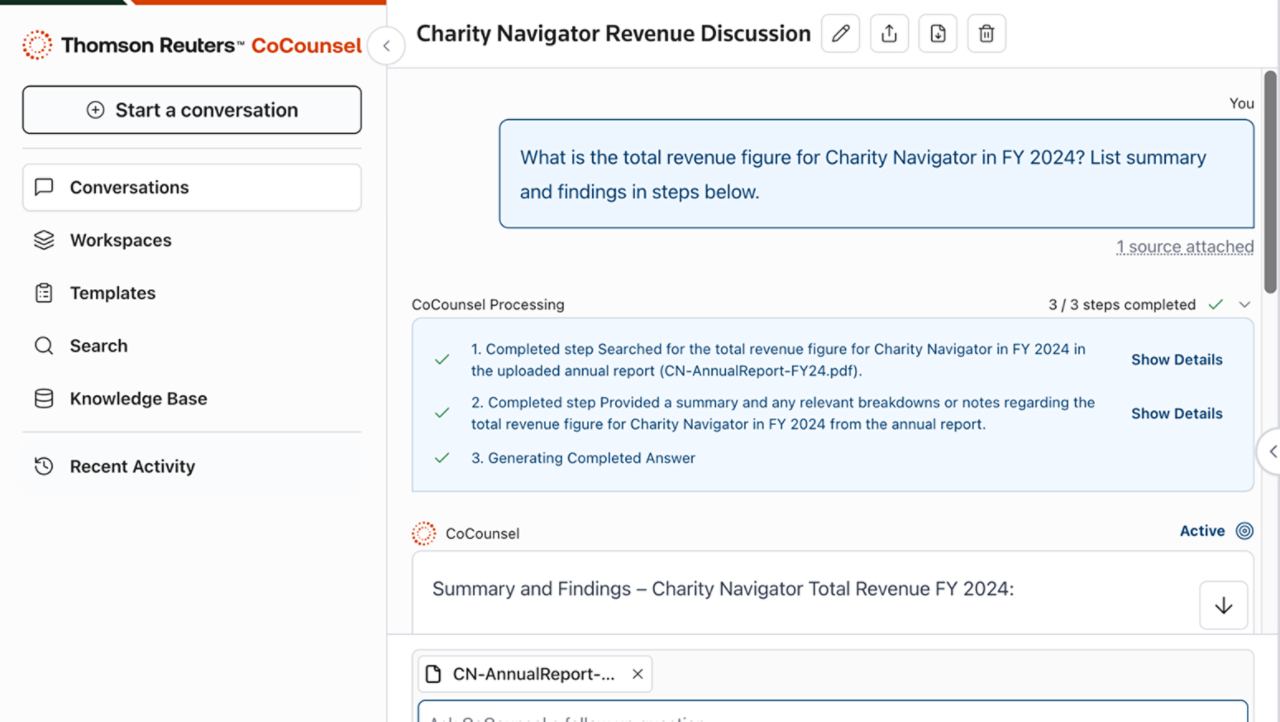
CoCounsel Tax
Deliverables in hours and expertise at scale: AI tax professionals count on
See it in action ↗