
How tax AI evolved from answering questions to executing workflows
Highlights
- Prompt-based AI can dramatically accelerate tax research, with practitioners reporting research time reductions of 50% to 90%.
- Agentic AI goes beyond answering questions by executing entire tax workflows, including document gathering, data verification, return preparation, and diagnostic resolution.
- Standardized AI workflows help firms scale expertise by embedding senior-level processes into repeatable templates, enabling more consistent reviews, research, and advisory recommendations.
Tax practitioners have spent the past two years learning how to write better AI prompts. But a second, distinct capability has entered the profession: agentic AI that plans, executes, and coordinates multi-step tax work with limited human input.
Understanding the difference between GenAI vs agentic AI helps firms stop seeing AI as a monolith, but instead as a multi-faceted, constantly evolving field. Let’s look at how different kinds of AI deliver different impacts on your tax practice.
Jump to ↓
AI prompts for tax planning and research
How agentic AI goes beyond prompting
Why prompting skill still matters
The art of GenAI prompting
Generative AI, in its simplest form, works as a single input/output exchange. You give a prompt, the model reasons over available content and provides an output. The quality of that answer also depends heavily on the question is framed.
Take a common research scenario: a taxpayer paid legal fees related to a work-related lawsuit, and you need to know whether those fees are deductible.
- Zero context: “Are legal fees deductible?” A generic answer, not useful for the return in front of you.
- Decent context: “A taxpayer had to pay legal fees for a work-related lawsuit. Are the legal fees deductible?” Narrower, but still missing details that change the outcome.
- Decent context with relevant information: “The taxpayer claims they were wrongfully terminated and discriminated against because of a medical condition.” Now the model has the fact pattern it needs to reason about the right code sections and precedent.
AI prompts for tax planning and research
The same pattern holds for planning questions. “What tax strategies are available to real estate professionals?” returns a broad overview. A prompt that specifies the taxpayer’s status under the passive activity rules, their intent to invest in limited partnerships, and a question about elections and excess business loss limitations returns something a practitioner can act on.
“Practitioners who are adopting [AI research tools] are cutting their research times by 50%, 70%, sometimes by 90%.”
CFP, EA, Owner of Brass Tax Presentations
Prompt-based AI had enormous utility in tax research, saving professionals countless hours with citation-backed answers and document summaries. However, that type of AI doesn’t lend itself to routine, multistep workflows quite as smoothly.
How agentic AI goes beyond prompting
Compared to GenAI, agentic AI is a different category of technology. Instead of answering one question at a time, an agent plans a sequence of steps, executes them, checks its own work against defined rules, and hands off a completed work product for review. The practitioner still directs the work and reviews the output, but they aren’t running each step.
Thomson Reuters Ready to Review and 1040 preparation
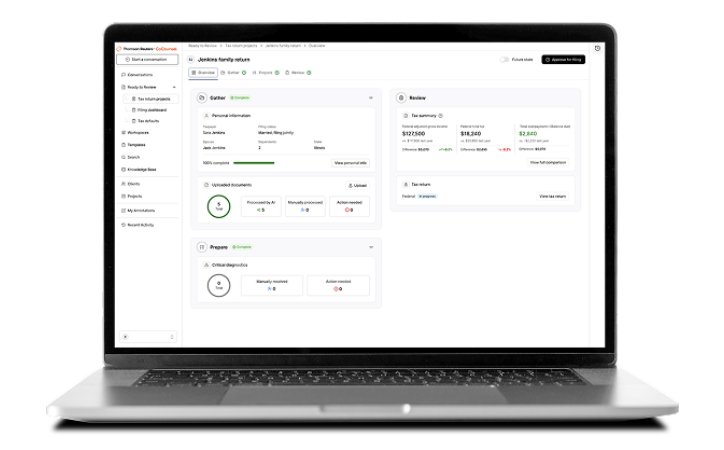
Ready to Review, built on the CoCounsel platform, applies agentic AI to individual tax return preparation. A preparer uploads a client’s source documents and prior-year return, and coordinated agents take over:
- A Gather Agent scans, extracts, categorizes, and verifies data from source documents against the prior-year return, flagging missing information before it becomes a problem later on.

- A Tax Preparer Agent maps the verified data into the correct fields, produces a complete draft return, and resolves routine diagnostics on its own, prioritizing issues that need a human’s judgment.
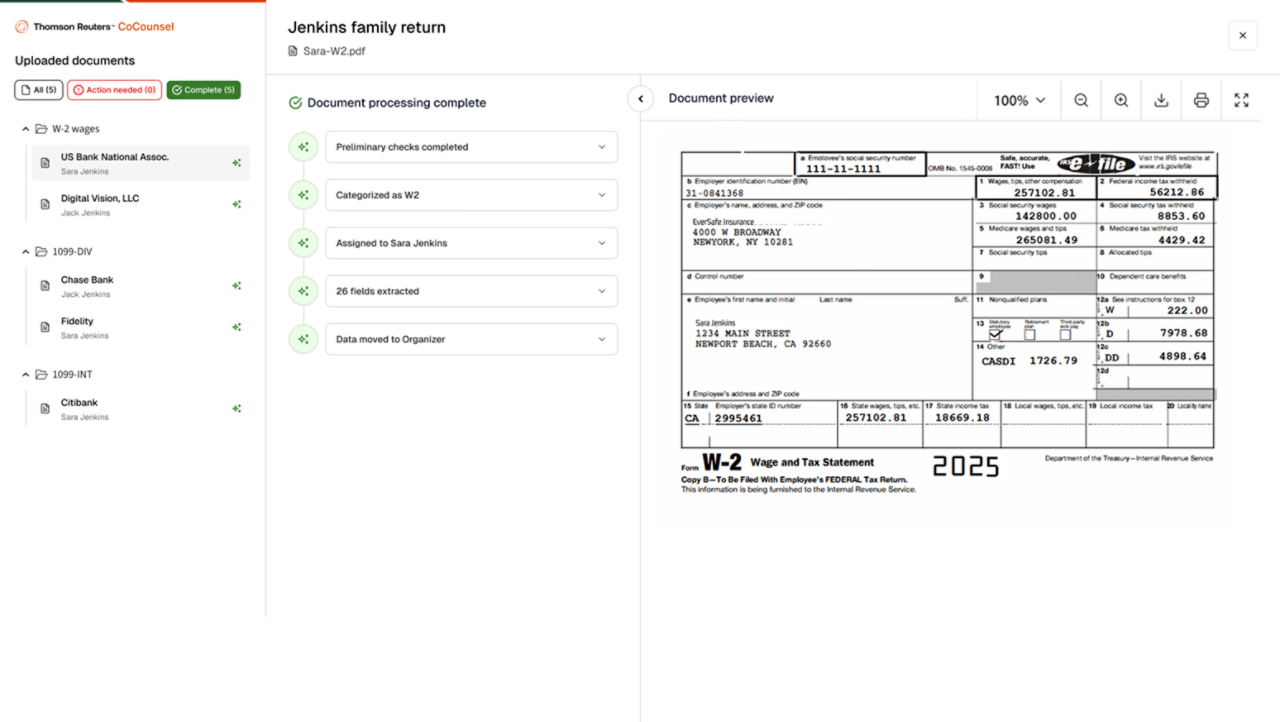
The preparer’s role shifts from data entry and document sorting to reviewing a draft already checked against source documents and run through the tax engine. That’s a multi-step workflow with its own internal reasoning and error-checking, not a single question and answer.
Thomson Reuters CoCounsel Tax and workflow standardization
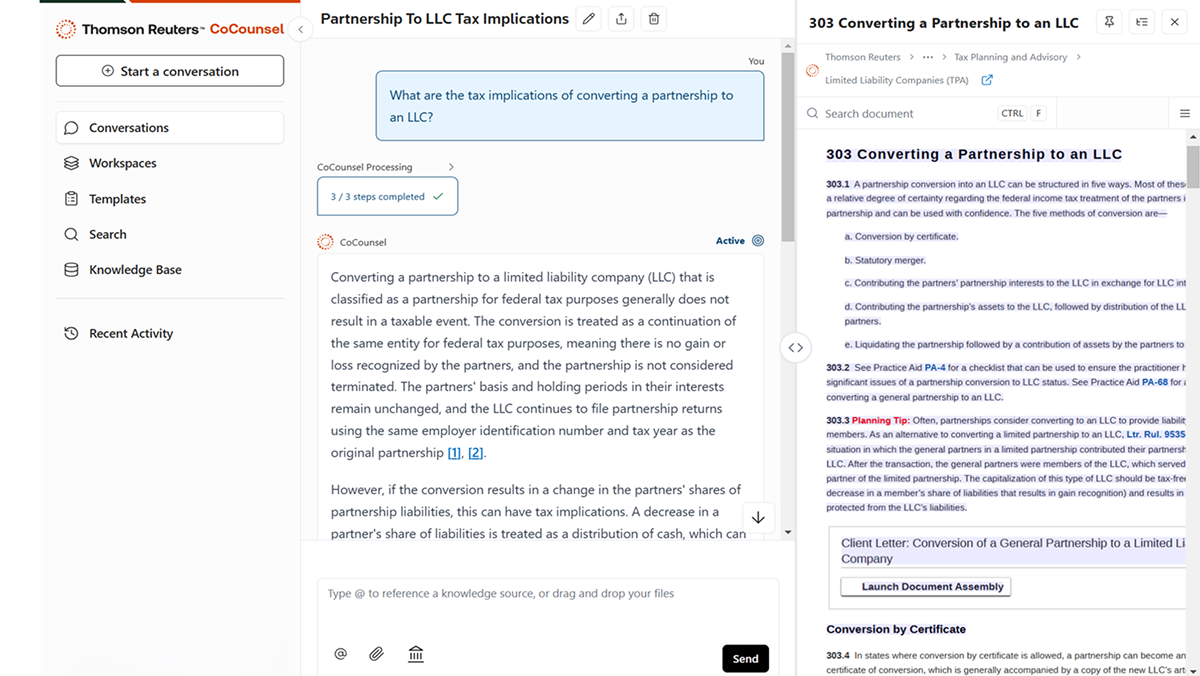
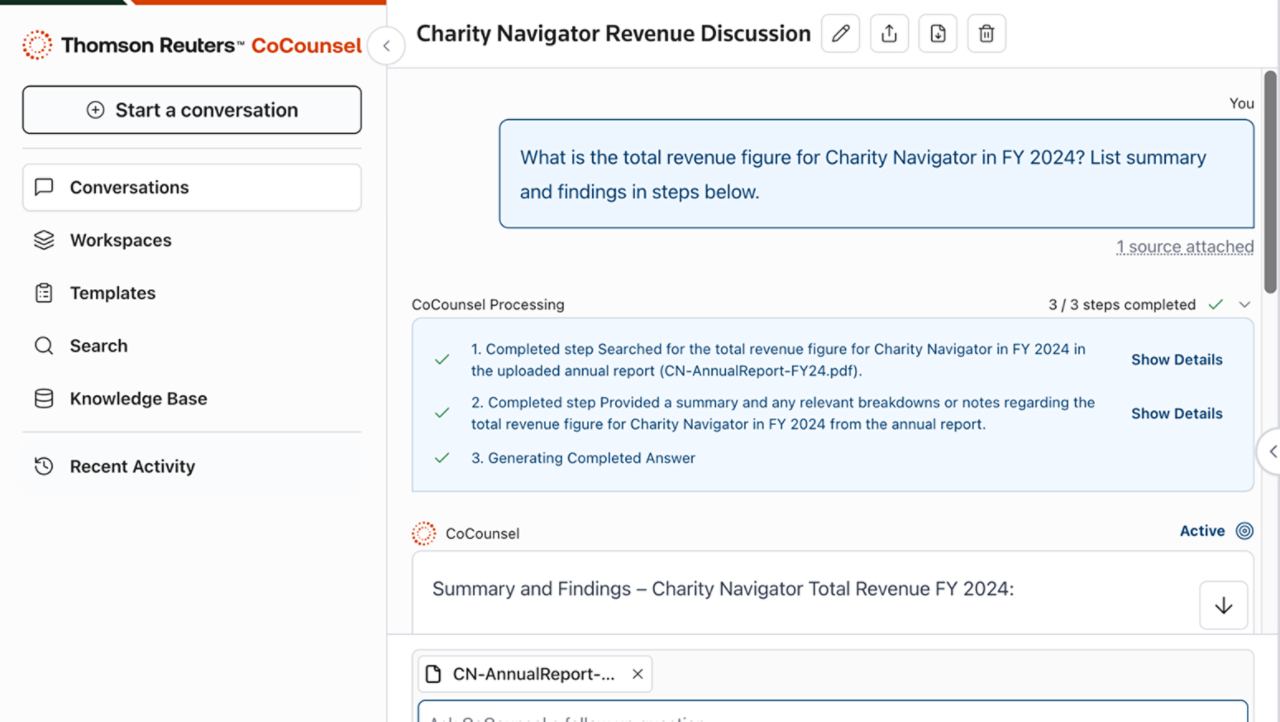
CoCounsel Tax applies the same principle to research and document review at the team level. Rather than writing prompts from scratch for each task or query, teams build Workspaces around a structured question set, checklist, or template, then apply that same workflow across a batch of documents or returns:
- Import a checklist or generate a question set with AI, then reuse it as a template for every similar engagement.
- Review multiple documents against that structured set at once, instead of one prompt at a time.
- Export outputs, including citations and review status, for documentation.
- Share templates across the team so junior staff apply the same framework a senior practitioner would use.
Learn more about CoCounsel Tax
See what your tax team could look like with a do-it-all agentic AI assistant.
See for yourself ↗Thomson Reuters Ready to Advise and advisory delegation
The same shift is happening on the advisory side. Ready to Advise integrates with Thomson Reuters UltraTax CS to analyze client data and identify and rank planning strategies by relevance and impact. Its interface guides the preparer through follow-up questions that refine each recommendation.
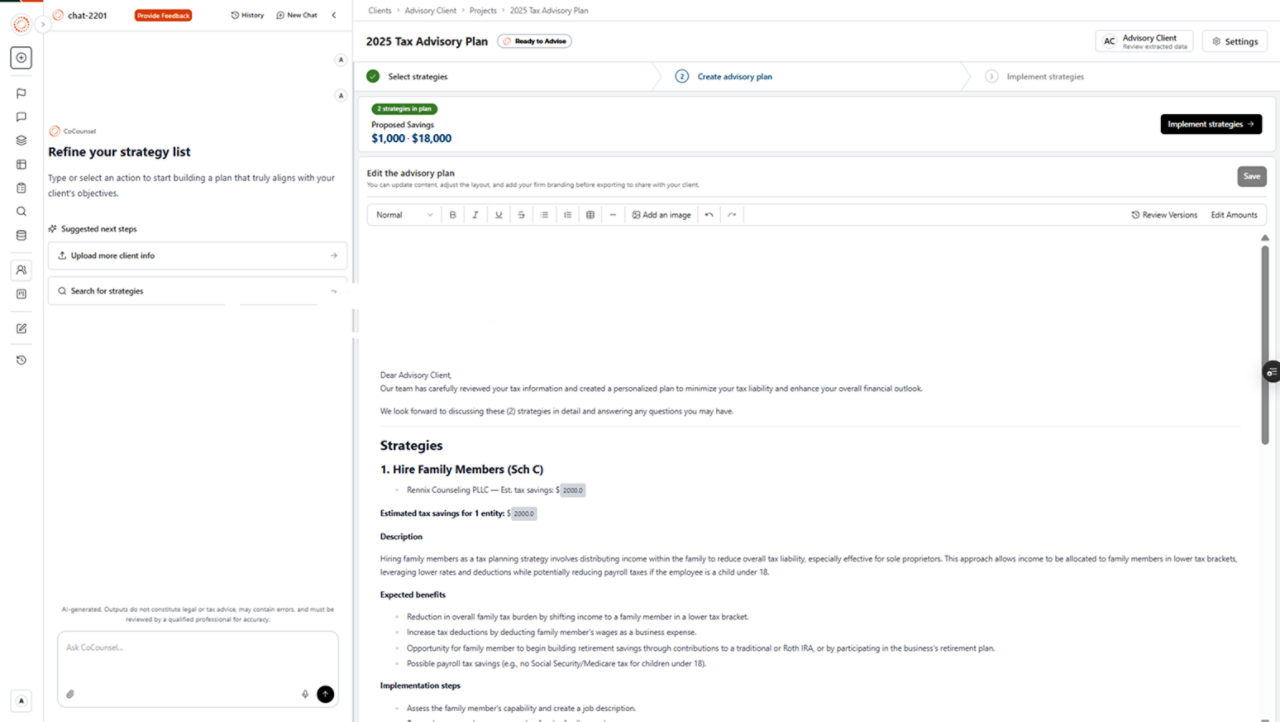
A senior advisor no longer has to walk a junior staff member through every strategy by hand. The workflow itself carries the firm’s advisory knowledge, so staff at any experience level can deliver consistent guidance.
Why prompting skill still matters
The GenAI vs agentic AI distinction comes down to scope. Prompting gets you a sharp output to a specific request or query. Agentic workflows take over the parts of a practice that follow a consistent, repeatable process, from document intake to a completed draft.
Firms don’t have to choose one over the other. Keep building prompting skills for research and one-off analysis, where a well-framed question gets the fastest answer. Then identify the repeatable parts of your practice (such as 1040 gathering and preparation or document review against a standard checklist) and evaluate where an agentic workflow fits.
If you’re ready to see what agentic AI looks like in a real 1040 workflow, visit the Ready to Review product page to explore features and see native AI tax preparation in action.
See Ready to Review in action!
Schedule a free, no-commitment demo with one of our agentic AI experts.
Get personalized demo ↗