
What triggers permanent establishment risk for remote workers and why it matters for payroll now.
Highlights:
- Employer of Record (EOR) models offer fast market entry, but headcount, revenue nexus, and risk appetite should trigger a re-evaluation against establishing a local entity.
- The “Digital Nomad” trend has matured into a permanent establishment (PE) risk, with the OECD’s 2025 commentary introducing a 50% working-time benchmark over a 12-month period.
- PE exposure cascades into payroll obligations, including local payroll registration, wage tax withholding, social security, and statutory reporting, often surfacing before Finance recognizes the corporate tax issue.
- Universal HR and time system rollouts succeed or fail on legislation, not technology, requiring a deliberate “global core, local flex” design principle.
- API-enabled local connections now allow payroll leaders to achieve global consistency and local compliance simultaneously, eliminating the historical trade-off.
Jump to ↓
What triggers permanent establishment risk for remote workers?
The EOR to local entity transition: When to switch
Digital nomad tax compliance and the OECD 50% rule
Building a “global core, local flex” payroll strategy
Your strategic roadmap for permanent establishment risk: Treat payroll as a growth partner
What triggers permanent establishment risk for remote workers?
Permanent establishment risk occurs when remote work creates a taxable business presence in another jurisdiction, triggering corporate tax and payroll obligations. Tax authorities now scrutinize four primary triggers:
Key PE risk triggers:
- 50% working-time benchmark: When an employee works more than half their time from another country over a 12-month period (per OECD’s 2025 Model Tax Convention update)
- Revenue-generating activities: Regular business activities like contract negotiations or client relationship management conducted from a foreign location
- Executive decision-making authority: Senior leaders making binding business decisions from remote locations that commercially benefit the company
- Fixed place of business: Consistent use of a home office that serves business purposes beyond employee convenience
The operational compliance cascade
For payroll leaders, this means permanent establishment risk surfaces as operational compliance requirements before Finance identifies the corporate tax exposure. A single remote hire can trigger:
- Local payroll registration
- Wage tax withholding obligations
- Social security contributions
- Statutory reporting requirements
- Employment law compliance
Why this matters for payroll right now
Global expansion in 2026 is no longer the domain of multinational giants. Mid-market employers, scale-ups, and even early-stage companies are hiring across borders, leveraging EORs, contractor networks, and remote-first policies to build distributed workforces. What was once a deliberate, multi-year market-entry strategy has compressed into weeks.
Payroll as the early-warning system
With that compression has come parallel growth in regulatory scrutiny around permanent establishment risk, worker classification, and cross-border tax exposure. The result is an environment where payroll teams are increasingly the early-warning system for compliance risk.
According to Globalization Partners, the risk exposure to modern organizations operating globally has intensified significantly in the recent decade, with geopolitical, regulatory, supply chain, talent, ESG, and cybersecurity risks all localized, layered, and compounded as companies scale globally.
The EY 2026 Mobility Reimagined Survey reinforces the urgency, finding that 95% of mobility functions face barriers to improving process speed, while 62% of mobility teams’ time is still spent on reactive, ad-hoc requests rather than strategic activities.
The technology integration challenge
Layered on top is the technology question. As companies scale, the temptation to deploy a single universal HR and time system across all geographies clashes with the reality that legislation, not software, dictates what’s possible.
Working time rules, leave entitlements, data residency requirements, and statutory reporting obligations vary not just by country, but often by region within a country.
The 2026 MuleSoft Connectivity Benchmark Report underscores how fragmented these ecosystems remain, noting that 82% of IT leaders cite data integration as one of the biggest challenges when using AI, 86% agree that without proper integration, AI agents can introduce more complexity rather than value, and currently half of all AI agents operate in silos.
The connected discipline approach
The organizations getting global scaling right in 2026 treat EOR strategy, PE risk management, and core HR system design as a single connected discipline rather than three separate workstreams.
To unpack these interconnected challenges, Checkpoint News gathered insight from three payroll and HR subject matter experts who are guiding organizations through this transformation:
- Mariah Hantis, CPP, HR Compliance & Payroll Consultant, Edge on Consulting, on weighing EOR strategy against local entity investment.
- Max van der Klis-Busink, MCIPP, RPP, Global Payroll Consultant, Passion For Payroll, on permanent establishment triggers in a digital nomad era.
- Anita Lettink, Managing Partner, HRtechradar, on designing universal core HR and time systems that respect local legislation.
Their perspectives frame this month’s Payroll Pulse, which examines how payroll teams can support sustainable global growth without absorbing compliance debt along the way.
The EOR to local entity transition: When to switch
As companies scale globally, how should leaders weigh the operational advantages of an Employer of Record (EOR) against the long-term financial and compliance considerations of establishing a local entity?
The EOR value proposition
According to Mariah Hantis, both approaches carry meaningful benefits and trade-offs depending on a company’s size, risk appetite, and strategic goals. EORs are particularly valuable as a starting point for companies that lack the global infrastructure, knowledge, or resources to directly employ workers internationally. They transfer employment liability and administration to the EOR entity and allow rapid pivots into new geographies without adding significant operational burden.
That observation aligns with broader market research from Globalization Partners, which describes how the ROI of EOR was not in the ability to pay anyone anywhere in the world, but in the agility it created for companies lacking business nexus in target countries, or the knowledge, time, and acumen required to succeed.
The 15-20 employee tipping point
But Hantis is clear that EORs are not permanent infrastructure. Three considerations should drive any reassessment:
- Legal risk appetite: Including both the length of EOR engagements and the specific countries where the company is willing to operate through one
- Headcount thresholds: Hantis pegs this at roughly 15 to 20 employees per country before re-evaluating the model
- Revenue nexus: Where meaningful revenue earned in a country can create a taxable presence regardless of whether the company has employees there directly or through an EOR
When local entities make sense
The local entity decision flips those advantages. Direct ownership delivers more control and flexibility over employment agreements, terminations, payroll provider selection, and broader operations. It can also unlock revenue opportunities with clients who require an in-country presence.
The trade-offs are real, however. Without sufficient internal knowledge, companies typically must outsource legal and financial support, which adds cost. And establishing an entity introduces a full set of regulatory obligations including local employment law, payroll processing, termination rules, tax filings, agency reports, and audit exposure.
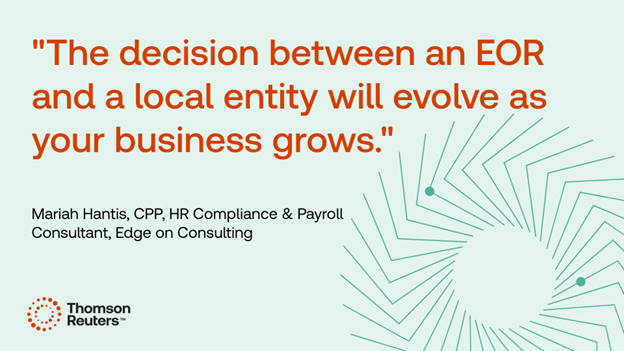
For payroll leaders, the practical implication is that the EOR-versus-entity decision is rarely permanent. It evolves as the business grows. Many companies start with an EOR to establish a market presence and then transition to a local entity once headcount, revenue, and operational readiness justify the investment. The most defensible models build that transition pathway into the original scaling plan rather than treating it as an emergency response.
Digital nomad tax compliance and the OECD 50% rule
The “Digital Nomad” trend is creating massive permanent establishment risks. What is the specific trigger point where a remote employee forces a company to register a new global entity?
The shift from flexibility to corporate tax exposure
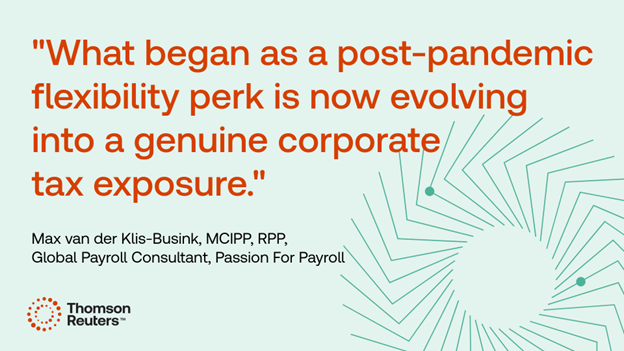
According to Max van der Klis-Busink, the borderless workforce and new employment models are driving companies toward a horizontal business growth model that has spotlighted permanent establishment (PE) risk. What began as a post-pandemic flexibility perk has evolved into a genuine corporate tax exposure.
The question is no longer whether employees can work remotely from another country, but when that remote work creates a taxable presence requiring company registration, corporate tax filings, payroll withholding, and broader compliance obligations.
This concern is reinforced by EY research on Remote Work and Pillar Two, which notes that nearly all employers (98%) report tracking domestic and international employee movements, compared to just 49% in 2023. This growing prevalence of flexible work arrangements and monitoring of locations by employers presents new risks as governments worldwide implement the Pillar Two global minimum tax project led by the Organization for Economic Cooperation and Development (OECD).
Understanding the OECD 50% working-time benchmark
The OECD’s 2025 update to the OECD Model Tax Convention attempts to bring more clarity to home office PE risk. The most-discussed element is a 50% working-time benchmark over a 12-month period, paired with a “commercial reason” test.
In practice, if an employee works more than half their time from another country and that arrangement benefits the business commercially rather than reflecting personal convenience, tax authorities may increasingly treat the home office as a fixed place of business of the employer.
Importantly, van der Klis-Busink stresses that there is still no universal magic number of days that automatically creates a PE. The real trigger is a combination of:
- Permanence: Regular, ongoing presence
- Business activity: Revenue-generating work
- Authority: Contract negotiation or binding decisions
- Employer dependence: The company relies on this location
A software engineer coding from a beach in Portugal for three weeks is materially different from a senior sales executive negotiating contracts year-round from Spain. And while employing through an EOR may appear to mitigate PE risk, governments are not looking solely at who owns the employment contract.
The payroll compliance cascade
For payroll, this is where operational challenges accelerate. PE risk does not exist in isolation. It can trigger local payroll registration, wage tax withholding, social security exposure, labor law obligations, and statutory reporting long before Finance is aware that a corporate tax issue is forming.
The traditional informal approach to remote work is increasingly untenable. Organizations now need clear remote work governance, location tracking, approval processes, and structured alignment across Payroll, Tax, HR, Legal, and Mobility teams. The risk is that a flexibility policy designed to attract talent quietly creates a taxable entity in a country where the company never intended to operate.
Building a “global core, local flex” payroll strategy
As companies scale globally, what are the most critical compliance variations they must account for when implementing a universal core HR or time system?
Legislation trumps technology
According to Anita Lettink, the hardest part of rolling out a universal core HR or time system is the legislation, not the technology. A process that looks clean at headquarters requires adjustments the moment it crosses a border.
Working time rules are the classic trap. Some countries cap the working week and mandate rest periods and daily breaks while others do not. Add overtime calculations, public holidays that vary by region within a country, leave entitlements, and time data recording and retention obligations for audits, and a single global template will either break local law or quietly ignore it.
Designing for global consistency and local compliance
The real design question, Lettink emphasizes, is deciding what genuinely belongs at the global level and what must be handled locally. The global layer should capture what makes the organization one company, including:
- Data model and reporting structure
- Security and privacy baseline
- Employee experience standards
Anything shaped by local legislation needs room to adapt country by country, including:
- Payroll inputs and tax treatment
- Statutory leave and working time enforcement
- Social security treatment
- Data residency under regimes like GDPR
Lettink has seen companies get this wrong by over-standardizing, which forces a global rulebook onto local entities and produces workarounds, shadow spreadsheets, and compliance risk. The organizations that succeed treat “global core, local flex” as a deliberate design principle and decide upfront where to make the cut between global and local.
The API revolution in cross-border payroll management
The encouraging development, Lettink notes, is that the local layer is far less painful than it used to be. It once required maintaining a patchwork of country-specific integrations or manual upload processes. API access to local systems now allows companies to connect directly to local payroll providers, time and attendance tools, and statutory reporting systems.
That pulls local information into the global core without rebuilding the architecture for each new market. The historical trade-off between global consistency and local compliance is no longer a binary choice. Organizations can have both if they design for it from the start.
This shift mirrors broader findings in the 2026 MuleSoft Connectivity Benchmark Report, which reports that 26% of IT projects, on average, were not delivered on time in the last 12 months, with this delay correlating with the heavy manual lift required for connectivity. IT teams now report spending an average of 36% of their time designing, building, and testing new custom integrations between systems and data.

Your strategic roadmap for permanent establishment risk: Treat payroll as a growth partner
Global scaling in 2026 is no longer a question of whether to expand across borders, but how to do it without creating compliance debt that surfaces years later. As this month’s Payroll Pulse demonstrates, the EOR, PE, and core HR system conversations are not separate problems. They are three lenses on the same underlying challenge: payroll’s role in keeping pace with how quickly the business is moving into new geographies.
The power of intentional design
The common thread across all three expert perspectives is intentionality:
- Hantis frames the EOR-to-entity transition as an evolving decision that should be planned, not improvised
- Van der Klis-Busink reframes the digital nomad conversation as a compliance question requiring governance, location tracking, and cross-functional alignment before tax authorities take notice
- Lettink reframes universal HR system design as a legislative challenge demanding a deliberate split between global standards and local flexibility
In each case, the cost of acting reactively is significantly higher than the cost of designing the right model upfront.
From downstream recipient to strategic partner
For payroll leaders, the strategic implication is clear: Global scaling decisions can no longer sit exclusively with Finance, HR, or Legal. Payroll holds the data, the regulatory exposure, and the operational visibility that determines whether a growth strategy is sustainable.
The organizations that treat payroll as a partner in scaling, rather than a downstream recipient of decisions already made, will navigate the borderless workforce era with significantly less risk and significantly more confidence.