
Highlights
- AI ROI means measurable change from a baseline, covering efficiency, risk, revenue protection, and strategic capacity.
- Only 16% of indirect tax professionals formally measure ROI, so hours saved alone rarely justifies AI spend.
- Set a baseline before rollout, then track a short list of metrics to build a defensible business case.
Below are the questions indirect tax leaders ask most about AI ROI, drawn from the Thomson Reuters white paper Measuring AI ROI in indirect tax. Each answer stands on its own, so jump to the one you need.
Jump to ↓
What is AI ROI in indirect tax?
Why isn’t “hours saved” times labor cost enough?
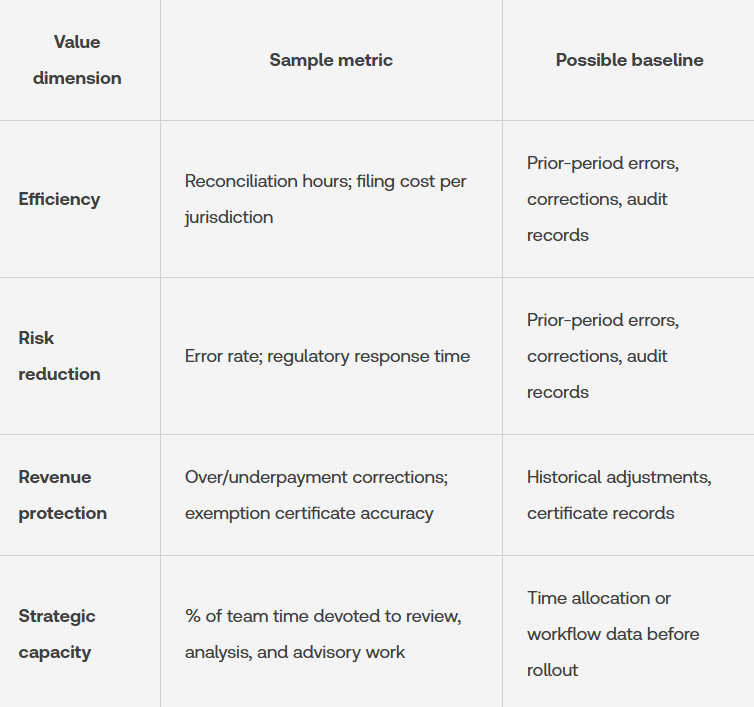
What should you track for each kind of AI value?
How do you set a baseline before rolling out AI?
How many tax teams measure AI ROI today?
How do you build a defensible AI business case?
What should indirect tax leaders measure first?
What is AI ROI in indirect tax?
AI ROI in indirect tax is the measurable change in tax performance after an AI investment, compared with a baseline set before rollout. It covers efficiency, risk reduction, revenue protection, and strategic capacity. Some of that converts directly into dollars while the rest acts as a leading indicator of long-term value.
Usage and satisfaction scores show adoption. They don’t show what changed, which is what ROI needs to establish.
Why isn’t “hours saved” times labor cost enough?
That formula captures only efficiency. It misses errors AI helps prevent, tax dollars it helps protect, and what your team does with the time it gets back. A fuller view tracks all four kinds of value.
The efficiency gain is real. The Contribution Gap, a Thomson Reuters Institute report, found that 87% of organizations run across multiple systems and 85% call manual reconciliation a major challenge. The same report found that 88% of indirect tax professionals say their work contributes significantly or moderately to business performance, but only 32% rate their own function’s contribution as significant.
What should you track for each kind of AI value?
Track processing time and reconciliation hours for efficiency, error rates and regulatory response time for risk reduction, overpayment and underpayment corrections for revenue protection, and the share of team time spent on review, analysis, and advisory work for strategic capacity.
Some of these outcomes are already within tax’s reach: 63% of indirect tax functions say they directly helped avoid a regulatory penalty or business disruption in the past year, and teams already influence supply chain decisions (59%), pricing (54%), and contract terms (50%). Dan LeCompte, a Thomson Reuters industry specialist, also describes one large organization whose pre-payment invoice review found about $4 million in annual overpayments and other tax issues.
How do you set a baseline before rolling out AI?
Document the current state of the workflow before implementation, including the data that feeds into it, the effort it takes, and the outcomes you expect AI to influence. Prior-period workflow logs, error and audit records, historical adjustments, and time-allocation data all work as sources.
Without that starting point, you can’t show whether AI created value. As LeCompte puts it, “To understand whether AI is truly adding value, you need to start with the goal and understand the process you’re automating.”
How many tax teams measure AI ROI today?
Few do. Only 16% of indirect tax professionals formally measure ROI on technology investments. Across legal, tax, accounting, risk, fraud, and government, only 18% of professionals say their organizations track AI ROI, according to the Thomson Reuters Institute’s 2026 AI in Professional Services Report. In corporate tax, 41% of respondents in the 2026 Corporate Tax Department Technology Report say they measure ROI and cost savings.
Compare yourself with teams of similar size and maturity. In that same report, 81% of corporate tax departments said they were still considering AI use.
How do you build a defensible AI business case?
Use four steps:
- Baseline: Establish current state
- Pilot metrics: Define what change you will measure
- Projected value: Translate expected change into business value
- Review cadence: Compare results with the baseline over time
Then, write down the assumptions behind each projection so you can test them against real results.
Turn expected changes into dollars only where the evidence supports it. Avoided overpayments may justify a direct estimate, while more time for planning and analysis often reads better as a strategic indicator. For Thomson Reuters ONESOURCE Sales and Use Tax AI powered by CoCounsel, useful measures include time spent monitoring economic nexus and whether you validate every line item instead of spot checking. For AI-powered product classification in ONESOURCE Determination, look at classification speed and accuracy across jurisdictions. For a related view on the financial side, see How to build a business case for indirect tax process automation.
What should indirect tax leaders measure first?
Pick one or two metrics you can baseline this quarter, then track the operational change AI produces. Build toward consistent, platform-level visibility from there.
Many AI ROI “failures” are measurement failures rather than technology failures. Teams that start now will be able to show where AI pays off and make the case for what comes next.
Get the full framework
Download the white paper, Measuring AI ROI in indirect tax, for the metrics, benchmarks, and business case process in detail.