
Why the real cost of outdated tax software shows up in lost time, staffing challenges, and missed growth.
Highlights
- Nearly half of firms automate 25% or less of their tax workflow.
- Talent shortages are already constraining 40% of firms.
- Firms investing in AI and connected workflows report stronger profitability.
Every tax partner and manager who’s pitched a new technology knows the objections before they’re even said out loud: license fees, training hours, and the risk of disruption in a discipline where routine is everything. Those costs are real, and they’re easy to tally on a spreadsheet. What’s harder to visualize is the hidden cost of staying put.
That’s the comparison firms need to run: not what new software costs against what they’re paying now, but against what a “good enough” workflow actually costs them in hours, errors, staffing, and growth over a multi-year timeline. Let’s break it down.
Jump to ↓
The hidden costs of outdated tax software for CPA firms
How do AI and technology solve tax workload issues?
Do the math: a soft ROI calculator for your 1040 tax workflow
The payoff: what firms get back with an AI-powered tax suite
The verdict: is “good enough” tax software really the safer bet?
The hidden costs of outdated tax software for CPA firms
Sticking with a patchwork of older tools rarely shows up as a single line item. It shows up as time; the one resource that tax firms can’t manipulate during busy season.
Manual work still eats away most of the day
The Thomson Reuters Institute’s 2026 State of Tax Professionals Report found that 44% of firms automate no more than a quarter of their tax workflow, and just 11% automate more than half of it. With recent breakthroughs in tax preparation automation, that leaves plenty of room for the re-entry, review, and error-catching that eats into a preparer’s day.
Staff feel the squeeze
A 2025 survey by Distinct Recruitment found that stress and long hours remain a constant feature of busy season, with a pronounced ‘mid-career slump’ among seniors and managers who feel overlooked, despite firms’ efforts to improve work-life balance.
Talent gaps make it worse
The Thomson Reuters Institute’s 2026 State of Tax Professionals Report found that a chronic shortage of qualified talent remains the most persistent problem facing tax firms today, with 40% of respondents saying their firm’s capabilities are constrained or at risk because of it.
Why tax firms keep buying capacity instead of building it
Overworked firms often respond to volume the same way every year: hire seasonal staff to cover the gap. That solves the immediate capacity problem, but it comes with its own costs:
- Recruiting and onboarding temporary staff takes senior time away from client work, right when that time is scarcest
- New seasonal hires are more likely to make errors in unfamiliar, manual-heavy processes
None of these pain points show up on an invoice, but they manifest on a P&L eventually, in the form of overtime, rework, and turnover.
How do AI and technology solve tax workload issues?
The State of Tax Professionals Report found that technology adoption and firm profitability move together, and that AI has become the clear front-runner for where firms want to put their investment dollars.
- 57% of respondents say AI is now their top investment priority, up from 35% just two years ago
- 65% cite greater use of technology as one of the most common tactics for improving profitability
- 50% say spending too much time on low-value, low-margin work is their top barrier to profitability
— Thomson Reuters Institute, 2026 State of Tax Professionals Report
That’s the same mechanism that plays out in any firm running 1040s through disconnected tools: less time moving data, fewer errors to fix later, and more capacity without adding headcount.
Do the math: a soft ROI calculator for your 1040 tax workflow
Here’s a simple way to frame it for your own firm. Take the number of 1040s you file, multiply by the average hours per return, and multiply that by your average loaded staff cost per hour. That’s your baseline. But the variables make all the difference. Here are some factors to keep in mind when assessing your efficiency and profitability.
Manual, poorly integrated workflow
- More re-entry between source documents, prep software, and review tools that don’t talk to each other
- Context switching between disparate programs
- Higher risk of transposition and omission errors that surface during review, or worse, after filing
- Deadlines that depend on manual status checks and follow-up emails
- Senior staff pulled into low-value data entry instead of review and advisory work
- LLMs not integrated with your software that spit out unverified results
- Training and implementation that require a new contact for every standalone program
AI-powered, single-suite workflow
- Data flows from source documents into the return with far less manual handling
- Fewer handoffs between disconnected tools means fewer places for errors to creep in
- Automated status tracking replaces manual chasing during the busiest weeks of the year
- Preparers and reviewers spend more of their time on judgment calls, not data movement
- Automated document drafting and research is trained on authoritative content and integrated with your internal documentation
- Easy access to support and training from a single, dedicated technology partner
What does that difference look like in practice? Here are some concrete and anecdotal figures to illustrate:
“We use [Thomson Reuters] CoCounsel day to day and this saves a ton of time. What would take an hour to do, CoCounsel can do in the matter of five minutes.”
Partner, Harris, Hardy & Johnstone, P.C
“With [Thomson Reuters] 1040SCAN PRO I’d [say] that I easily saved 50-75% of my time.”
Sassetti LLC
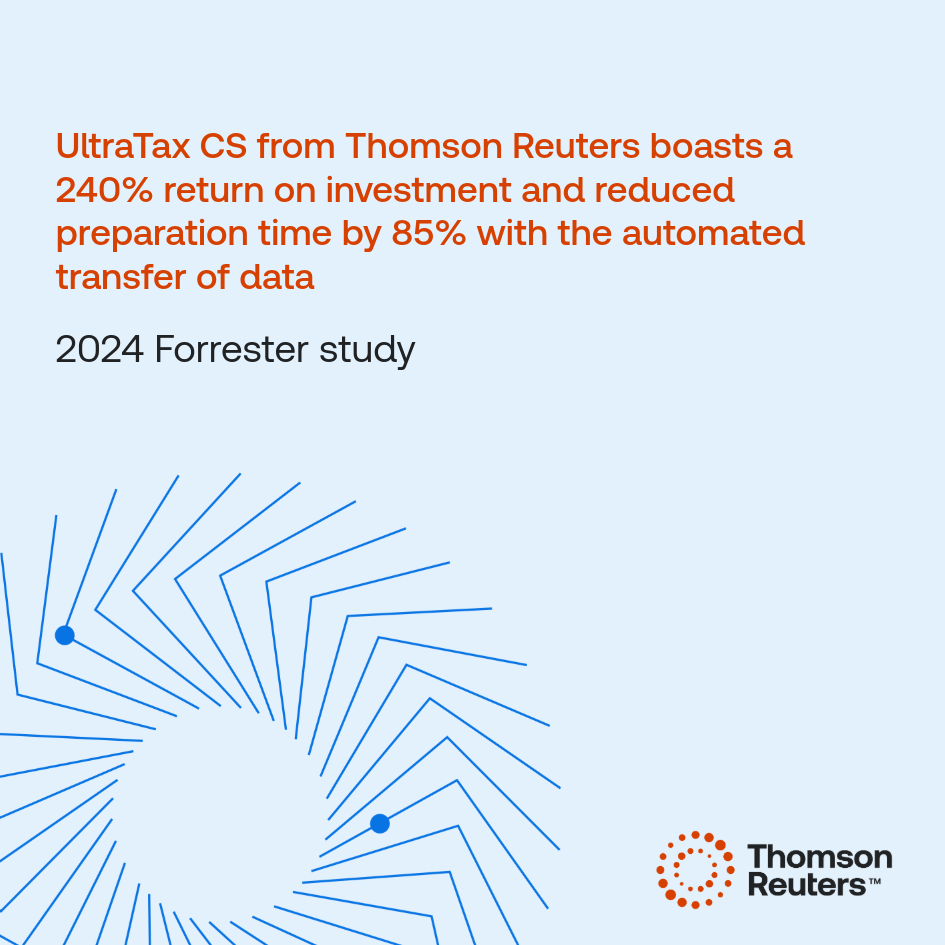
Our own ROI calculator uses SurePrep’s document coverage and review efficiency to give you a custom estimate. Find out your potential savings with one simple equation!
Discover how much time your firm may save by using SurePrep to maximize efficiency and automate tax workpaper preparation.
SurePrep ROI calculator
The payoff: what firms get back with an AI-powered tax suite
Firms that treat AI as a multi-year strategy (opposed to a one-off tool) are noticing the difference. The Thomson Reuters Institute’s Future of Professionals Report 2026 found that well-planned implementation separates firms that see results from firms that don’t.
- 74% of professionals now use AI several times a week
- 66% of professionals at firms with a named AI strategy say AI is meeting or exceeding expectations for creating value at work
- Just 22% say the same at firms without an active strategy
— Thomson Reuters Institute, Future of Professionals Report 2026
That’s the other side of the soft ROI calculator: not just what “good enough” costs you today, but what a connected, automated workflow gives back, in hours, in accuracy, and in the ability to grow revenue without growing headcount.
The verdict: is “good enough” tax software really the safer bet?
“Good enough” tax software rarely announces its true cost. It arrives quietly, in an extra hour per return, a missed deadline during the busiest week of the year, a senior preparer who burns out and leaves, or a seasonal hire who needs more oversight than the work saved.
Run the comparison honestly, including the hours, the errors, and the staffing costs on both sides, and the short-term cost of upgrading starts to look a lot smaller than the long-term cost of standing still.
If you’d like to learn more about calculating the cost of manual processing vs. tax automation, check out our in-depth strategy guide for cost analysis, ROI calculations, and implementation tips.

Know your tax workflow ROI
Find out where firms’ manual processes are hurting profitability and learn why automation is the operational answer for ROI gains
Access study ↗