
What the proposed legislation means for taxpayers, advisors, and IRS enforcement going forward
Highlights
- Aligns tax treatment of digital assets with traditional financial instruments to eliminate inconsistencies and confusion.
- Introduces clearer reporting and compliance expectations for taxpayers, exchanges, and advisors.
- Aims to close enforcement gaps while supporting broader adoption of digital assets within existing tax frameworks.
The Digital Asset Protection, Accountability, Regulation, Innovation, Taxation, and Yields (PARITY) Act (H.R. 8899) was introduced May 19, 2026 by a bipartisan group led by Reps. Max Miller (R-OH) and Steven Horsford (D-NV). The bill proposes a sweeping new tax framework for digital assets — and for tax professionals already managing new digital asset tax reporting requirements, it adds both clarity and urgency.
Jump to ↓
What does the PARITY Act cover?
PARITY Act vs. CLARITY Act: What’s the difference?
How the PARITY Act affects taxes — and what to do now
How CoCounsel Tax simplifies digital asset reporting requirements for accountants

Get exclusive Checkpoint content
Sign up to receive the latest tax and accounting news sent to your inbox each week.
Redeem offer ↗What does the PARITY Act cover?
The legislation addresses six major areas where current law has left both taxpayers and practitioners without reliable guidance.
Wash sale and constructive sale rules
The bill extends the wash sale rules under IRC § 1091 to digital assets, closing what sponsors call the “fake-loss loophole.” Under current law, a taxpayer can sell a digital asset at a loss, immediately repurchase the same asset, and still claim the deduction. Something stock investors can’t do.
If enacted, a 30-day waiting period would apply before a repurchased asset qualifies for loss treatment. The bill also extends constructive sale rules under IRC § 1259 to prevent investors from locking in gains without triggering a taxable event.
Staking and mining reward deferral
One of the bill’s most consequential provisions addresses so-called “phantom income” — the practice of taxing staking and mining rewards the moment they are credited to a wallet, even when the tokens aren’t liquid enough to cover the bill. The PARITY Act gives taxpayers an election to defer those rewards as ordinary income for up to five years, or until the assets are sold or transferred.
Stablecoin tax relief
A new “deemed-basis rule” would treat regulated, dollar-pegged payment stablecoins — those meeting the definition under the GENIUS Act and acquired within 1% of $1.00 — the same as cash. This removes the obligation to track and report minor gains or losses on routine stablecoin transactions. Professional dealers and traders are explicitly excluded.
Digital asset lending
The bill extends the securities-lending framework under IRC § 1058 to qualifying digital asset loans, so that lending a digital asset is not treated as a taxable sale.
Charitable contributions
A two-track system distinguishes between liquid assets (like Bitcoin or Ethereum with high trading volume, which would require no appraisal) and illiquid or speculative crypto (where deductions are capped at the charity’s actual sale proceeds).
Mark-to-market election
Professional digital asset dealers and active traders would gain access to a mark-to-market election, aligning their tax treatment with existing rules for securities markets.
PARITY Act vs. CLARITY Act: What’s the difference?
Both bills are moving through Congress simultaneously, and while they’re easy to confuse, they address distinct aspects of digital asset regulation.
- The CLARITY Act is primarily a market structure bill. It focuses on how digital assets are classified (as commodities vs. securities), which regulator (the SEC or the CFTC) has jurisdiction over which assets, and what rules exchanges and issuers must follow. Its impact lands mainly on the regulatory and compliance side of the industry.
- The PARITY Act is a tax bill. It doesn’t change how assets are classified or which agency oversees them, but rather how transactions are taxed. Where the CLARITY Act defines the rules of the road for digital asset markets, the PARITY Act determines what tax treatment applies when those markets are used.
For tax professionals, the PARITY Act is the more operationally significant legislation. However, the two are linked: the PARITY Act’s stablecoin relief provisions rely on the definition of a “regulated payment stablecoin” established under the GENIUS Act — the same regulatory framework the CLARITY Act intersects with. Staying current on both is essential for advising clients accurately.
How the PARITY Act affects taxes — and what to do now
If passed, the PARITY Act would add another layer of structural change on top of existing obligations. Here are some of the ways in which digital asset tax reporting requirements for accountants could be affected:
- Audit client portfolios for wash sale exposure: Clients currently using tax-loss harvesting strategies in crypto may need to unwind or restructure those positions before any effective date.
- Document staking elections clearly: The new deferral option will require careful tracking of reward receipt dates, fair market values, and any dispositions within the five-year window.
- Flag charitable crypto donations: Clients planning gifts of digital assets need to know which track applies and whether a written acknowledgment from the charity will be required.
- Revisit stablecoin transaction records: If the deemed-basis rule passes, clients who have been meticulously tracking small stablecoin gains may be able to simplify their records going forward — but only for qualifying stablecoins.
- Watch the effective date: BDO analysts have noted it may be possible to reset basis or restructure positions before enactment. Timing matters.
How CoCounsel Tax simplifies digital asset reporting requirements for accountants
Your clients will likely have questions about digital asset reporting requirements in the upcoming season. To answer them effectively, you’ll need to stay informed. CoCounsel Tax from Thomson Reuters gives tax professionals instant access to AI-powered expert-backed research built on Checkpoint content. CoCounsel Tax can help your team:
- Research the PARITY Act’s tax mechanics: Get clear, citation-backed answers on how provisions like the wash sale extension and staking deferral election interact with existing IRC sections.
- Track IRS guidance in real time: Stay on top of Form 1099-DA updates, proposed regulations, and agency announcements as they’re issued — without manual monitoring.
- Standardize client communications: Build consistent, firm-wide responses to common client questions on staking, stablecoin treatment, and charitable donations of digital assets.
- Identify planning opportunities before enactment: Research effective dates and transitional rules so clients can act on basis-reset or restructuring options while the window is open.
As the rules around digital assets continue to shift, firms that build research and standardization workflows around tools like CoCounsel Tax will be better positioned to serve clients — and protect themselves from the compliance risks that come with getting this wrong.
To learn more about CoCounsel Tax and see it in action, check out the stats, testimonials, and video demos on our product page!
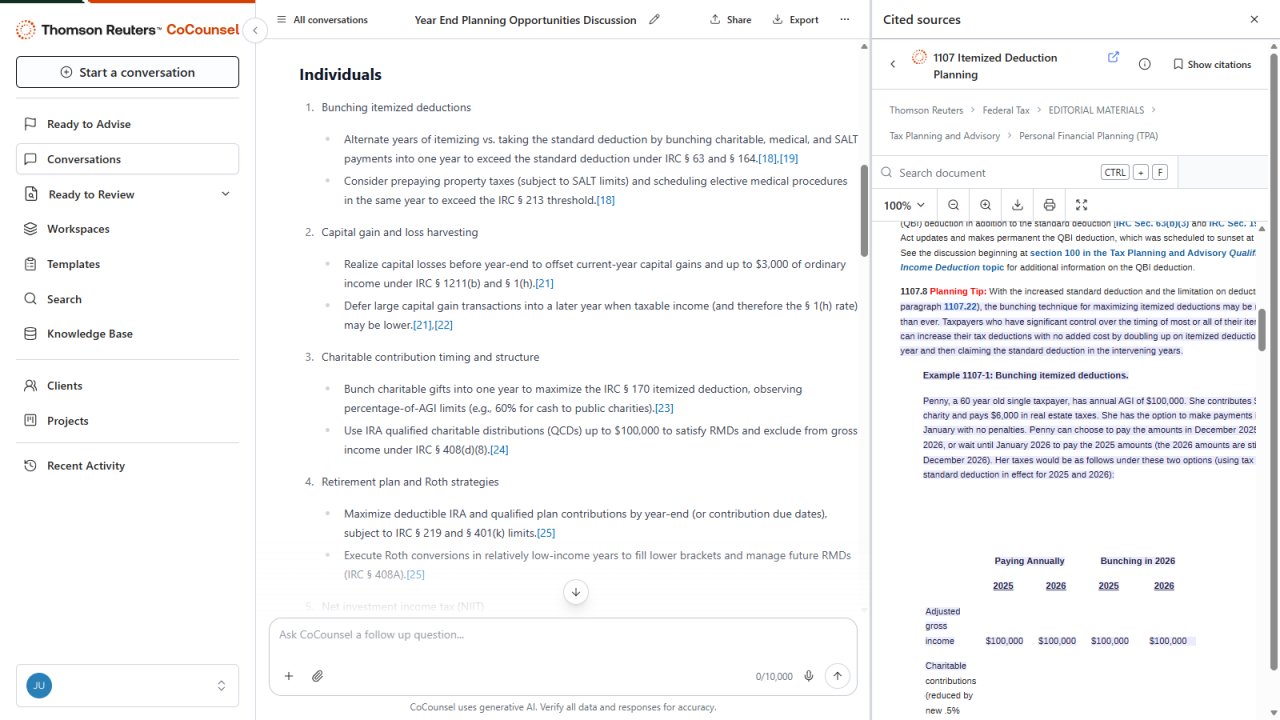
See how CoCounsel Tax adds clarity
Get a free personalized demo to see how CoCounsel Tax fits with your workflow!
Book your demo ↗