
Find out what OPR Alert 2026-19 has do say about AI use in the tax profession
Highlights
- How the IRS is applying existing Circular 230 standards to AI
- Why AI is recommended as a support tool rather than a fully autonomous agent
- Why the IRS recommends efficiency savings be passed on to clients
The IRS Office of Professional Responsibility (OPR) has issued its first formal guidance on AI, applying already professional standards under Circular 230 to the use of AI tools in the tax profession. Here’s what that means for tax and accounting firms across the country.
Jump to ↓
Did the IRS create new rules for AI use?
A client service opportunity hiding in plain sight
How CoCounsel Tax helps you meet the IRS standard
How will IRS guidelines affect AI for tax pros?
Did the IRS create new rules for AI use?
No. OPR Alert 2026-19 (released on June 24, 2026) instead aligns the IRS requirements for AI with the obligations practitioners already carry under Circular 230. These guidelines specifically focus on GenAI tools capable of producing documents, research, analysis, and tax advice with minimal human input.
What does OPR guidance cover?
The alert addresses six areas of Circular 230 as they apply to AI-assisted tax work:
- Due diligence in preparing and filing tax documents (§ 10.22)
- Competence and technological literacy (§ 10.35)
- Firm procedures and supervisory responsibilities (§ 10.36)
- Requirements for written advice (§ 10.37)
- Fee practices and client billing (§ 10.27)
- Protection of taxpayer data under IRC §§ 6713 and 7216(a)
The OPR’s core message: AI should assist, not replace, professional judgment. Final decisions must always rest with qualified professionals.
Due diligence: you can’t outsource it to an algorithm
Under § 10.22, practitioners must thoroughly review every AI-generated document before it reaches a client or the IRS (including verification of facts, citations, and calculations). The guidance cites real-world cases in which lawyers were sanctioned for submitting filings with fabricated citations (“hallucinations”) and warns that tax professionals face the same exposure. Penalties have included financial sanctions, public censure, mandatory ethics courses, and disciplinary referrals to state licensing authorities.
Under the Circular 230 AI due diligence requirements, AI output should be treated as a starting point, never a finished product.
Competence now includes technological literacy
Section 10.35 requires practitioners to have the knowledge, skill, and preparation necessary for each matter they handle. The OPR now makes technological literacy part of that standard. Practitioners must:
- Understand how AI systems generate content, including their limitations
- Recognize where errors, bias, or unreliable outputs may arise
- Evaluate whether AI output is suitable for use in IRS matters
The OPR defines AI as the use of machines in a way that mimics human cognitive skills, including judgment, perception, and prioritization. It also notes that unlike legacy software, GenAI can make discretionary decisions without human interaction, which is why understanding it is now a competence requirement. A lack of technological literacy, the OPR says directly, could lead to improper advice or flawed filings.
Tax firm leaders carry compliance obligations too
Section 10.36 places responsibility on firm leadership to ensure adequate procedures are in place for all staff. Satisfying the IRS requirements for AI encourages both individual practitioner awareness and systemic policy. Firms must:
- Train staff comprehensively on AI risks and requirements
- Establish documented protocols for secure data handling and accuracy monitoring
- Vet outsourced or third-party AI tools before deployment
Firm leaders cannot claim ignorance. If staff use consumer AI tools without oversight, that’s a firm-level compliance failure.
Written advice and client data
Under § 10.37, any AI-drafted written advice must rest on reasonable factual and legal assumptions, independently verified. Relying on AI outputs without that verification may constitute unreasonable reliance.
The OPR is equally firm on data protection. IRC §§ 6713 and 7216(a) impose civil and criminal penalties for unauthorized disclosure of tax return information. Practitioners must use only secure, enterprise-approved AI systems. Where § 7216-protected information is involved, specific signed client consent is generally required before sharing data with any AI tool.
A client service opportunity hiding in plain sight
The most forward-looking section of OPR Alert 2026-19 pertains to its treatment of billing. Under § 10.27(a), charging an unconscionable fee is prohibited — and the OPR now makes explicit that billing clients for manual labor time that AI has replaced could cross that line.
The guidance is clear: cost savings from AI should be passed on openly, with billing practices that reflect the efficiencies gained. Practitioners should disclose the AI activities performed and fairly credit any cost reductions to the client’s account. The OPR explicitly calls out double-billing (charging for AI-assisted work and then billing again as if the task were done manually) as a potential violation. A noticeable pattern of billing differentials, the OPR warns, may constitute a § 10.27 violation.
Shortsighted firms might see this as an annoyance, but forward-thinking professionals can leverage it as an opportunity to communicate value, improve client satisfaction, and upsell clients on consultative engagements.
How CoCounsel Tax helps you meet the IRS standard
Meeting the IRS requirements for AI means being able to demonstrate, when scrutiny comes, that your work was reviewed, verified, and grounded in authoritative sources.
Thomson Reuters CoCounsel Tax is purpose-built for exactly this. Unlike consumer AI platforms, it’s connected to a comprehensive tax research library, including:
- Checkpoint
- IRS code
- internal documentation via Sharepoint
Every answer is tied to citable, verifiable authority, giving practitioners the paper trail needed to justify your work in the face of due diligence obligations.
Research and automation that tax pros can trust
CoCounsel Tax also keeps client data within an enterprise-grade secure environment, directly addressing the confidentiality requirements under IRC §§ 6713 and 7216(a) — no risky uploads to public platforms, no consent workarounds.
When a client or regulator asks how a position was reached, practitioners using CoCounsel Tax can point to the research, the authority, and the reasoning: documented, auditable, and defensible.

White paper
Not all AI is created equal. What data is your solution learning from?
Read white paper ↗How will IRS guidelines affect AI for tax pros?
The OPR alert doesn’t change the rules. Instead, it confirms that IRS requirements for AI are grounded in obligations that practitioners already hold. Before your next AI-assisted filing or client communication, ask yourself:
- Have you independently verified every fact, citation, and calculation the AI produced?
- Do you understand how the AI tool generates content and where it may fail?
- Is client data handled only through secure, enterprise-approved systems?
- Does your firm have documented AI training and data protocols in place?
- Does your billing reflect the actual efficiencies AI has created?
The practitioners who get this right will meet the compliance bar and build the kind of client trust that sets them apart.
To learn more about how CoCounsel Tax stands apart from consumer-grade AI solutions, check out our information page and schedule a personalized demo today!
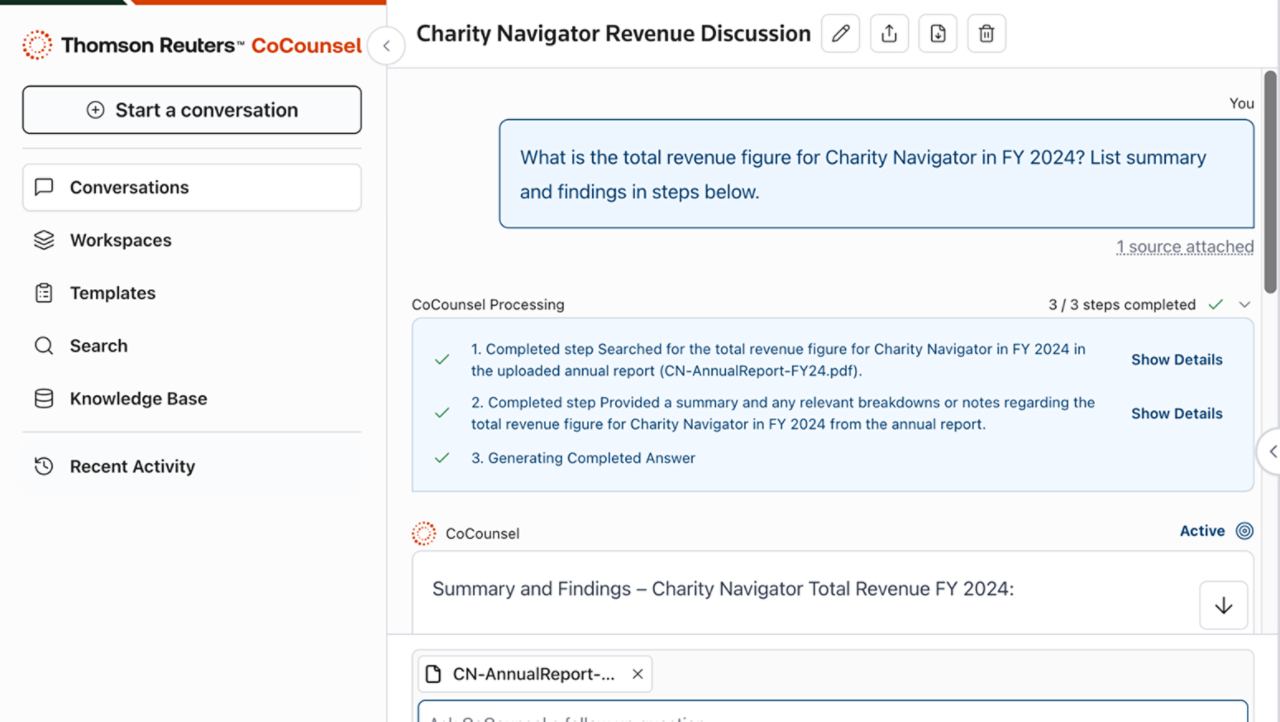
See how CoCounsel Tax works for you!
Instant authoritative research, automated workflows, enhanced analysis. It's all just a click away.
Get your free demo ↗