
Highlights
- Tax firms face a critical choice between adopting isolated AI point solutions or investing in integrated end-to-end platforms.
- Point solutions offer quick wins but create long-term inefficiencies, while unified platforms streamline workflows and enhance compliance.
- Strategic evaluation of firm size, growth, and security needs is essential for maximizing AI ROI in tax practices.
Firms that have already deployed AI are discovering an unexpected problem: the more point solutions they add, the more time their staff spends managing tools instead of serving clients. The question isn’t whether to invest in AI. It’s whether to build that investment piece by piece or all at once.
This guide provides a framework for evaluating both strategies, with an honest look at where each approach fits — and where each falls short.
Jump to ↓
Point solutions vs. platform strategy: What’s the difference?
Why point solutions create long-term challenges for tax firms
How end-to-end AI tax platforms drive ROI
A strategic framework for AI investment decisions
From fragmented tools to unified intelligence
Making your tax firm’s AI platform decision
Point solutions vs. platform strategy: What’s the difference?
Point solutions are single-purpose AI tools designed to address specific challenges within your tax practice. These might include AI-powered document review software, automated client intake systems, or specialized research assistants. Examples in today’s market include standalone tools for tax code research, isolated document analysis platforms, or single-function compliance checkers.
The initial appeal is obvious: lower upfront costs, targeted functionality, and the ability to test AI capabilities without a major commitment. Many firms start here, purchasing individual tools as specific pain points emerge.
End-to-end agentic AI platforms
Comprehensive AI platforms take a different approach, integrating multiple capabilities into a unified ecosystem. Rather than automating individual tasks in isolation, they create a connected workflow that spans research, analysis, document creation, and knowledge management — with AI agents that can move work across each stage without manual handoffs.
What is agentic AI? In practical terms, it means AI that doesn’t just answer a question — it takes a sequence of actions on your behalf, maintains context across a matter, and routes work to the right next step automatically.
CoCounsel Tax and Audit exemplify this approach, combining legal and tax research (built on Westlaw’s authoritative database), document analysis, workflow automation, and firm-wide knowledge sharing in a single environment.
When point solutions make sense
Not every firm needs a platform from day one. Point solutions are a reasonable starting point if your firm is small (under 20 professionals), your AI use cases are genuinely isolated with no data sharing required between them, or you need to pilot AI capabilities before committing to a larger investment. The risk is that what starts as a targeted tool tends to multiply — and the integration costs grow with each addition.
Why point solutions create long-term challenges for tax firms
The hidden costs of point solutions become apparent as your AI toolkit grows. Each new tool creates another data silo, requiring manual data transfer between systems and creating workflow gaps that reduce efficiency rather than enhancing it.
Consider a typical scenario: your research tool finds relevant precedents, but you must manually transfer that information to your document analysis platform, then again to your client communication system. Each handoff introduces potential errors and adds time.
IT overhead multiplies as well. Managing multiple vendor relationships, security protocols, and integration requirements can quickly overwhelm smaller firms and strain resources at larger practices.
Scaling limitations
Point solutions that seem cost-effective for a few users become expensive as your firm grows. Per-seat licensing across multiple tools can exceed the cost of a comprehensive platform, while training overhead multiplies as staff must master different interfaces and workflows. Staff switching between multiple AI tools face constant context switching — reducing the productivity gains AI should provide.
Security and compliance considerations
Each additional platform in your stack introduces new security protocols to manage and potential vulnerabilities to monitor. Data governance becomes increasingly complex when client information flows through multiple systems with different security standards and audit capabilities. For tax professionals, where client confidentiality and regulatory compliance are paramount, a unified platform simplifies this management significantly.
How end-to-end AI tax platforms drive ROI
Integrated platforms eliminate the friction between AI-powered tasks. Research flows seamlessly into document creation, which connects directly to client communication and case management. Your team works within a single environment where AI agents can access the full context of each matter.
This unified approach enables more sophisticated automation. Instead of optimizing individual tasks, you’re optimizing entire workflows. The platform learns your firm’s preferences, standard language, and decision patterns, becoming more valuable over time. In practice, firms that move from fragmented tools to a unified platform typically report a 40% reduction in research time and a 60% reduction in manual handoffs between systems — with the added benefit of a unified audit trail that simplifies compliance reporting.
Economies of scale
Consolidated licensing and vendor management reduce both hard costs and administrative overhead. Instead of negotiating with multiple AI vendors, you develop a strategic partnership with a single platform provider who understands your tax practice’s evolution.
Training time decreases significantly when staff learn one comprehensive system rather than multiple specialized tools. Support becomes simpler, with one point of contact for technical issues or feature requests, and enterprise-grade security and compliance capabilities are built in rather than bolted on.
Agentic AI in practice
CoCounsel Tax and Audit demonstrate what integrated agentic AI looks like day-to-day: research insights automatically inform document analysis, which in turn surfaces relevant precedents and compliance considerations. The platform becomes an extension of your team’s expertise rather than just a collection of tools.
A strategic framework for AI investment decisions
| Evaluation criteria | Point solutions | Integrated platform |
| Initial investment | Lower upfront cost | Higher initial investment |
| Long-term TCO | Higher due to complexity | Lower through efficiency |
| Implementation time | Faster per tool | Longer initial setup; faster long-term |
| Scalability | Limited and expensive | Built for growth |
| Data integration | Manual/complex | Native and seamless |
| User adoption | Multiple learning curves | Single, consistent experience |
| Security management | Multiple protocols | Unified enterprise security |
| Vendor relationships | Multiple contracts | Single strategic partnership |
Key questions for decision-makers
Before choosing your approach, work through these questions as a leadership team:
-
- What’s our three-year growth projection, and how will our AI needs evolve?
- How important is data continuity and context across our workflows?
- What’s our tolerance for managing multiple vendor relationships and integration challenges?
- Do we need enterprise-grade security and compliance capabilities?
- How much staff time can we dedicate to managing and optimizing multiple AI tools?
If you answered “significant,” “high,” or “limited” to most of these, an integrated platform is likely the right fit. If your needs are narrow and stable, starting with a point solution is a defensible choice — with a clear plan for what comes next.
From fragmented tools to unified intelligence
Jansen & Company CPAs recently moved from a fragmented AI approach to an integrated platform strategy. The firm’s challenge wasn’t a lack of AI tools — Senior Tax Managing Director Matthew M. Hauger had already experimented with several AI products, including ChatGPT. The problem was that generic AI tools lacked the authoritative, tax-specific sources needed for professional-grade research. As Hauger explained:
“I don’t want you to pull an article from some guy in a basement.”
The firm implemented CoCounsel Tax, built on Thomson Reuters’ Checkpoint-verified sources, creating a unified AI-powered research environment grounded in trustworthy content. The results were material: faster pathways to answers for complex cases involving corporate conversions, multistate rentals, and international tax planning, with structured, source-linked research that enhanced client communication and confidence. As Hauger noted:
“It saves us time, but not just time — there’s an accuracy and a confidence element there.” He found that while other AI tools were helpful for brainstorming, “CoCounsel shines for deep research. Nobody can touch it.”
Key factors in their success: choosing professional-grade AI with authoritative sources over generic alternatives, focusing on complex research scenarios where accuracy is paramount, and maintaining the ability to validate recommendations with confidence rather than relying on assumptions or legacy practices.
Making your tax firm’s AI platform decision
Point solutions may offer lower initial costs, but integrated platforms provide the foundation for sustainable competitive advantage. The firms that will lead in the next five years are those treating AI as infrastructure, not a collection of add-ons.
Consider total cost of ownership, not just initial investment. Factor in the hidden costs of integration, training, and vendor management that come with a fragmented stack. Most importantly, choose technology that will evolve with your firm’s needs rather than constrain them.
Explore CoCounsel Tax and Audit to see how an integrated platform can eliminate point-solution complexity and maximize your return on AI investment.
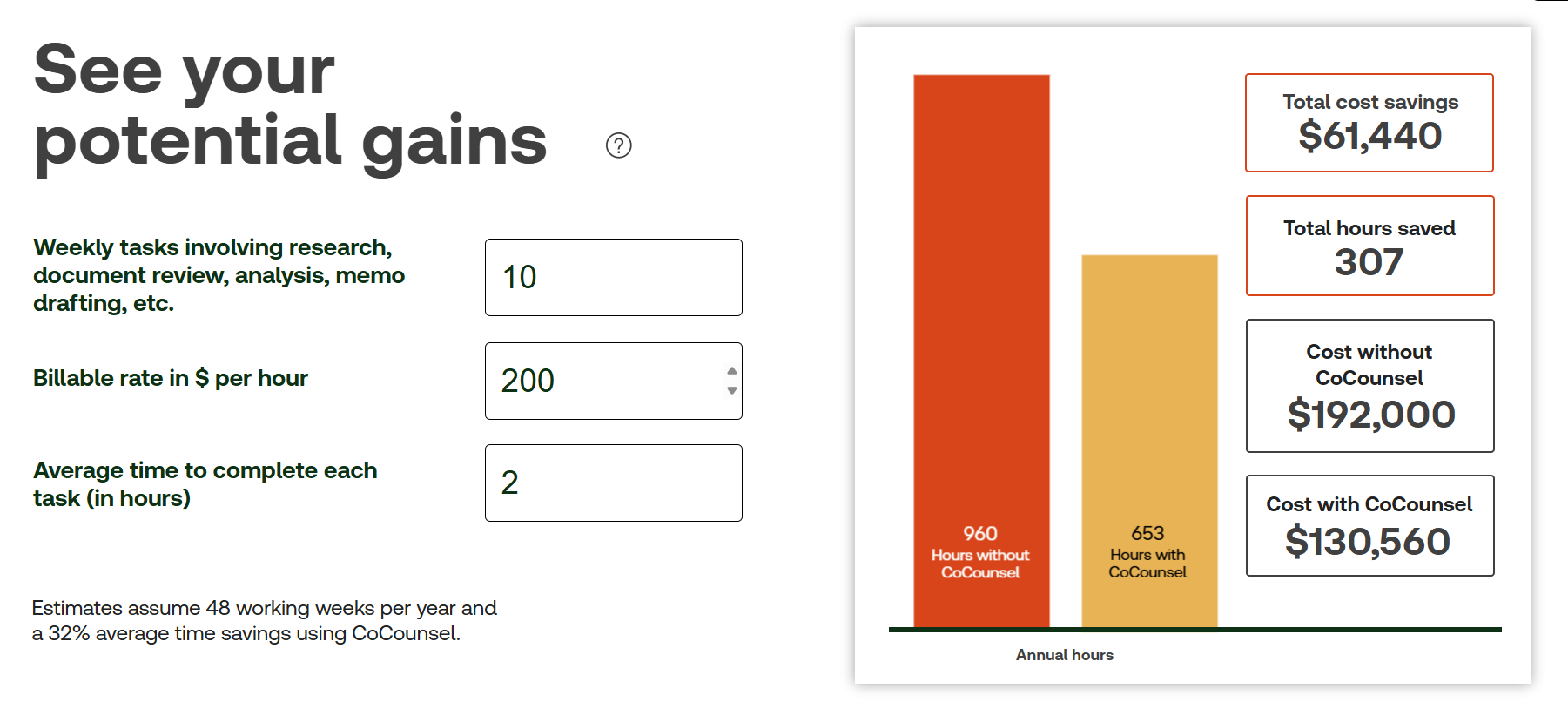
ROI calculator
Discover how much time your firm may save with CoCounsel Tax & Audit
Try calculator ↗