Streamline compliance, mitigate risks, improve productivity, and innovate your tax practice with Fiduciary-Grade AI™.
Highlights
- How AI is already embedded in tax research and compliance workflows, helping professionals stay ahead of regulatory change
- Why AI-powered automation improves risk mitigation, data accuracy, and decision-making in highly regulated environments
- What firms must do now, including governance, oversight, and measurement, to use AI responsibly and strategically
As regulatory bodies continue to sort out the tax implications of the One Big Beautiful Bill Act (OBBBA), keeping up with compliance has become part of the daily grind for tax and accounting firms. But what if technology could help?
According to the Thomson Reuters 2025 Future of Professionals Report, 79% of tax, audit, and accounting pros expect AI to have a transformational impact on their industry within the next five years. Yet only 14% of tax firms currently have a defined AI strategy in place. For your firm, that gap should spell enormous opportunity, especially for keeping up with changing tax laws.
Jump to ↓
Tax research as a top AI use case
How AI can track new tax laws for you
Is AI accurate enough to rely on for tax research and compliance decisions?
Finding your AI tax law strategy

Tax research as a top AI use case
Tax research stands out as the leading AI use case for tax professionals, with 69% of tax firms saying it is an area of interest, according to the 2026 AI in Professional Services Report.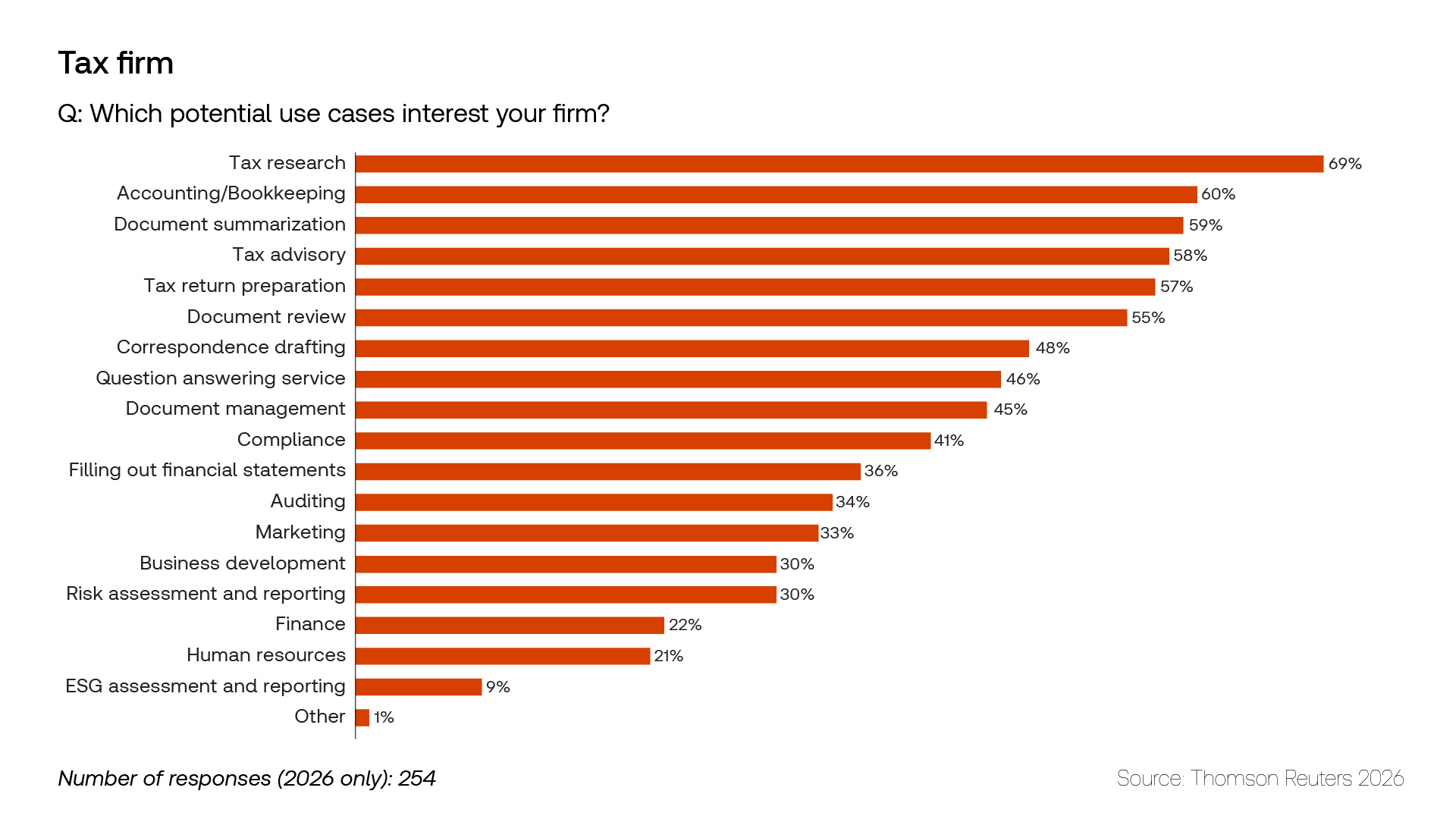
This is a clear signal that firms see AI as especially valuable where tax work is most knowledge-intensive and time-sensitive. For tax professionals, research is not simply about finding an answer; it is about identifying the right authority, understanding how guidance applies to a client’s facts, and doing so quickly enough to support confident advice.
Tax rules continue to evolve across federal, state, local, and international jurisdictions, creating constant pressure on firms to monitor changes and translate them into practical client guidance. AI-powered tax research tools can help tax professionals surface relevant statutes, regulations, rulings, cases, and commentary faster, while also summarizing complex developments and highlighting issues that may require deeper review.
How AI can track new tax laws for you
Staying current on tax law has never been a simple task, but legislation like the One Big Beautiful Bill Act (which permanently extended TCJA provisions while introducing new deductions for tips, overtime, and seniors, and raising the SALT cap to $40,000) illustrates just how quickly the ground can shift under a tax pro’s feet.
Here’s how to make the most of AI when tracking tax legislation:
- Start with authoritative source feeds, then layer AI on top. Tax teams can create saved searches and alerts on official sources such as Congress.gov for bills involving terms like “Internal Revenue Code,” “IRS,” “deduction,” “credit,” “excise tax,” “partnership,” “S corporation,” “estate tax,” or industry-specific terms. Congress.gov supports saved-search alerts and bill alerts, including notifications when legislation changes status. Firms can also subscribe to IRS e-News for Tax Professionals and other IRS topic-specific updates to capture new guidance, releases, and tax law updates.
- Use AI to filter the noise. Once alerts are flowing in, tax pros can have AI summarize each new bill, IRS notice, proposed regulation, or court development into a short internal brief: what changed, effective date, affected taxpayers, affected Code sections, planning implications, and open questions. The goal is not just “tell me something changed,” but “tell me whether this matters to my clients.” For example, an AI workflow could tag updates by practice area — individual, corporate, SALT, international, estate and gift, payroll, exempt organizations, credits and incentives — and route them to the right partner or manager.
- Create a client-impact checklist. Tax professionals can set up AI prompts or workflows that compare new developments against firm-defined client segments. For example: “Review this proposed bill and identify whether it may affect pass-through business owners, real estate investors, high-net-worth individuals, manufacturers, or nonprofit clients.” AI can then produce a practical triage list: clients to review, returns or positions that may be affected, deadlines to monitor, and whether the item is immediate, proposed, or merely worth watching.
- Build a repeatable weekly “tax law watch” workflow. A practical setup might look like this: official alerts come into a shared inbox; AI summarizes and categorizes each item; a tax manager reviews the AI output; relevant items are added to a tracker; and client-facing opportunities are assigned to owners. The tracker can include columns such as source, jurisdiction, topic, status, effective date, client impact, responsible reviewer, and recommended action.
- Keep a human review step. AI can make tax law tracking faster and more proactive, but it should not be the final authority. Tax professionals should use AI to identify, summarize, and prioritize developments, then verify conclusions against primary sources before advising clients. That combination — automated monitoring plus professional judgment — is what helps firms stay ahead of regulations without getting overwhelmed by the volume of new tax information.
Is AI accurate enough to rely on for tax research and compliance decisions?
The honest answer depends on which AI you’re using. General-purpose tools are trained on broad, unverified data; this is useful for drafting emails, but it is less suited for determining whether a client’s tip income qualifies for the OBBBA deduction.
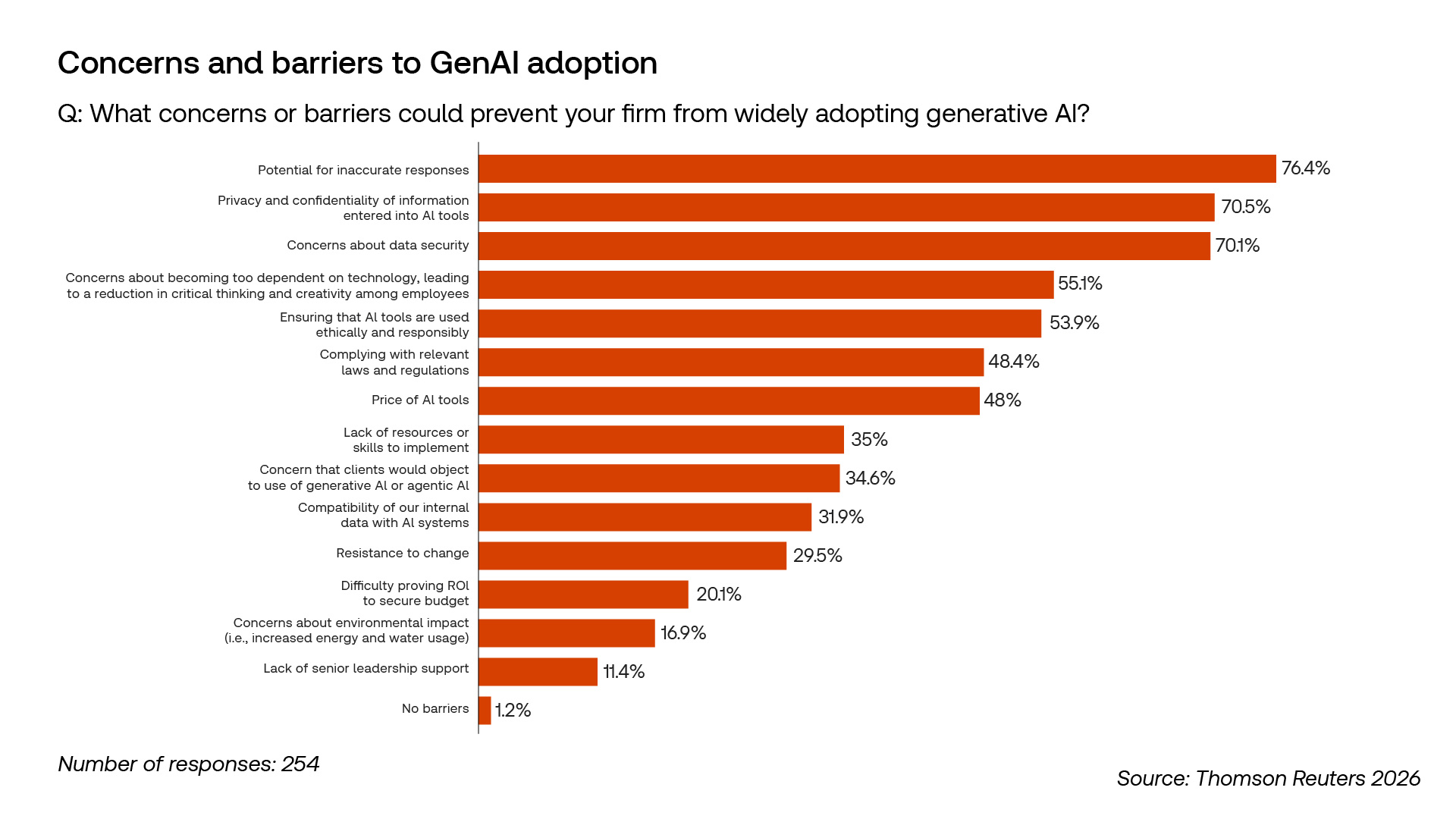
The stakes in tax work are too high for that kind of ambiguity, and professionals know it. 76% of tax firm respondents in our 2026 AI Report cited “Potential for inaccurate responses” as their #1 concern.
Tax-specific AI built on authoritative sources (e.g. Checkpoint) operates differently. Fiduciary-Grade AI protocols ensure that answers are grounded in verified primary sources, not pattern-matched from the open web. That distinction matters when a client’s liability or an IRS audit is on the line.
How should firms double-check AI-generated tax research results?
Even with reliable AI, verification remains a professional responsibility. A few practical approaches:
- Trace the source: Quality tax AI cites its authority. If it doesn’t, treat the output with caution
- Apply professional judgment: AI surfaces relevant guidance — the analysis still belongs to the practitioner
- Test edge cases: Run known scenarios through any new tool before relying on it for complex client work
- Stay current on limitations: AI tools evolve quickly; and so do the laws they interpret
Finding your AI tax law strategy
A strong AI tax law strategy starts with focus. Rather than trying to automate every part of the tax workflow at once, firms should begin with the areas where AI can create immediate value: monitoring new laws and guidance, summarizing complex developments, flagging affected clients, and supporting faster research. From there, tax professionals can build repeatable processes that combine AI-powered tracking with human review, ensuring that insights are timely, accurate, and grounded in professional judgment.
For tax firms, the goal is not to replace tax expertise — it is to make that expertise easier to apply at scale. By setting clear use cases, choosing reliable sources, and creating review workflows, tax professionals can turn AI into a practical tool for staying ahead of regulations. The firms that develop a thoughtful AI strategy now will be better positioned to respond quickly to change, advise clients with confidence, and keep pace with an increasingly complex tax environment.