
Not all AI is created equal, and in tax compliance, the difference is everything.
Highlights
- AI-first tax solutions infer answers from patterns; expert-first solutions execute validated rules with confidence.
- ONESOURCE automates compliance across 19,000+ jurisdictions with expert-validated content and complete audit trails.
- Touchless compliance requires AI built on authoritative tax knowledge, not statistical probability.
If you’re evaluating AI-powered indirect tax compliance solutions, you’re in a market where every vendor makes the same promises: accuracy, automation, agentic AI, expert-backed content. The language has converged, making evaluation harder and the cost of choosing wrong higher.
The question that cuts through the noise is, “When your AI agent makes a determination, does it know what the correct answer is or is it calculating what the most statistically likely answer is?”
That distinction is the entire game.
This is what Thomson Reuters calls Fiduciary-Grade AI™ — AI grounded in authoritative content, designed and tested by domain experts, and created to produce results that can be verified and audited under real-world scrutiny. In indirect tax compliance, where errors result in regulatory fines, audit exposure, and reputational risk, the standard your AI is built to matters enormously.
Jump to ↓
The problem with AI-first tax compliance
What expert-first tax compliance means
Touchless compliance: What it requires
Human-in-the-loop: Control by design, not by accident
The evaluation framework for AI tax compliance solutions
Three questions that will define your decision
The problem with AI-first tax compliance
There is a fundamental architectural difference between AI-first solutions and expert-first solutions that most vendor marketing deliberately obscures.
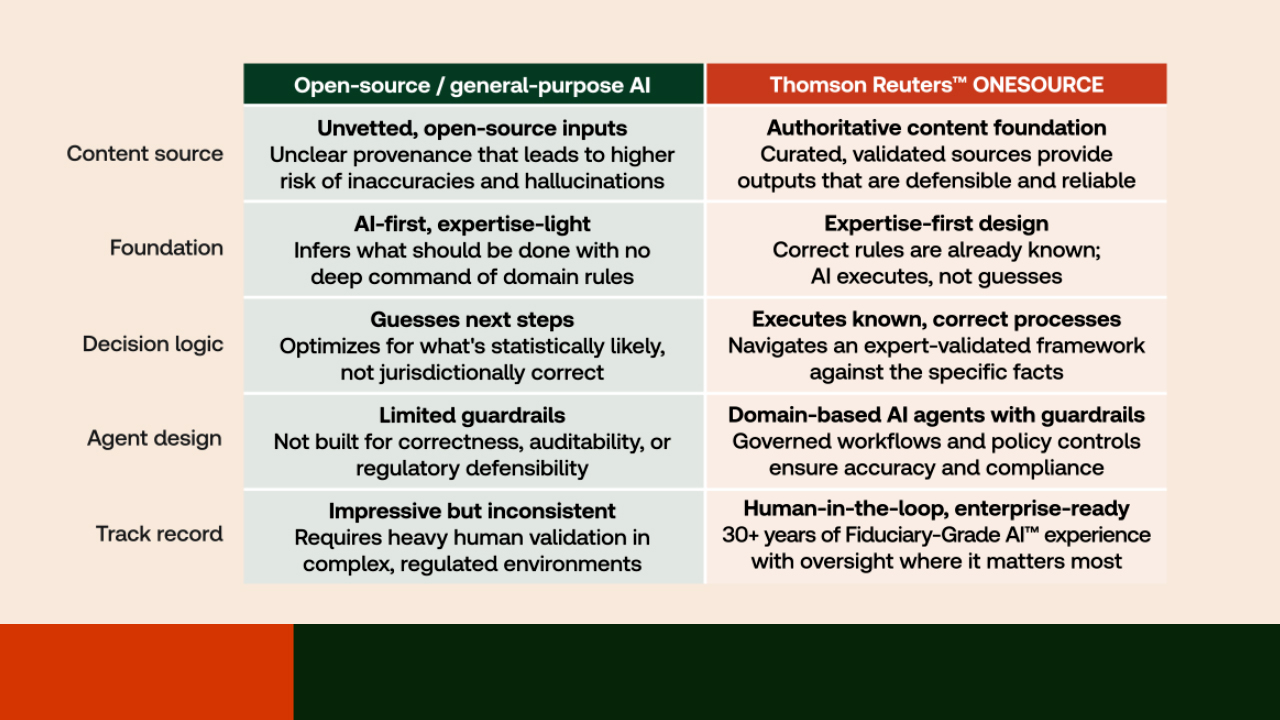
AI-first solutions treat the model as the expert. They rely on AI to infer how tax work should be done, often without real command of domain rules, jurisdictional dependencies, or regulatory nuance. When something goes wrong (and in a landscape of 19,000+ U.S. tax jurisdictions, it eventually will) the system has no authoritative foundation to fall back on. It has patterns, not answers.
The consequences are concrete. AI trained on unverified content can produce outputs that are confident and wrong, including misclassified transactions, incorrect rate applications, and compliance gaps that surface during audits, when correction costs spike. In regulated environments, an answer without a verifiable source is a liability.
Some AI agents take this risk further by operating without sufficient guardrails, optimizing for what appears statistically plausible rather than what is jurisdictionally correct. The question an untethered agent asks is, “What usually happens next?” That is the wrong question for tax compliance. The right question is, “What is correct under the rules, given the specific facts of this transaction?”
What expert-first tax compliance means
Thomson Reuters ONESOURCE is built on a different architectural principle where expertise comes first, and AI amplifies what the system already knows to be correct.
ONESOURCE Determination is built on decades of tax content developed, maintained, and validated by Thomson Reuters tax law specialists. Rates, rules, and jurisdictional nuance are researched and verified by domain experts who understand not just what the law says, but how it applies. This is proprietary, curated content that is continuously updated and backed by legal, regulatory, and professional standards.
When AI enters the picture in ONESOURCE, it is not introduced to guess at tax treatment. It is introduced to intelligently navigate this expert-validated framework at scale. The correct process has already been established. Agentic AI determines how and when to execute steps more efficiently. Decisions are automated and coordinated without compromising intent or accuracy. Think of it as giving a seasoned expert a highly capable assistant, not hiring someone who has only read about the job online.
Thomson Reuters has spent more than 30 years embedding Fiduciary-Grade AI into solutions, long before generative AI became mainstream. Today, products like CoCounsel are used by over one million professionals globally.
Touchless compliance: What it requires
ONESOURCE Sales & Use Tax AI is built around a clear operating principle: compliance should be touchless by default, manual by exception. That is not a tagline. It explains the architectural commitment that is only possible because of the automation’s foundation.
The solution automates the compliance workflow — data import, validation, tax return mapping, and filing — across 19,000+ U.S. jurisdictions, with access to 1,200+ signature-ready official returns and direct electronic filing in 33 states and Canada. Automatic monthly content updates keep forms and rates current with no manual intervention.
During the testing and iterating phases of ONESOURCE Sales & Use Tax AI, early customers saw up to a 65% reduction in time spent on routine reporting. That time doesn’t just disappear. Instead, it’s redirected to tax planning, strategy, and advisory work that drives business value. Touchless compliance at this level is only achievable when AI is executing against expert-validated knowledge, not inferring its way through jurisdictional complexity.
Human-in-the-loop: Control by design, not by accident
One version of “full automation” should concern any enterprise tax leader. This can be visualized as autonomous agents operating without accountability, making determinations that cannot be explained, defended, or audited. In regulated work, autonomy without oversight does not reduce risk. It instead concentrates it at exactly the wrong moment.
ONESOURCE Sales & Use Tax AI is designed with human oversight as a structural feature, not an afterthought. The automated workflow handles data transfer, validation, and mapping. Tax professionals retain final review and sign-off on every return. The reduction in manual intervention is what frees your experts, not what replaces them.
This design also solves the audit problem that AI-first solutions cannot. When an auditor questions a determination, “the AI made the decision” is not a defensible answer. ONESOURCE generates complete audit trails that provide transparency and documentation for every automated decision, traceable back to expert-validated content and documented rules logic. Citations and reasoning are surfaced, not hidden. Your team can stand behind every determination with confidence.
How end-to-end tax compliance excellence extends from transaction to filing in one connected portfolio
Point solutions create point problems. A tax determination engine that does not connect to your returns workflow creates reconciliation work. A returns tool that does not connect to certificate management creates exposure gaps. Compliance that operates in isolation from your broader indirect tax obligations creates blind spots that surface at the worst possible time.
ONESOURCE Sales & Use Tax AI integrates seamlessly with the Thomson Reuters broader indirect tax portfolio, including tax determination and calculation, exemption certificate management, international VAT compliance, and e-invoicing, for a complete solution from transaction to filing.
This is the end-to-end distinction that matters. ONESOURCE is not a platform that promises to connect everything eventually, but a portfolio that connects determination, returns, certificate management, and global compliance today, under a single expert-first architecture.
The evaluation framework for AI tax compliance solutions
If you are at the stage of comparing vendors, the following table reflects the architectural differences that will determine your outcomes in routine processing, audits, regulatory changes, and the strategic value your tax function delivers to the business.
Three questions that will define your decision
Before selecting any solution, ask these questions and require specific answers, not marketing language.
- Is the AI executing against expert-validated tax content, or is it inferring correct behavior from patterns? The answer determines whether your automation scales confidence or scales uncertainty.
- Does the solution give your team meaningful control and a complete, auditable record of every determination — or does “human-in-the-loop” mean your team is still doing the work the AI was supposed to do?
- Does the platform cover your full indirect tax workflow — determination, returns, certificate management, VAT, and e-invoicing — or does it solve one problem and create three others?
ONESOURCE Sales & Use Tax AI was built to answer yes to all three. When accuracy, compliance, and credibility matter, expert-first AI wins.
See how Thomson Reuters ONESOURCE Sales & Use Tax AI compares to what you’re evaluating and why it’s safer to deploy.