
A practical, step-by-step framework for moving from AI experimentation to scalable audit efficiency
Highlights
- Start with a focused pilot to validate AI’s impact on audit workflows.
- Build repeatable processes before expanding firmwide adoption
- Scale AI with governance, training, and measurable performance gains
Here’s the scenario playing out at firms across the country: Leadership buys an AI tool. Staff get a link to a webinar. An email goes out: “We have AI now. Go use it.”
Three months later, adoption is dismal. Teams are frustrated. The technology sits unused while competitors pull ahead.
This approach costs team more than just the licensing fee. It creates weeks of scattered experimentation, the opportunity lost while your team reinvents the wheel in silos, and the cultural capital spent on a failed rollout that breeds cynicism toward future innovation.
AI audit implementation doesn’t fail because of bad technology. It fails because firms skip the deliberate, phased approach that turns tools into transformation. And most critically, they skip the pilot program — the non-negotiable phase where success is actually built.
Jump to ↓
Why firms are embracing AI audit implementation
The 5-phase AI implementation roadmap
Scaling the implementation roadmap for your firm
Start your AI audit implementation journey today
Why firms are embracing AI audit implementation
The profession stands at an inflection point. In just five years, AI has moved from impressive demos to practical tools to autonomous agents. The technology that enabled ChatGPT to reach 100 million users in two months is now embedded in audit platforms, analyzing contracts, detecting anomalies, and drafting work papers at speeds that fundamentally change engagement economics.
Every firm feels the opportunity. Recruitment depends on it. Top talent expects AI capabilities. Competitive differentiation increasingly hinges on who can deliver faster, more insightful audits. And the potential to transform audit work from data wrangling to high-value analysis is real.
But opportunity without strategy creates risk.
The most common failure pattern looks like this: buying tools without implementation planning, assuming staff will figure it out independently, skipping structured training and change management, and measuring nothing meaningful. The result? Shelf-ware, skepticism, and wasted investment.
What makes AI different from previous technology shifts is that this is a workflow transformation, not a software change. Thomson Reuters research shows that AI impacts every level from partners to first-year staff. It requires new skills, not just new logins. And it carries documentation and compliance considerations that demand thoughtful implementation.
The 5-phase AI implementation roadmap
This framework transforms AI adoption from a technology purchase into a strategic capability. Here’s how your firm can apply it:
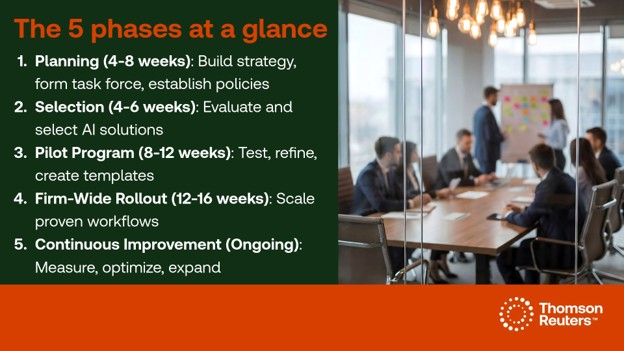
Phase 1: Planning (4-8 weeks)
Objective: Build your foundation before making any technology decisions.
The firms that succeed with AI audit implementation start by answering strategic questions, not evaluating vendors.
Form a cross-functional AI task force
Your task force should include:
- Audit team members at all levels
- IT professionals from day one (critical — many projects fail here)
- Risk management and legal counsel
- HR and talent development
- Client relationship owners
- External vendors (when appropriate)
Conduct a current-state analysis
Assess your readiness across key dimensions:
- Infrastructure: Do you have the processing power, storage, and bandwidth AI requires?
- Data quality: What’s the state of client data you work with? AI outputs are only as reliable as inputs.
- Skills gaps: Where is your team in AI literacy?
- Change capacity: What else is happening right now that might compete for attention?
- Client readiness: How will clients react? What are their AI policies?
Define your strategy and vision
Answer these critical questions:
- How does AI align with your firm’s strategic objectives?
- Are you aiming for efficiency gains, capacity to take on more clients, or new service offerings?
- What does success look like in six months? One year? Three years?
- What are your non-negotiables around data governance, compliance, and independence?
Establish policies and governance
Create clear policies covering:
- When and how AI can be used
- Data security and client confidentiality standards
- Documentation requirements for AI-assisted work
- Approval workflows
- Vendor evaluation criteria
Communicate early and often
Top-down leadership visibility is mandatory. Address concerns head-on — job security, accuracy concerns, ethical considerations. Create feedback channels and announce your strategy firm-wide.
Deliverable: A written AI strategy document with goals, metrics, timeline, and policies.
Phase 2: Selection (4-6 weeks)
Objective: Choose the right solution for your firm’s specific needs.
With strategy defined, evaluate solutions against your identified use cases. Consider integration with your existing technology stack, vendor reputation and financial stability, data security and compliance certifications, training and support offerings, and pricing models that scale with your firm.
Remember: This is a partnership, not a transaction. Understand your vendor’s AI roadmap. Clarify data storage and usage terms. Negotiate robust training and implementation support.
Deliverable: Signed agreements with clear implementation plans.
Phase 3: Pilot program — The non–negotiable phase (8–12 weeks)
Objective: Test, learn, refine, and prepare for firm-wide success.
This is the make-or-break phase, and where most firms fail by skipping straight to firm-wide rollout. Here’s what that mistake costs:
Without a pilot, you lose:
- Proven use cases specific to your firm
- Success stories to drive adoption
- Refined processes and templates
- Identified champions and super-users
- Measurement baseline
- Coordinated learning (teams work in silos, reinventing the wheel)
Select your pilot projects strategically. Choose high-impact, low-complexity tasks that deliver quick wins: contract analysis for lease terms, journal entry testing for anomaly detection, meeting note-taking for client interviews, document matching for subsequent checks, or memo drafting for standard work papers.
Structure your pilot team to include early adopters who will champion the tools and skeptics who influence others once convinced. Include different role levels and practice areas. Keep the team manageable: 5-15 people depending on firm size.
Define success metrics. Both quantitative (time saved per task, hours reduced per engagement, volume processed versus manual baseline) and qualitative (user satisfaction, confidence in output quality, training effectiveness).
The gold mine of the pilot phase is creating reusable templates. Develop proven prompt templates for common tasks, document workflows, build quality control checklists, establish documentation standards for AI use, and compile best practices guides.
For example, if you use Thomson Reuters CoCounsel Audit for lease analysis during your pilot, you can create a template prompt that consistently extracts key terms, payment schedules, and renewal options, then share it firm-wide for immediate adoption.
Pilot phase timeline:
- Weeks 1-2: Intensive training for pilot team
- Weeks 3-8: Active testing on live engagements
- Weeks 9-10: Template refinement and documentation
- Weeks 11-12: Results analysis and firm-wide preparation
Encourage experimentation. Refine prompts iteratively. Document what doesn’t work — it’s as valuable as what does. Create a safe space for questions and concerns.
Deliverable: Pilot results report with metrics, templates, use cases, and rollout recommendations.
Phase 4: Firm-wide rollout (12-16 weeks)
Objective: Scale what worked in pilot across your entire organization.
With proven templates and success stories in hand, rollout becomes dramatically easier. Present pilot results and time savings projections. Share the workflows that worked. Introduce your champion users who can support their peers.
- Don’t rely only on vendor webinars for training. Deliver firm-specific training covering your use cases, your templates and standards, your documentation requirements, and professional ethics considerations. Include Q&A sessions with pilot team members who’ve navigated the learning curve.
- Provide robust implementation support: Dedicated channels for questions, office hours with super-users, an easily accessible documentation repository, and regular check-ins with teams.
- Integrate audit automation into your standard workflows. The technology should feel like a natural extension of how work gets done, not an extra step. Update engagement letters, quality control procedures, and work paper documentation standards to reflect AI-assisted processes.
Reinforce expectations through visible leadership. Usage should be integrated into performance expectations. What gets rewarded gets done — recognize innovation and early wins.
Deliverable: 100% of audit staff trained and actively using AI in defined use cases.
Phase 5: Retrospective & continuous improvement (ongoing)
Objective: Measure success, optimize usage, and plan the next evolution.
With quarterly formal reviews, measure against your baseline. Review efficiency gains, quality improvements, client satisfaction impact, and employee engagement scores. Calculate ROI to justify continued investment and expansion.
Gather feedback continuously. What’s working well? Where are the pain points? What additional use cases have emerged? What training gaps remain?
Optimize and expand based on experience. Refine prompts and templates. Extend to additional use cases. Evaluate new AI capabilities as they emerge — the technology evolves rapidly. Consider additional tools for emerging needs.
Share results internally through newsletters, intranet success stories, and by featuring wins in performance reviews. Share externally through conference presentations and recruiting materials that highlight your firm’s innovation.
As agentic AI and deeper audit automation emerge over the next 2-3 years, your foundation will position you to adopt advanced capabilities faster than competitors starting from scratch.
Deliverable: Quarterly AI performance reports and annual strategic plan updates.
Scaling the implementation roadmap for your firm
- Small firms (1-20 people): Compress the timeline to 4-6 months total. Your task force may be 3-5 people. The pilot can involve 2-3 people testing 2-3 use cases. But don’t skip the phases.
- Mid-size firms (20-100 people): Follow the standard timeline of 6-9 months total. Form a task force of 8-12 people. Run a pilot team of 10-15 across practice areas. Test multiple use cases simultaneously.
- Large firms (100+ people): Extend the timeline to 9-12 months. Create a robust task force with sub-committees. Consider multiple pilot cohorts or office-by-office rollout. Dedicate a project manager to the initiative.
The universal truth: Everyone needs the five phases, just scaled appropriately.
Start your AI audit implementation journey today
The stakes have never been higher. Technology moves faster than ever. We’re on 2-3 year cycles now, not decades. Your competitors are implementing AI right now. Your future talent expects these capabilities. And your clients will soon require them.
The firms that follow this deliberate roadmap, especially those that commit to the pilot phase, will pull ahead significantly. Not just in efficiency, but in quality, in talent attraction, and in client value.
AI implementation is fundamentally a people change, not just a technology change. The technology is ready. The question is whether your firm is ready to implement it right.
Take the first step toward AI audit implementation success. Join our upcoming webinar where experts share proven strategies from firms that have successfully navigated all five phases.

Webinar: How to build an AI-ready audit team
Get a clearer picture of where AI is headed in audit, plus a grounded set of actions your team can take to start (or strengthen) adoption responsibly.
Save your spot ↗