Technology can transform your indirect tax compliance operations, but only if your team knows how to use it.
Highlights
- Only 50% of corporate tax departments offered technology training in 2025, despite rising AI budgets.
- 64% of tax departments remain stuck in the chaotic or reactive stage of technology maturity this year.
- One in four professionals facing an AI value gap plan to leave within two years, at $232,000 per replacement.
This is a dramatic shift from just 12 months ago when most expected a 3-5 year timeline. However, an AI-powered indirect tax solution is only as valuable as your team’s ability to work with it. Without proper training, even the most sophisticated AI tool becomes shelfware.
Jump to ↓
The tax technology competency gap
64% of tax teams are stuck in reactive mode
A multi-step framework to automate indirect tax processes the right way
The cost of standing still for tax departments
What comes next: Indirect tax technology investment

White paper
From applications to outcomes: How AI is reshaping indirect tax compliance
Download now ↗The tax technology competency gap
The gap between what your tax technology can do and what your team can accomplish with it is widening. If you’re leading an indirect tax function, you’re feeling it every day in missed opportunities, manual workarounds, and the nagging sense that you’re not getting the return you expected from your tech investments.
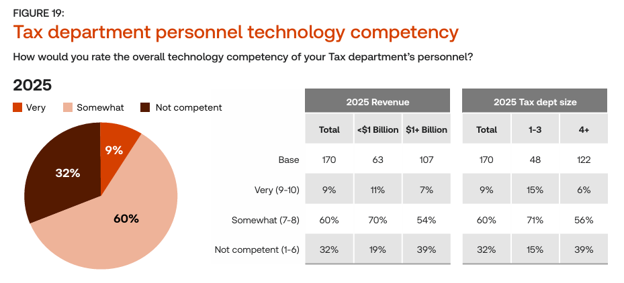

That competence gap determines whether automation transforms your workflow or just creates different work.
64% of tax teams are stuck in reactive mode
The “frustration gap” is widening, the 2026 Corporate Tax Technology Report reveals.
Your team knows what’s possible. They see competitors moving faster and understand that AI could handle routine compliance tasks to free them for strategic work. Yet they’re stuck, not because the technology doesn’t exist, but because the infrastructure to deploy it effectively isn’t there yet.
Meanwhile, the timeline for change is compressing. 39% of tax professionals now expect AI to be central to their workflow within 1 to 2 years, up from 31% who thought it would take that long just last year, according to the 2026 Corporate Tax Technology Report.
Organizations must realize that ensuring competence before enforcing AI usage circumvents this frustration, both between colleagues and between the organization and its employees.
Why investing in technology without investing in people backfires for indirect tax compliance processes
According to the Thomson Reuters 2026 Future of Professionals Report, which surveyed over 1,800 professionals across 60+ countries, 41% of professionals lack access to AI tools designed for professional work and built on verified professional content.
Even when organizations do invest in the right tools, they often skip the most critical step of preparing their people to use them.
Despite being one of the most cost-effective performance enablers available, only 50% of corporate tax professionals said their departments provided technology training in 2025, according to the 2026 Corporate Tax Technology Report.
Corporate tax departments have yet to see peak efficiency because of underdevelopment in workforce training and a growing mismatch between what advanced AI tools can do and what employees can handle.
You can’t automate your way out of a competence problem. Technology amplifies capability, but if the underlying capability isn’t there, professionals don’t have what they need to deliver value.
A multi-step framework to automate indirect tax processes the right way
Here’s a framework built on insights from the 2026 Thomson Reuters reports to help you close the gap.
Step 1: Assess your technology maturity honestly
The Technology Maturity Curve maps progression from chaotic through reactive, proactive, optimized, and predictive stages. This year, 64% of respondents placed their tax department at the chaotic or reactive end of the spectrum, according to the 2026 Corporate Tax Technology Report.
Identify where your team ranks today, not where you want to be. This baseline matters because it determines what’s realistic to tackle next.


Step 2: Appoint someone to own your technology strategy
88% of companies have now appointed a person to lead the tax department’s technology strategy, a jump from 51% the previous year, according to the 2026 Corporate Tax Technology Report.
This isn’t about adding bureaucracy. Someone needs to own the roadmap, the training plan, and the integration between systems. Without that ownership, technology decisions happen in silos and competence never scales.
Step 3: Invest in training as a strategic priority, not an afterthought
The firms and departments seeing real results from AI are doing more than just buying better tools. They’re also building better users.
Tax professionals’ attention is directed toward the many ways AI can enhance the tools they already use. AI was the only category of technological investment which experienced year-on-year budget growth, according to the 2026 State of Tax Professionals Report.
Budget alone doesn’t drive adoption. Professionals who use AI routinely are 2.4 times as likely to report organizational benefits from AI adoption compared to those who use it sporadically or not at all, the 2025 Future of Professionals Report found.
Training determines whether technology delivers ROI or goes unused.
Step 4: Start with clearly defined indirect tax compliance problems, not shiny solutions
AI is being marketed as a universal solution, but experienced professionals are finding that it works best when applied to clearly defined problems. Before purchasing another platform or piloting another tool, successful tax departments are asking what they’re trying to accomplish.
For indirect tax compliance, that might mean automating sales and use tax determination across multiple ERPs, streamlining e-invoicing compliance across jurisdictions, reducing manual review time for exemption certificate management, or accelerating technical research on multi-jurisdictional issues.
Define the outcome first, then find the technology and train your people to deliver it.
Step 5: Build competence through hands-on experience
39% of corporate tax professionals expect AI to be central to their work within the next 1 to 2 years. Corporate tax executives must start experimenting with AI for technical research, compliance automation, and document analysis to build the team’s comfort and competency through hands-on experience.
You can’t train people on hypotheticals. Give them real use cases, real data, and real stakes. Let them see what works and what doesn’t. That’s how competence scales.
The cost of standing still for tax departments
Of the 91% of professionals who reported some degree of AI value gap, one in four (24%) are considering leaving their organization within two years, at an estimated replacement cost of $232,000 per professional.
Your best people won’t wait for you to catch up. They’ll go somewhere that gives them the tools and the training to do work that matters.
78% of corporate clients say receiving AI-enabled quality improvements from their providers is very important or essential, but only 6% say most or all of their providers actually deliver, according to the 2026 Future of Professionals Report.
The disconnect between expectation and execution is both frustrating and expensive.
What comes next: Indirect tax technology investment
Two-thirds of respondents say technology investment over the past three years has enabled their department to shift toward more strategic, proactive work in indirect tax compliance. Nearly a quarter described the shift as significant.
Progress is possible, but it requires more than buying better software. Organizations must invest in the people who will use it, train them intentionally, and build a culture where competence builds over time.
Your indirect tax compliance process is only as strong as the people running it. The technology is ready. Now it’s time to prepare your team to use it with confidence.
From applications to outcomes: How AI is reshaping indirect tax compliance
Learn how AI-powered platforms are enabling end-to-end, outcome-driven compliance for indirect tax teams
Download now ↗