Highlights
- AI-driven classification systems deliver SSAE18-certified accuracy, reducing manual HS code errors significantly.
- 40% of organizations now use generative AI for trade compliance, up from 22% last year.
- ONESOURCE Global Trade provides comprehensive multi-country support with certified global tax rates and rules.
In an era where a single customs classification error can cost enterprises millions in penalties and delays, global trade professionals are turning to artificial intelligence to navigate increasingly complex international regulations. With more and more professionals across legal, tax, accounting, and government sectors already embracing AI solutions, the question isn’t whether AI will transform trade compliance — it’s how quickly your organization can adapt.
The numbers tell a compelling story: 40% of organizations are now using generative AI, up from just 22% last year. For trade professionals managing multi-jurisdictional compliance requirements, regulatory updates, and classification accuracy demands, this technological shift represents both an opportunity and a necessity.
Jump to ↓
The critical challenges facing global trade teams today
How AI in global trade compliance is changing operations
ONESOURCE Global Trade: Your strategic advantage
Embracing the future of trade compliance

The critical challenges facing global trade teams today
Regulatory complexity and constant change
Global trade professionals operate in an environment where regulations shift constantly across 100+ countries. Each jurisdiction maintains its own compliance requirements, documentation standards, and penalty structures. A single HS code misclassification can trigger customs audits, financial penalties, and supply chain disruptions that ripple through entire operations.
The challenge intensifies when considering real-time regulatory updates. Trade agreements change, tariff schedules evolve, and new compliance requirements emerge with little advance notice. Traditional manual monitoring systems cannot keep pace with this regulatory velocity, leaving trade teams reactive rather than proactive in their compliance strategies.
Manual process inefficiencies
Despite technological advances in other business areas, many trade operations still rely heavily on manual processes. Document processing, customs declarations, and duty calculations consume significant resources while introducing human error risks. According to Gartner’s 2025 Market Guide for Global Trade Management, GTM solutions are ‘typically offered and used independently to support siloed processes in a tactical manner’ rather than strategic integration, highlighting how organizations remain trapped in routine compliance activities instead of leveraging technology for strategic trade optimization.
These manual workflows create bottlenecks in customs clearance, delay shipment processing, and limit visibility into global trade operations. Resource allocation challenges compound the problem, as compliance monitoring requires specialized expertise that many organizations struggle to maintain across all relevant jurisdictions.
Audit preparedness and risk management
Customs authorities worldwide are increasing audit frequency and scrutiny. Trade teams must maintain comprehensive documentation, demonstrate compliance processes, and provide evidence of due diligence across all international transactions. The financial exposure from compliance failures extends beyond immediate penalties to include supply chain disruptions, reputation damage, and increased regulatory oversight.
With 80% of trade professionals now using AI tools at least weekly for compliance tasks, the gap between AI-enabled and traditional trade operations continues to widen. Organizations relying on manual processes find themselves increasingly disadvantaged in audit situations and strategic trade optimization opportunities.
How AI in global trade compliance is changing operations
Automated classification and duty optimization
AI-driven classification systems now deliver SSAE18-certified accuracy in HS code assignments, dramatically reducing manual classification errors. These systems analyze product descriptions, technical specifications, and regulatory requirements to determine optimal classifications across multiple jurisdictions simultaneously.
Real-time duty calculations across global markets enable trade teams to identify cost-optimization opportunities instantly. AI algorithms can evaluate preferential trade agreement eligibility, duty drawback programs, and special customs procedures to minimize total landed costs while maintaining full compliance.
The technology extends beyond simple calculation to strategic optimization. AI systems can model “what-if” scenarios for supply chain changes, evaluate the trade impact of new market entries, and recommend classification strategies that balance compliance requirements with cost efficiency.
Document processing and workflow management
Modern AI solutions automate customs documentation generation and validation, eliminating manual data entry and reducing processing errors. Workflow routing ensures approvals and compliance reviews follow established protocols while adapting to exception handling requirements.
Integration capabilities with existing ERP systems like SAP S/4HANA, Oracle, and NetSuite create data flows between trade management and broader business operations. The Thomson Reuters Partnership Program exemplifies this ecosystem approach, enabling connections with specialized applications.
These integrations transform trade compliance from an isolated function into an integrated business process. Real-time data sharing enables better decision-making, improves cash flow management, and provides visibility into trade operations across the entire organization.
Predictive analytics for risk mitigation
AI-driven early warning systems monitor regulatory changes across global markets, alerting trade teams to compliance impacts before they affect operations. Machine learning algorithms analyze historical patterns to identify high-risk transactions, unusual activity patterns, and compliance gaps.
Compliance risk scoring enables prioritized resource allocation, focusing attention on the highest-impact areas while maintaining oversight across all trade activities. Automated audit preparation compiles evidence, generates compliance reports, and maintains the documentation trail required for regulatory reviews.
Thomson Reuters has earned IDC MarketScape Leader positioning in both Value-Added Tax Management and Sales/Use Tax Automation, reflecting deep enterprise expertise serving Fortune 1000 companies across 70+ countries. This recognition validates the expanding ecosystem approach through programs that enable comprehensive integration with existing business systems.
ONESOURCE Global Trade: Your strategic advantage
Comprehensive global coverage
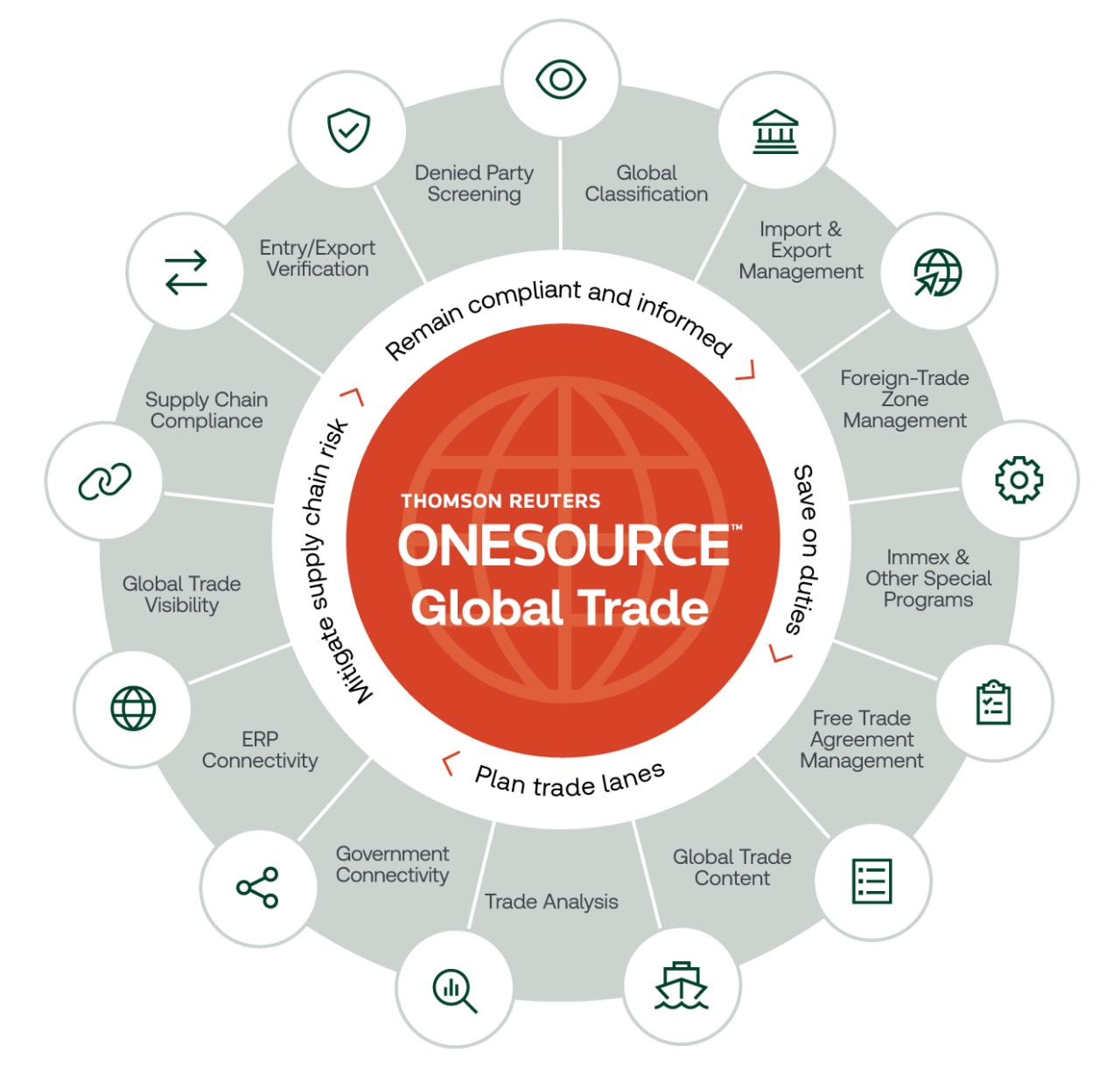
The ONESOURCE solution determines liability for customs duties, tariffs, and other country-specific trade taxes using continuously updated, certified global tax rates and rules. Whether entering new markets or modernizing existing trade systems, businesses worldwide rely on ONESOURCE for accurate transaction calculations and reporting.
Multi-country support encompasses the complex regulatory requirements of major trading jurisdictions while maintaining the flexibility to adapt to local compliance needs. This comprehensive content coverage eliminates the need for multiple point solutions while ensuring consistent compliance standards across global operations.
Enterprise-grade integration and scalability
Pre-built integrations with major ERP platforms enable rapid deployment without disrupting existing business processes. API-first architecture supports custom development needs while cloud-based deployment provides advanced security protocols and performance.
The platform’s enterprise focus addresses the complex needs of large, multi-entity organizations while remaining accessible to growing businesses expanding their trade footprint. This scalability ensures that trade management capabilities can evolve with business requirements without requiring platform changes.
Proven ROI and implementation success
Organizations implementing comprehensive AI-driven trade solutions report measurable efficiency gains in compliance operations, reduced audit preparation time, and improved accuracy in trade documentation. The strategic focus shifts from manual task management to trade optimization, enabling teams to identify cost-saving opportunities and competitive advantages.
Real-world applications demonstrate the technology’s impact: automated customs declaration processes reduce clearance times, automated duty optimization strategies minimize total landed costs, and comprehensive audit trails provide confidence in regulatory reviews.
Embracing the future of trade compliance
The convergence of AI technology and global trade management represents a competitive necessity rather than just an efficiency opportunity. As 87% of professionals expect AI to be central to their workflow within five years, trade teams adopting comprehensive solutions position themselves to thrive in an increasingly complex regulatory environment.
Success in this change requires strategic implementation of AI in global trade compliance through classification tools, automated workflow systems, integrated trade management platforms, predictive analytics capabilities, and partnerships with proven industry leaders. IDC MarketScape Leader recognition for Thomson Reuters in tax management applications validates this comprehensive approach to trade compliance modernization.
The future belongs to organizations that adopt AI not as a replacement for human expertise, but as a tool that amplifies professional capabilities and enables strategic focus on high-value trade optimization activities.
 |
|