
How the partnership between Thomson Reuters and Oracle helps organizations manage regulatory change, reduce risk, and scale global trade operations with confidence

Oracle Global Trade Management (GTM) plays a critical role in helping organizations manage the movement of goods across borders. It provides global trade teams with an operational framework for import and export processing, denied party screening, and export controls within the ERP environment.
Compliance and trade leaders understand that software alone does not determine compliance outcomes. The quality, accuracy, and timeliness of the global trade content behind the system directly influence whether trade decisions hold up under scrutiny.
As regulatory change accelerates, Oracle GTM customers benefit from the Thomson Reuters partnership, which integrates validated, timely, and trusted global trade content to ensure compliance decisions reflect current regulations rather than static data feeds.
Jump to ↓
The reality of global trade compliance today
What Oracle GTM delivers and where content fits
Why trade content quality is the differentiator for Oracle GTM users
How Thomson Reuters powers Oracle GTM with validated global trade content
What this means for Oracle GTM teams in practice
A stronger Oracle GTM ecosystem starts with trusted content
The reality of global trade compliance today
Recent changes in U.S. trade policy reveal how quickly compliance requirements can shift. When tariff authorities lapse or new measures emerge under alternative legal frameworks, global trade teams have little margin for delay.
Global trade compliance is fundamentally data-driven. Every import, export, and cross-border transaction relies on precise regulatory content that varies by country, product, destination, and trading partner. Even small gaps or delays in that information can disrupt operations.
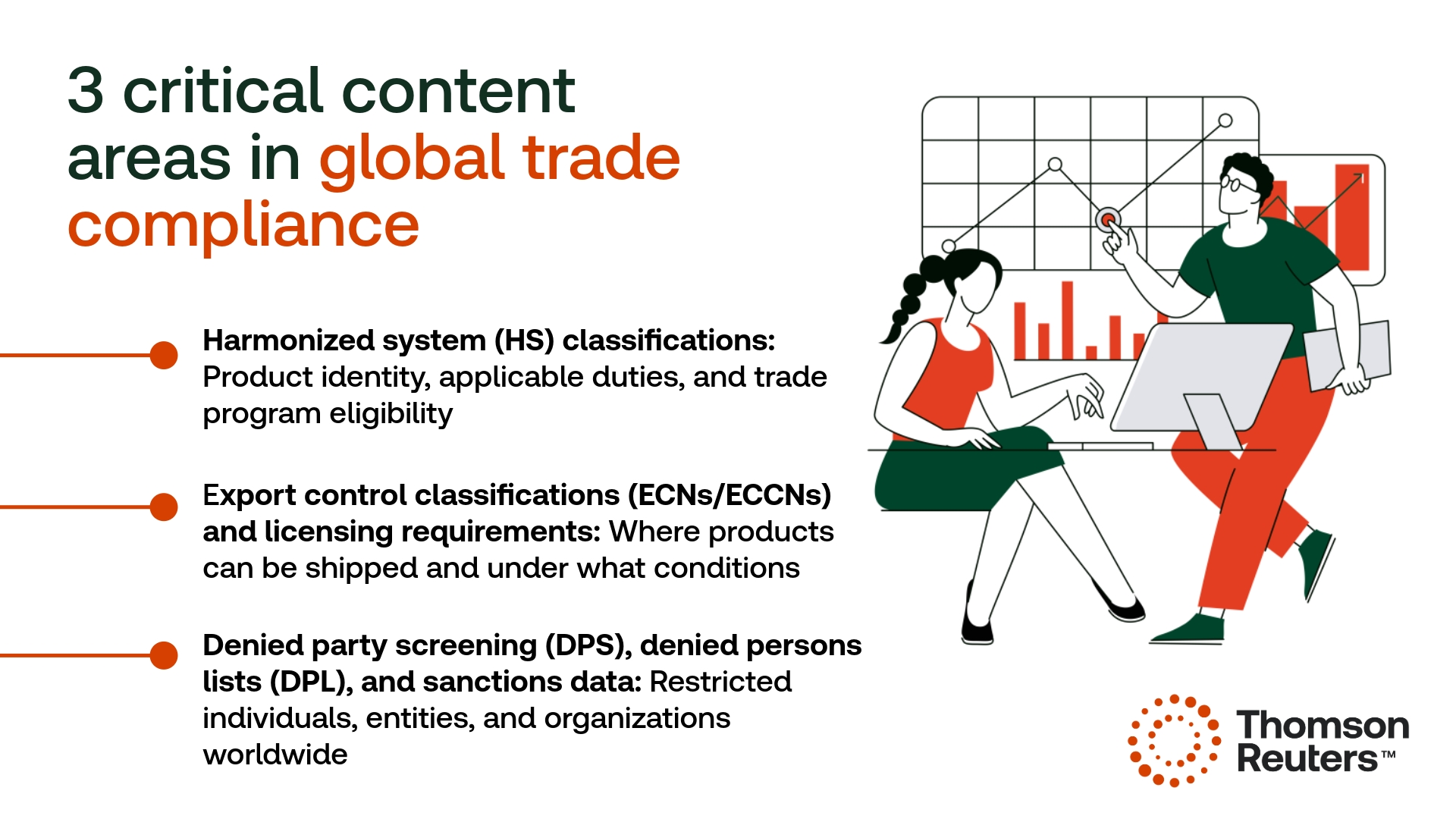
In Oracle Global Trade Management, these content areas are operationalized through direct integrations that feed classifications, export controls, and denied party data into live compliance workflows. HS data supports classification, tariff determination, and trade program eligibility. Export control content informs licensing and restriction decisions. Denied party data enables real-time screening against hundreds of global sanctions, embargo, and restricted party lists.
These content sets change constantly, often without warning, as they are sourced from thousands of government agencies and regulatory bodies worldwide. For global organizations, keeping pace manually isn’t realistic.
When content falls behind, the consequences are immediate and measurable. Shipments stall, duties are miscalculated, and licenses lapse. This exposes organizations to fines, penalties, lost trading privileges, reputational damage, and in severe cases, criminal liability.
As a result, global trade teams increasingly treat compliance content as a core risk control rather than a background data feed.
What Oracle GTM delivers and where content fits
Oracle GTM is designed to orchestrate global trade processes within the ERP. It manages workflows, filings, transactions, and compliance checks across import and export operations. For many organizations, it serves as the backbone of their global trade program.
The platform intentionally does not maintain proprietary global regulatory content at scale. This design choice reflects the volume, complexity, and rapid pace of global trade regulations, which require specialized expertise to manage effectively.
Instead, it depends on integrated global trade content from ONESOURCE Global Trade Management to power classifications, screenings, and compliance decisions. Without this regulatory intelligence, even the most advanced GTM system cannot operate effectively.
Why trade content quality is the differentiator for Oracle GTM users
Many global trade teams treat trade content as interchangeable, assuming coverage and periodic updates are enough to keep systems running. As compliance demands rise and enforcement accelerates, those assumptions begin to break down, and the differences between content providers become more consequential.
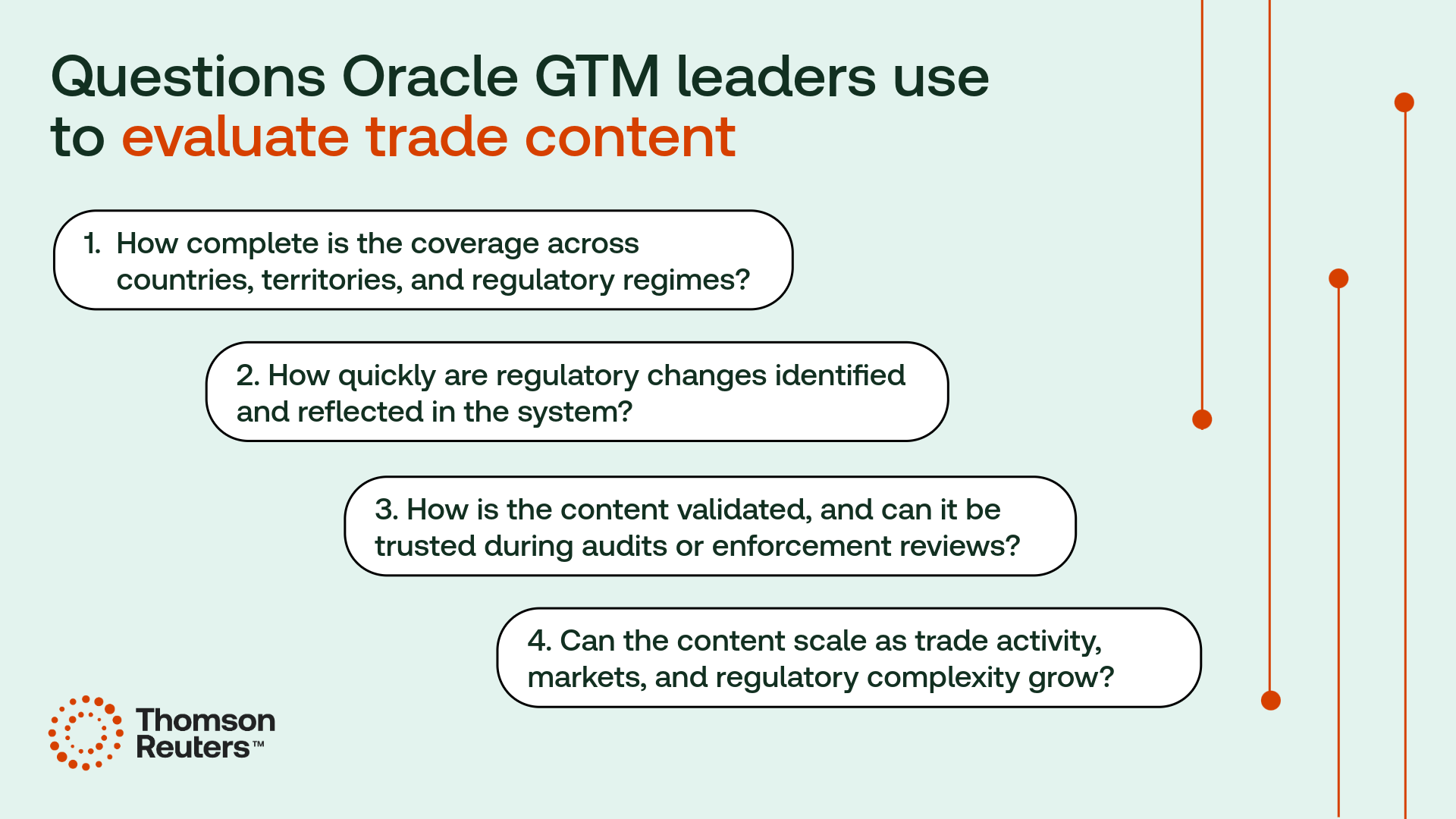
How Thomson Reuters powers Oracle GTM with validated global trade content
Oracle GTM relies on external regulatory intelligence to execute classifications, screenings, and compliance checks with confidence. Thomson Reuters ONESOURCE Global Trade Management supplies this intelligence as an integrated content layer designed to support the scale, complexity, and scrutiny of enterprise global trade operations.
This content does more than fill regulatory gaps. It brings together broad global coverage, daily regulatory updates, and rigorous validation processes to ensure that the data feeding Oracle GTM supports accurate, defensible compliance decisions.
Comprehensive global coverage
Thomson Reuters delivers trade content across more than 220 countries and territories. This includes complete tariff schedules, HS classifications, duties and charges, export control lists, denied party and sanctions data, and rules of origin for trade agreements.
Coverage extends beyond basic classifications to include country-specific documentation requirements, regulatory conditions, and supporting reference materials. For Oracle GTM users operating across multiple regions, this breadth reduces gaps that often lead to manual workarounds.
Global trade content that keeps pace with regulatory change
Global trade regulations change constantly, often daily. Thomson Reuters made more than 155 million content updates in 2025 alone, reflecting the scale of change organizations must manage.
A global team continuously monitors regulatory sources around the clock, identifying updates as they occur and integrating changes in under one business day on average. This speed is critical for Oracle GTM users who need confidence that the decisions made today align with the regulations in force.
Validated, not just collected
One of the most significant differentiators is validation. Thomson Reuters does not rely solely on automated scraping or passive aggregation.
Dedicated global content and validation teams review updates, crosscheck sources, and confirm accuracy before changes are released. Automated anomaly detection supports this process, but human expertise remains central. In many cases, validation teams identify and correct errors in government published sources themselves, working directly with authorities to resolve discrepancies.
Updates are identified and processed with an average turnaround of less than a business day, using automated anomaly detection and multiple layers of human validation to ensure accuracy before changes are released into Oracle GTM. This level of validation provides confidence in daily operations as well as during audits, disclosures, and enforcement inquiries.
What this means for Oracle GTM teams in practice
When validated, up‑to‑date content is integrated directly into Oracle GTM, the impact becomes tangible across operations.
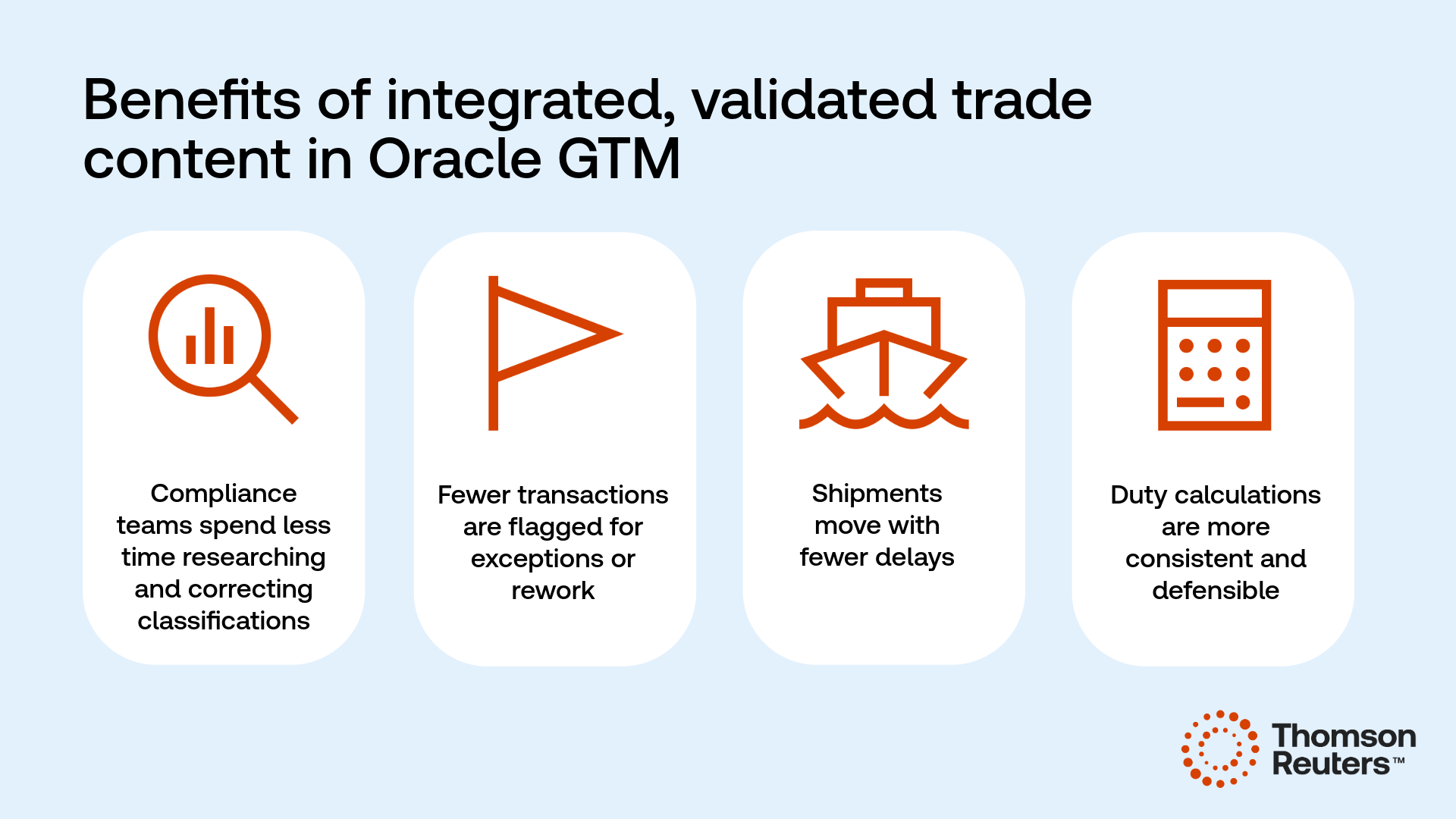
Most importantly, Oracle GTM teams can make decisions with confidence rooted in current regulations. They know the data will stand up to scrutiny and support growth into new markets without introducing disproportionate risk.
For organizations in highly regulated industries or those operating across complex trade lanes, this confidence becomes a competitive advantage.
A stronger Oracle GTM ecosystem starts with trusted content
Oracle GTM is only as effective as the content behind it. With Thomson Reuters delivering validated, continuously updated regulatory intelligence, Oracle GTM users gain the confidence to make daily trade decisions that stand up to scrutiny and scale with global complexity.
Learn how Thomson Reuters content integrates with Oracle GTM and how organizations use this partnership to strengthen compliance, reduce risk, and support global trade operations with confidence.
Explore the Thomson Reuters and Oracle partnership and see how our integrated solutions strengthen Oracle environments.

Thomson Reuters and Oracle
Learn how Thomson Reuters extends compliance capabilities within Oracle.
Modernize compliance ↗