Highlights
- Trade compliance research is fragmented across scattered government sources with no unified portal or cross-referencing.
- Every research finding requires time-consuming cross-checking, driving up trade team workload, overtime, and stress industry-wide.
- AI-powered research tools like ONESOURCE deliver cited, defensible answers instantly, complementing classification tools to close the compliance gap.
It’s 4:45 on a Friday, and the VP of Supply Chain has a question: does the new Section 301 action affect the automotive parts coming in from a key supplier? It’s a fair question. It’s also one the Regulatory Compliance Manager can’t answer in the next five minutes: not because they don’t understand trade, but because the answer doesn’t live in one place. It’s somewhere between a Federal Register notice, a CSMS message, and a USTR exclusion list nobody has re-checked since the last update.
Most conversations about AI in trade compliance start and end with product classification, and for good reason. Assigning the right HS code is essential, and it’s visibly slow. But classification is only half the job. The other half, the one that rarely gets its own headline, is the research that has to happen before a compliance decision can be trusted: confirming what a regulation actually says, whether a ruling still applies, and whether the ground has shifted since anyone last checked. That work is the upstream bottleneck. Fix classification alone, and the research problem is still waiting on the other side of it.
Jump to ↓
The global trade research bottleneck has three faces
How AI solves the global trade research challenges
 |
|
The global trade research bottleneck has three faces
1. Fragmented regulatory sources
There is no single government portal for trade regulation. Compliance teams piece together answers from Federal Register notices, CBP guidance, CROSS rulings, CSMS messages, and agency-specific publications, each with its own format, its own update cadence, and no cross-referencing between them. It’s telling that, according to the 2026 Global Trade Report from the Thomson Reuters Institute, only 7% of trade organizations industry-wide currently use software to stay on top of tariff changes. The rest are doing this by hand: opening tabs, running searches, and hoping nothing relevant was published somewhere they didn’t think to check.
This isn’t a minor inefficiency. It’s a structural gap between how fast regulations change and how manually most teams are still tracking them.
2. Every answer has to be double-checked
Finding a plausible answer isn’t the same as finding a reliable one. Before a research finding can be acted on, it typically has to be cross-checked against two or three other sources, because a single Federal Register notice rarely tells the whole story, and getting it wrong carries real cost. This validation cycle is where a huge share of the “hidden” hours actually go, and it’s largely absent from conversations that measure efficiency only in terms of classification speed.
It shows up in the numbers, too. The Global Trade Report found that more than half (56%) of trade professionals report increased workload or overtime over the past year, and nearly as many (49%) report increased stress on their teams. Research validation isn’t the only driver of that, but it’s a significant, underacknowledged piece of it.
3. The pressure to justify decisions is rising, and the paper trail often isn’t there
Here’s the paradox: trade teams are being invited into more strategic conversations than ever. According to the Global Trade Report, over a third of trade professionals (37%) now report more frequent involvement in executive decision-making, and that number is expected to climb to 53% within the next year. That’s a real elevation for the function, but it comes with a catch. Greater visibility means greater scrutiny. When a VP asks why a call was made, or a CBP auditor asks the same question in a very different tone, “I’m confident it’s right” isn’t sufficient. There needs to be a citation and audit trail.
Tellingly, the Global Trade Report itself recommends the fix: maintaining auditable decision logs and building executive-facing dashboards that translate trade decisions into defensible documentation. That’s not a hypothetical best practice: it’s a direct response to a gap teams are already living with.
How AI solves the global trade research challenges
Looked at individually, these feel like three separate frustrations. They’re not. They’re symptoms of the same underlying problem: trade research still runs on manual search, manual cross-checking, and manual documentation, in an environment where the regulatory landscape moves faster every year. Speeding up classification doesn’t touch any of this: the research still has to happen, at the same pace, with the same gaps.
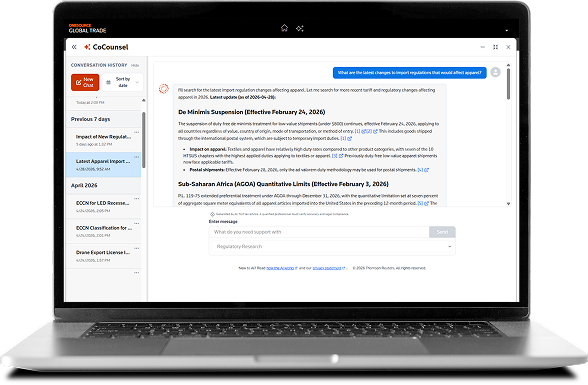
This is where AI-powered trade compliance research changes the equation: not by replacing judgment, but by removing the manual search-and-verify cycle that currently eats the most time. Instead of a compliance manager hunting across a dozen sources, an AI regulatory research assistant can synthesize an answer from a vetted library of trade documentation (Federal Register notices, CBP guidance, executive orders) and return it with citations attached, in seconds rather than hours.
That last part matters more than the speed. For compliance leaders weighing where AI fits into their function, the natural question isn’t “is it fast?” It’s “can I trust it, and can I defend it?” The value here isn’t a black-box answer; it’s traceability. A cited, sourced answer is more defensible in front of an auditor than an uncited one, not less, because the missing paper trail becomes a solved problem by design, not something bolted on afterward. This is also why the underlying content matters: an assistant trained on vetted government and proprietary trade content behaves very differently from a general-purpose AI tool pulling from the open internet, particularly when the content itself updates in under a business day of a regulatory change.
ONESOURCE Global Trade Research powered by CoCounsel, is built around exactly this idea: pairing natural-language research with the citations needed to act on the answer immediately, embedded within ONESOURCE Global Trade Content. It’s the upstream complement to classification tools, not a replacement for them: one gets the code right, the other confirms what the code actually means under today’s rules.
Where this leaves trade teams
Classification will keep getting attention because it’s visible, measurable, and easy to point to. Research stays in the background, until the day it costs you: a missed exclusion, a stale ruling, a decision nobody can fully explain after the fact. Solving classification without solving research addresses half a problem well. The other half is still waiting.
If you want to see how these two pieces work together in practice, our companion piece, From hours to minutes: How AI is revolutionizing HS product classification, walks through the classification side of this in more detail.
 |
|
And if you’re ready to see the research side for yourself, check out the Global Trade Content page.
 |
|