Highlights
- AI classification software reduces manual research time by 50% while maintaining 95% accuracy.
- Machine learning adapts to your business, learning product patterns for tailored HS code suggestions.
- Automated audit trails with regulatory citations ensure compliance defensibility across global operations.
There is a reality that every global trade professional knows all too well: managing thousands of SKUs across 220+ countries while manually researching fragmented government sources. As Blair Kellum, Senior Implementation Consultant at Thomson Reuters Professional Services, puts it: “Product classification can be time consuming. It can be all consuming. Managing a high velocity inventory requires more than just time. It requires a specialized lens of trade knowledge to handle the high visibility risks and internal dependencies that come with every SKU. Product classification is the foundational DNA of the supply chain, where even minor oversights have a compounding impact on the bottom line.”
This challenge has only intensified. With rising penalties, increased regulatory volatility, and trade teams evolving from cost centers to strategic differentiators, the stakes have never been higher. The question isn’t whether you can afford to modernize your classification process — it’s whether you can afford not to.
Jump to ↓
The hidden costs draining your trade team’s strategic potential
How AI HS code classification software transforms the classification experience
Real-world impact: From busywork to strategic value
The Thomson Reuters advantage: Content meets technology
Your next step: Experience classification technology

The hidden costs draining your trade team’s strategic potential
Time drain that steals strategic focus
Manual classification workflows can consume valuable time that organizations could redirect toward strategic priorities. According to Mariana Maldonado, Implementation Consultant at Thomson Reuters Professional Services: “Collaboration and knowledge-sharing across trade compliance and business teams remain fundamental to understanding and improving classification processes.”
Professional teams spend countless hours hunting through Federal Register notices, CBP messages, and tariff schedules, cross-referencing multiple sources for single classification decisions. Junior staff lack the expertise to handle complex classifications, while senior professionals become overwhelmed with research requests that prevent them from focusing on higher-value trade optimization activities.
Risk amplification in a volatile regulatory environment
Misclassification penalties and supply chain delays create cascading business impacts. The HS system has 5,000 codes at the global six-digit level, expanding to over 19,000 unique codes for the U.S. schedule alone. With similar expansion across over 200 countries, maintaining accuracy while staying current with near-daily regulatory changes becomes an operational challenge.
Inconsistent classifications create audit vulnerabilities, while difficulty tracking regulatory changes increases compliance risk. Poor audit trails compound these challenges, making it harder to defend classification decisions when customs authorities make inquiries.
Operational inefficiencies are holding trade teams back
Decentralized classification processes lead to errors and compliance gaps across global operations. Data quality issues complicate accurate classification decisions, while fragmented workflows prevent teams from achieving the consistency required for multinational operations. The result? Trade professionals spend more time on administrative tasks and less time driving strategic value for their organizations.
How AI HS code classification software transforms the classification experience
Machine learning solutions that learn your business
ONESOURCE Global Classification AI uses machine learning to deliver HS code predictions targeting 95% accuracy based on product descriptions and historical data. Unlike generic AI tools, this AI HS code classification software learns your unique product characteristics and business logic, adapting to your specific operational needs.
“By integrating CoCounsel into our global classification module, we are significantly reducing the manual effort required to navigate complex tariff schedules. This shift allows your team to achieve precise product classifications with greater speed and less administrative burden,” explains Kellum. The system performs similarity analysis across key attributes to identify comparable products and classifications, helping professionals make informed decisions quickly.
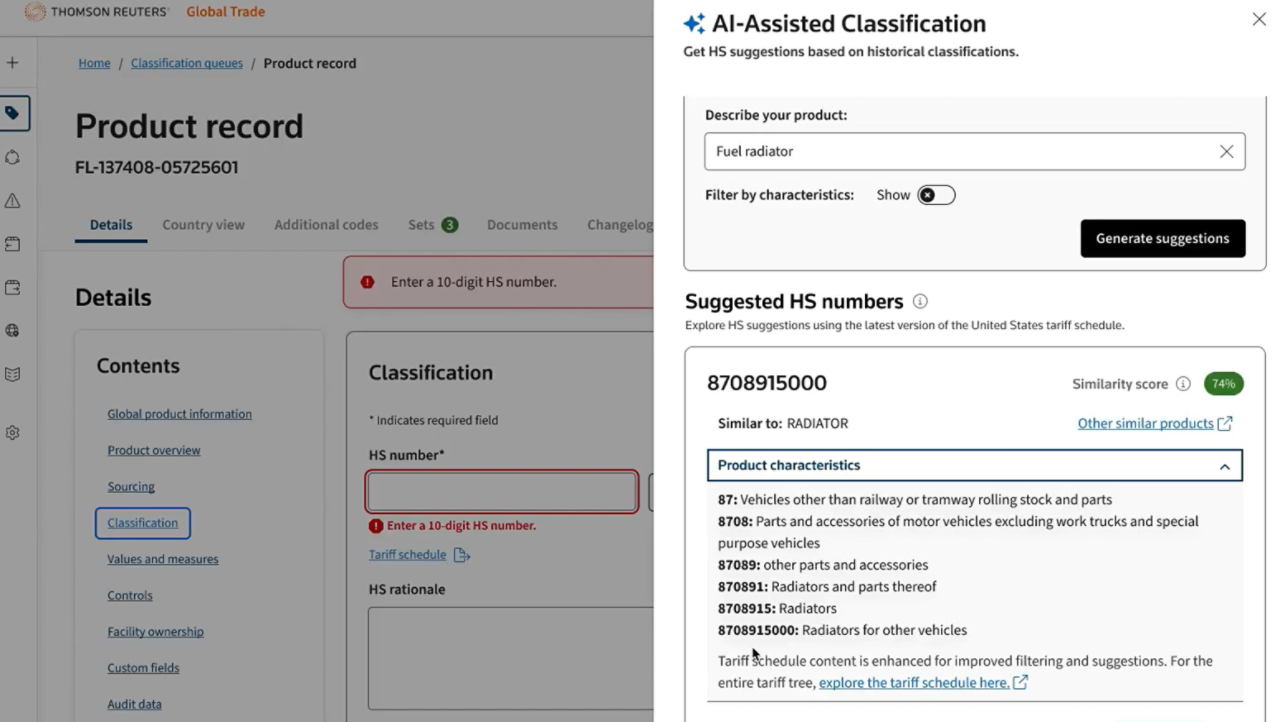
The AI provides multiple classification suggestions with detailed similarity scores to guide decision-making. For example, when classifying a brake pad, the system might suggest two options: one with a 74% similarity score for an automobile, highlighted in green as the higher likelihood choice, and another with a 60% score, for a high-speed train, in orange indicating lower reliability. This scoring system helps professionals understand the AI’s confidence level in each recommendation.
Research acceleration with authoritative sources
The Interactive Classification Research feature, powered by CoCounsel, provides direct access to enhanced tariff schedules, WCO notes, and binding rulings. This systematic application of General Rules of Interpretation uses trusted Thomson Reuters content to deliver comprehensive research capabilities within your existing workflow.
The AI HS code classification software automatically handles expired HS codes, offering valid replacement suggestions and ensuring continuity in your classification database. This eliminates the risk of using outdated codes while maintaining classification accuracy across regulatory changes.
Automated audit readiness
Every classification decision generates proactively created rationales linking precise regulatory documentation. The system provides comprehensive audit trails with GRI rule citations, tariff notes, and binding rulings, while historical decisions are recorded for compliance review and audit purposes.
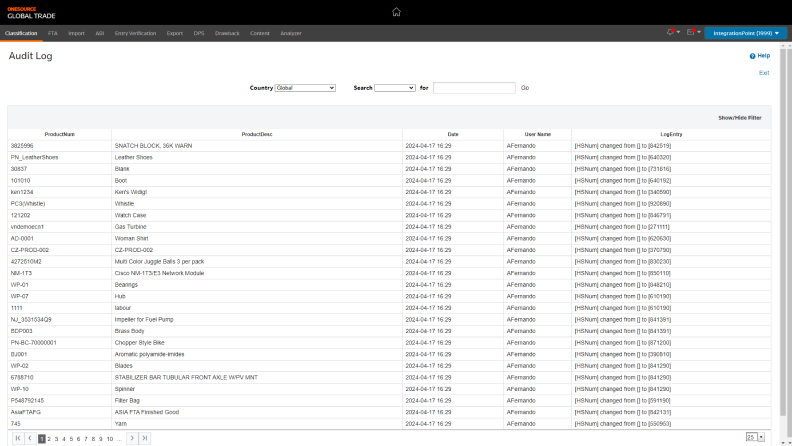
This automated documentation significantly reduces the burden and time needed for customs audit preparation, giving trade teams confidence in their classification defensibility.
Real-world impact: From busywork to strategic value
Efficiency gains that matter
Early implementations show 50% reduction in time spent on HS classification tasks. The system’s batch processing capabilities support high-volume classification needs, freeing experts for strategic trade initiatives rather than repetitive classification work.
As the system learns from user decisions, classification accuracy improves over time. “One of the most significant advantages of this model is its capacity for continuous learning,” notes Kellum. “By leveraging the classification decisions made by the professionals in your classification department, the AI identifies patterns and refines its accuracy over time. You are essentially digitizing the collective expertise of your team into a growing intelligence layer tailored to the SKUs relevant to your business.”
This means when you input “brake pad,” and you are an auto-manufacturer, the system won’t suggest a train brake pad classification because it has learned your business context and product patterns, offering more tailored classifications specific to your industry.
Confidence in complex decisions
Multiple predictions with detailed rationales support informed decision-making. Similarity scores help professionals choose the most appropriate classifications, while built-in handling of expired HS codes provides automatic suggestions for valid replacements.
The AI HS code classification software demonstrates sophisticated understanding by parsing through product acronyms and brief descriptions to understand the true intent behind each classification request, ensuring that nuanced decisions receive appropriate context and support.
Consistency across global operations
Centralized classification capabilities maintain global consistency while standardized product descriptions improve data quality across ERP systems. The new classification queue system provides a workflow-driven approach where teams can efficiently move from unclassified products through validation and final approval stages.
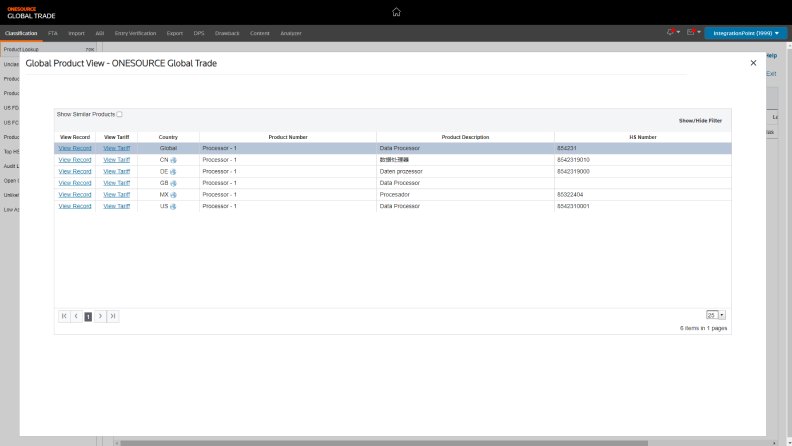
As Maldonado explains: “The new global classification queues feel like a true work‑cadence process. You start by identifying unclassified or HS‑invalid products that need correction. As classification progresses, additional queues — such as Tariff Changes, HS Suggestions, and Classification Audit — come into play. This structured workflow makes it easy for trade compliance teams to collaborate and move efficiently from one classification queue to the next.”
The Thomson Reuters advantage: Content meets technology
Unmatched global trade content foundation
Thomson Reuters maintains 200+ researchers monitoring 1,300+ sources across 220+ countries, delivering 100M+ regulatory updates annually with same-day content updates. This comprehensive coverage includes Federal Register notices, executive orders, and CBP guidance — all integrated into the AI’s knowledge base.
Domain-specific AI that understands trade
Purpose-built for global trade compliance rather than generic search, the system demonstrates deep understanding of HTS codes, duty drawback, customs procedures, and cross-border nuances. Integration within the trusted ONESOURCE ecosystem provides comprehensive workflow management.
The AI’s proven accuracy includes passing the U.S. Customs and Border Protection Licensure Exam with scores of 85% and 86% — demonstrating real-world competency in trade compliance scenarios.
Proven accuracy and reliability
Every answer includes direct citations to authoritative sources for verification. This transparency allows compliance teams to validate and audit AI recommendations with confidence, maintaining the human-in-the-loop approach essential for regulatory compliance.
The system provides detailed breakdowns showing the complete classification hierarchy, from the initial two-digit chapter through the full ten-digit classification, with explanatory text helping users understand the logic behind each level of classification.
Your next step: Experience classification technology
See how AI HS code classification software transforms your daily workflow. Request a personalized demonstration showing real classification scenarios relevant to your industry. Discover how your team can reclaim hours for strategic trade optimization while maintaining the accuracy and defensibility required for global compliance.
Connect with Thomson Reuters to explore implementation tailored to your specific industry needs and begin your journey toward efficient product classification.