Highlights
- ACE is the central U.S. system governing all import/export compliance touchpoints and data integrity.
- Manual ACE processes create compounding risks including duty errors, audit exposure, and shipment delays.
- ONESOURCE Global Trade automates classification, filing, and drawback with AI-powered regulatory intelligence.
The Automated Commercial Environment (ACE) is the central system used by U.S. Customs and Border Protection (CBP) to track, control, and process all imported and exported goods. It serves as the primary system through which the trade community reports import and export data to the U.S. government.
For corporate trade compliance professionals, understanding ACE is only the beginning. In an era of escalating tariff volatility and heightened CBP enforcement, having the right technology infrastructure behind every ACE interaction is no longer optional — it is a competitive and compliance imperative.
Jump to ↓
What is the role of ACE in U.S. trade compliance?
What are the risks of manual processes in the Automated Commercial Environment?
Why technology is no longer optional for ACE compliance
The AI advantage: Global Trade Research powered by CoCounsel
Enforcement is intensifying. Your infrastructure needs to keep pace.
 |
|
What is the role of ACE in U.S. trade compliance?
ACE is not simply a filing portal. It is the end-to-end trade data ecosystem that governs every major compliance touchpoint for U.S. importers. Entry summary filings, post-summary corrections (PSCs), protest submissions, reconciliation filings, duty drawback claims, and tariff exclusion refund processing all flow through ACE. Each of these functions demands data integrity, regulatory accuracy, and audit-ready recordkeeping.
The stakes attached to each interaction are significant. According to the Gartner 2025 Market Guide for Global Trade Management Software, 98% of supply chain leaders are making or planning strategic changes in response to recent U.S. tariff shifts. ACE is where many of those strategic decisions play out in practice — in the form of classification accuracy, drawback eligibility, and the completeness of the compliance record.
What makes this environment particularly demanding is that the pressures compounding on trade compliance teams are not isolated — they are converging from multiple directions simultaneously: shifting regulations, geopolitical realignments, supply chain disruptions, expanding sanctions regimes, sustainability requirements, and the sheer pace of tariff change. Each force on its own is manageable. Together, they represent a level of complexity that ACE-dependent processes must absorb — and that no manual workflow can keep pace with.
Managing filings, duty assessments, and drawback claims
Every ACE interaction carries financial and regulatory consequences. Overpaid duties erode margins. Underpaid duties trigger enforcement action. Unsupported drawback claims invite audit scrutiny. And entry filings that cannot be reconciled consume compliance resources that most teams cannot spare.
What many organizations discover too late is that ACE performance is upstream of all of these outcomes — and that the quality of that performance is directly determined by the quality of the technology and data infrastructure behind it.
How does ACE customs work?
ACE operates as a single window through which importers, exporters, customs brokers, freight forwarders, and CBP exchange the data required to clear goods across the U.S. border. When a shipment arrives, the importer of record — or their broker — submits an entry through ACE containing classification data, valuation, country of origin, and applicable duty calculations. CBP reviews this information against its risk-based targeting criteria and either releases the shipment or flags it for examination.
Beyond the initial entry, ACE governs the full lifecycle of an import transaction: post-entry amendments via PSC, formal protests of CBP decisions, reconciliation filings for entries with undetermined elements such as transfer pricing, and drawback claims for duties on goods that are later exported or used in exported manufacturing. Each of these processes has its own documentation requirements, filing windows, and audit exposure profile.
Precision is non-negotiable in this environment. A single misclassified HTS code can cascade into overpaid duties, missed drawback opportunities, or a CBP inquiry — and with tariff volatility now a permanent feature of the trade landscape, the pace of regulatory change has made manual classification and filing processes increasingly untenable.
What are the risks of manual processes in the Automated Commercial Environment?
Shipment delays and audit exposures
Organizations that approach ACE through manual processes — spreadsheets, disconnected systems, broker-dependent data entry — face compounding risk across every filing. Classification errors generate duty discrepancies that require correction or protest. Data re-keyed between systems introduces transcription errors that delay clearance. And without a centralized, auditable record of every entry decision, responding to a CBP inquiry becomes a resource-intensive exercise with no guarantee of a clean outcome.
The new customs enforcement executive order has made that exposure tangible. Importers are now held to a higher standard than accurate filings alone — they must be able to demonstrate a systematic, documented compliance record on demand. Those who cannot are precisely the organizations most exposed to CBP scrutiny.
IEEPA tariffs and the CAPE refund process: A real-time stress test for ACE infrastructure
The stakes of inadequate ACE infrastructure have never been more concrete. On February 20, 2026, the U.S. Supreme Court ruled 6–3 that IEEPA — the International Emergency Economic Powers Act — does not authorize the imposition of tariffs. (IEEPA itself remains in force for sanctions and asset-blocking purposes; it is the specific use of the statute to impose tariffs that was ruled outside the scope of the statute.) With IEEPA-based tariffs terminated, CBP built the Consolidated Administration and Processing of Entries (CAPE) system directly within ACE to manage the resulting refund process, launching April 20, 2026. The scale is extraordinary: more than 330,000 importers paid IEEPA tariffs on 53 million shipments, representing $166–179 billion in potential recoveries. Within days of launch, over 75,000 CAPE declarations had been submitted.
For trade compliance teams, CAPE is a direct test of ACE data quality. Entries lacking complete electronic records in ACE are failing CAPE validation — meaning importers with gaps in their entry history, documentation, or duty payment records risk losing recovery on refunds they are legally entitled to. CAPE declarations, once accepted, cannot be amended; errors require a new submission. Importers with complete, accurate, centrally maintained ACE records are best placed to recover what they are owed.
It is also worth noting that the end of IEEPA-based tariffs did not mean the end of tariff pressure: Section 122 reciprocal tariffs replaced them within hours of the ruling. However, that authority is itself now also being contested. The Court of International Trade found Section 122 unlawful on May 7, 2026, and the government’s appeal is currently before the Federal Circuit. Section 232 tariffs on steel, aluminum, copper, and autos remain fully in effect, and Section 301 investigations targeting 60 countries are actively underway. For trade compliance teams, the operational demands on ACE have not eased — they have shifted, and the quality of your ACE infrastructure will determine how much of that complexity your organization absorbs versus deflects.
The question for trade compliance leaders is not whether technology matters in this context. It is whether your current technology is equal to the demands of the current environment.
Why technology is no longer optional for ACE compliance
Leveraging ONESOURCE Global Trade and AI-powered research
Thomson Reuters ONESOURCE Global Trade is the operational backbone that connects classification, entry management, duty liability, supply chain documentation, and partner screening into a single, auditable compliance infrastructure. It is precisely the architecture an effective ACE process requires.
The platform supports the ACE process across five critical dimensions:
Accurate tariff classification. Every ACE entry originates with an HTS code. ONESOURCE automates the classification workflow for both imports and exports, drawing on regulatory content covering 220+ countries and territories. In a tariff environment this volatile, the shift from rules-based to AI-driven classification is no longer a future-state consideration — it is what keeps classification accuracy current as HTS codes, rates, and rules of origin change faster than any manual process can track. For teams working to build and sustain that accuracy, maintaining classification compliance as an ongoing discipline rather than a one-time exercise is the difference between a defensible ACE record and one that fails under scrutiny.
End-to-end import management. ONESOURCE Import Management gives compliance teams control over entry documents at every stage, with information maintained in a centralized, consistent, and secure database. It automatically calculates costs and expenses — creating the foundation for accurate ACE filings and the visibility needed to identify savings opportunities and flag potential overpayments before they become problems.
Duty optimization and drawback identification. ONESOURCE Global Duty Optimization supports duty suspension programs worldwide — including U.S. duty drawback, foreign-trade zones (FTZ), free trade agreements, and IMMEX/maquiladoras. For ACE purposes, the drawback capability is particularly important: the platform maintains the supply chain data needed to support drawback claims on goods subsequently exported or used in the manufacture of exported products.
Direct government connectivity. ONESOURCE’s government connectivity solutions allow importers and brokers to file declarations directly with customs authorities without leaving the platform. For ACE filings specifically, this eliminates the rekeying of shipment data, reduces transcription errors, and integrates seamlessly with freight forwarders and 3PLs.
Up-to-date regulatory content at scale. ACE filings are only as accurate as the regulatory data behind them. ONESOURCE Global Trade Content provides access to over 220 tariff schedules, 500+ trade agreement rules of origin, 2 million+ import/export controls, and 750+ denied party lists — all maintained in a single repository and updated in real time.
The AI advantage: Global Trade Research powered by CoCounsel
Thomson Reuters has gone further than traditional trade management software. Global Trade Research is an AI-powered tool trained on a vast collection of vetted trade documents — including Federal Register notices, CBP Cargo Systems Messaging Service (CSMS) messages, and executive orders. Thomson Reuters describes this as Fiduciary-Grade AI™: built to meet a higher standard than general productivity tools, with outputs designed to stand up to regulatory scrutiny.
In a recent demonstration of its regulatory reasoning capability, Global Trade Research passed all six publicly available U.S. Customs Broker License Exams (CBLE) administered over a three-year period — 18 total runs, with a mean score above 84%. The CBLE is widely regarded as one of the most challenging professional licensing exams in the United States, with pass rates that have fallen as low as 2%.
For corporate trade compliance teams, this means access to a research and interpretation capability that can synthesize regulatory guidance, analyze binding rulings, and surface enforcement intelligence — directly within the ONESOURCE platform. When a CBP inquiry arrives or a novel tariff scenario emerges, your team is not starting from scratch.
Enforcement is intensifying. Your infrastructure needs to keep pace.
The Gartner 2025 Market Guide for Global Trade Management Software puts the stakes in stark relief: 98% of supply chain leaders are making or planning strategic changes in response to recent U.S. tariff shifts, and the global trade management software market is projected to grow at a compound annual growth rate of 16.7% through 2029. These are not incremental adjustments — they reflect a broad recognition that trade compliance infrastructure must be rebuilt for a more volatile world.
CBP’s enforcement posture has shifted materially in parallel. The new customs enforcement executive order has formalized expectations that were previously more informal. Importers are now expected to demonstrate not just compliance, but systematic, auditable compliance — with the records to prove it. ONESOURCE Global Trade is designed to provide exactly that: because all classification, entry management, duty liability, and documentation functions are connected within a single platform, compliance teams can produce a complete, consistent audit trail on demand.
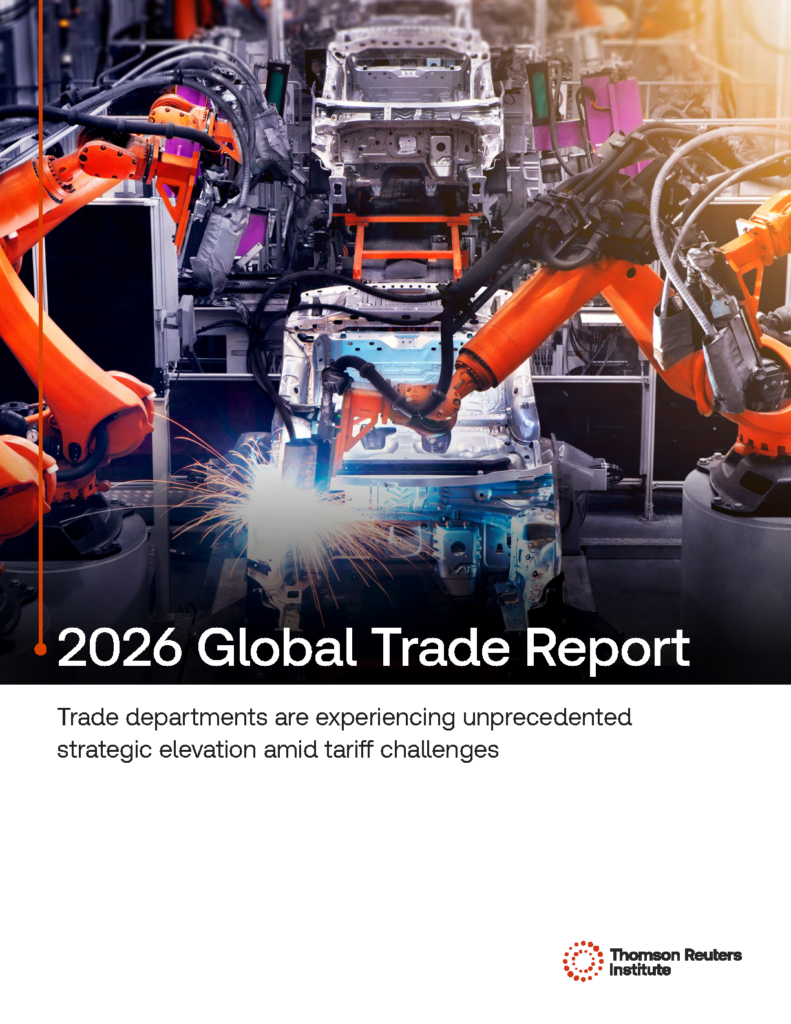
The Thomson Reuters 2026 Global Trade Report confirms the strategic elevation that accompanies this pressure: 43% of trade professionals report enhanced influence over procurement decisions, and 37% report more frequent involvement in executive decision-making. The technology infrastructure supporting those professionals needs to reflect that elevated standard.
The bottom line for global trade professionals
A smooth ACE process is not primarily a matter of having skilled staff — though that matters. It is a matter of having technology that ensures those staff are working from accurate data, filing through reliable connectivity, capturing every duty savings opportunity, and maintaining the records that demonstrate compliance when it counts.
Thomson Reuters ONESOURCE Global Trade delivers that infrastructure — and its recognition in the Gartner 2025 Market Guide confirms it meets the rigorous independent standards enterprise compliance teams require. For corporate trade compliance professionals managing the demands of the U.S. import environment, it represents not just a software platform, but a competitive and compliance advantage — one that grows more valuable as regulatory complexity continues to increase.
In an environment where CBP is more likely than ever to come asking, ONESOURCE customers have answers.
To learn more, visit ONESOURCE Global Trade Management or download the 2026 Global Trade Report.