
Most CFOs underestimate how much corporate tax work can be automated. This is a 6-minute read for finance leaders who’ve been told the tax department is “running lean,” and assume that’s a good thing.
Most CFOs treat the tax department the way they treat the boiler room of a building. As long as nothing is on fire, the staffing model is working. Headcount stays flat. Software requests get deferred. Compliance gets done. The audit closes. From the top of the org chart, tax looks like a function that scales gracefully: quiet, dependable, and inexpensive relative to its risk surface.
That picture is almost always wrong, and the gap between picture and reality is one of the more expensive blind spots in modern finance leadership. The problem isn’t that tax departments are under-resourced in the obvious way. The problem is that the costs of running them lean show up in places CFOs don’t typically look, on lines that don’t typically get attributed back to tax.
Jump to ↓
| The tax department work expands invisibly |
| The cost shows up everywhere except the tax budget |
| The data on tax department tech is sobering |
| Tax automation vs. staff headcount: the wrong question |
| The CFO’s actual leverage |
| What tech helping tax department staff looks like in practice |
The tax department work expands invisibly
Every year, the tax department absorbs a wave of new regulatory complexity that no one budgets for: Pillar Two, evolving e-invoicing mandates, ESG disclosure requirements, more granular audit requests, faster close cycles imposed by finance transformation initiatives. None of these announce themselves as “we need another person.” They show up as longer hours, deferred analytical work, and quiet downgrading of the department’s ambitions.
The tax team that was lean three years ago is now meaningfully understaffed against the work it’s actually being asked to do. But because the work expanded continuously rather than in discrete jumps, no one has the conversation. The headcount line in the budget hasn’t changed, so on paper, nothing is wrong.
The cost shows up everywhere except the tax budget
When a tax department runs at the edge of its capacity for an extended period, it produces a recognizable pattern. Provision calculations get done at the level of accuracy the deadline allows, not the level the company would prefer. Errors get caught, usually, but the catch happens late and consumes finance leadership attention that should be elsewhere. Audit responses become reactive rather than proactive, with documentation reconstructed under deadline pressure. And tax planning, the genuinely strategic work the department could be doing, gets crowded out entirely.
None of these costs are recorded as “tax department staffing shortfall.” They’re recorded as audit fees, restatement costs, missed planning opportunities, and a slow erosion of confidence in the close. The CFO sees the symptoms across multiple line items and rarely connects them back to a single root cause. (Related: why under-resourced tax departments face higher penalty risk.)
The data on tax department tech is sobering
This isn’t opinion. According to the 2026 Corporate Tax Department Technology Report from the Thomson Reuters Institute and Tax Executives Institute, 64% of corporate tax departments still operate at the chaotic or reactive end of the technology maturity curve. Only 5% have reached an optimized state. And 56% of tax professionals are now dissatisfied with their department’s tech stack, up from 34% just a year earlier. Actual AI use remains rare: only 9% of departments call themselves active users, while 81% are still exploring or considering it.
Half of the respondents reported their company purchased no new tax technology in the past 12 months. Only 27% said they could secure the budget and resources they need when they need them.
Read those numbers as a CFO and the diagnosis is straightforward: a function the rest of the organization has been quietly digitizing for a decade is, in most companies, still running on email, spreadsheets, and manual reconciliation. That’s not a tax department problem. That’s a finance leadership problem.
Tax automation vs. staff headcount: the wrong question
When a CFO does eventually ask whether tax is appropriately staffed, the question is usually framed as a headcount question. That framing produces the wrong conversation.
The better question is this: how much of your tax department’s work could be automated? It isn’t really a question of whether it’s better to hire or automate — the same report finds that two-thirds of tax leaders at companies that have invested in technology say their department has successfully shifted toward strategic, proactive work — analytics, forecasting, advisory support. At companies that haven’t made the investment, the shift hasn’t happened, and the team is stuck doing production work a system could handle. Hiring itself is already tilting the same direction: 62% of tax departments are now hiring for tax expertise over tech/IT roles, a reversal from a year ago when the majority of new hires were technical — see how one team reclaimed thousands of hours by automating this kind of work.
A tax department where senior professionals spend significant time on work that could be automated is understaffed in a meaningful sense, even if the org chart looks fine, because the actual capacity for skilled tax work is a fraction of what the headcount implies.
The CFO’s actual leverage
The shift, when it happens, is rarely about hiring more people. It’s almost always about changing what existing people spend their time on. There’s evidence the function knows this: the share of tax departments that now have a designated leader for technology strategy jumped from 51% to 88% in a single year. The question for the CFO is whether that person has the air cover and the budget to actually do the job.
If you’ve defaulted to treating tax as a fixed-cost function that quietly absorbs whatever the regulatory environment demands, the highest-leverage thing you can do this quarter isn’t to evaluate the headcount. It’s to ask your head of tax two questions.
How much of the team’s work could be handled by automation the company hasn’t yet invested in? And what would the function look like — what would you look like — if that work moved off their desks?
The answers will tell you more about the financial position of your tax function than the line-item budget will.
What tech helping tax department staff looks like in practice
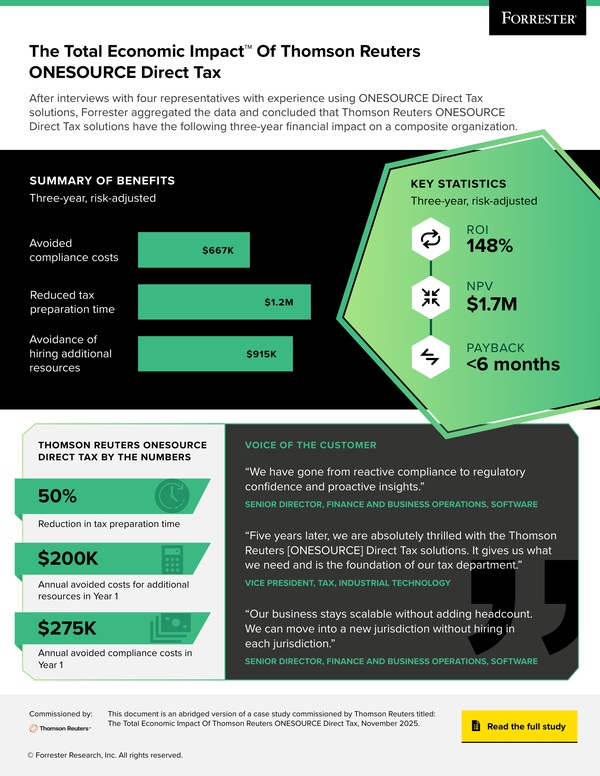
A commissioned November 2025 Forrester Consulting Total Economic Impact™ study of Thomson Reuters Direct Tax customers found that a composite organization modeled on their experience:
Forrester TEI Study
- Avoided hiring two additional tax resources a year, worth $915,000 over three years
- Cut tax-return preparation time in half
“Our business stays scalable without adding headcount. We can move into a new jurisdiction without hiring in each jurisdiction.”
— Senior director, finance and business operations, software industry, interviewed for the Forrester study
The tax department isn’t understaffed because it lacks people — it’s understaffed because too much of its capacity is locked up in work a system could be doing. Automation isn’t a cost to justify — the numbers already make that case.
 |
|