
Highlights
- Agentic AI adoption in organizations is projected to jump from 15% to 77% by 2030.
- Tax professionals spend 56% of time on reactive tasks but want 70% for strategic work.
- AI agents orchestrate workflows across systems, eliminating manual reconciliation and compliance gaps.
Corporate tax departments have always had tension at their core. The work is too important to automate carelessly, yet too voluminous to do manually at the pace regulators now demand. For years, tax departments navigated the tension by adding headcount, layering in software, outsourcing, or all three. Now there’s a new option and it’s arriving faster than most tax leaders expected: agentic AI.
Agentic AI is no longer a concept on a vendor roadmap. Today, roughly 15% of organizations are actively deploying AI agents across business functions. By 2030, that number is projected to reach 77%. In one business cycle, the question has shifted from, “Should we explore AI?” to, “How fast can we make it safe, governed, and real?”
For indirect tax professionals, the stakes are especially high. The compliance function is relentlessly transactional — VAT filings, e-invoicing reconciliations, sales and use tax calculations across dozens of jurisdictions — yet strategic contribution is expected too. The 2025 State of the Corporate Tax Department report quantifies the gap. Tax professionals currently spend 56% of their time on reactive, basic tasks, when they aspire to devote up to 70% of their time to strategic work. With 58% of departments now reporting they are under-resourced (up from 51% just a year ago), capacity to absorb additional volume is increasingly constrained.
Something has to change. Indirect tax agentic AI is what that change looks like in practice.
Jump to ↓
A new kind of tool: One that uses other tools
Why most AI agents aren’t ready for indirect tax
The governance gap: How to match AI speed with control in indirect tax
Why the right partner matters more than the right AI feature
What indirect tax agentic AI can do for you
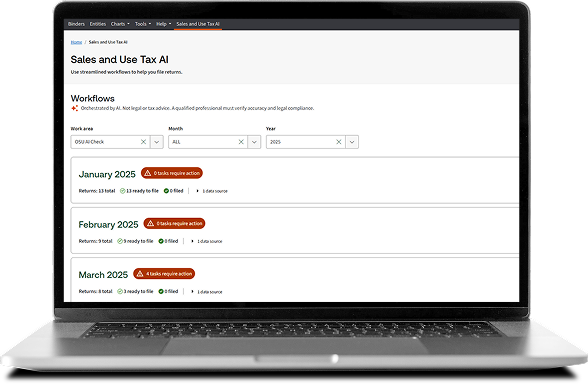
ONESOURCE Sales and Use Tax powered by CoCounsel
Streamline your workflows, enhance research, and ensure accuracy
Learn more ↗A new kind of tool: One that uses other tools
To understand what makes agentic AI different, it helps to understand how it works. That challenge of making AI both fast and trustworthy is exactly the problem Thomson Reuters has been focused on solving. Alex Bunnett, Senior Product Manager for Indirect Tax at Thomson Reuters, draws a distinction that clarifies the approach.
“Before, it was: we give you tools to do the work,” he explains. “Now it’s: we can build things that do the work for you.”
An AI agent doesn’t sit inside a single application but rather it moves between applications, pulling data from an ERP, running calculations in a tax engine, validating results against e-invoicing records, and generating a filing-ready output, all without a human navigating each step. The applications, in Bunnett’s framing, become tools that the agent uses, rather than tools that the user operates manually.
For indirect tax teams juggling fragmented systems across multiple jurisdictions, that reframing is significant. Tax compliance rarely lives in a single product. Professionals move between source systems, calculation engines, reporting tools and Excel, often manually reconciling data at each handoff. That invisible middle layer, the work between applications, is where hours disappear and errors accumulate. Agentic AI not only accelerates individual tasks, but it also eliminates the seams.
Why most AI agents aren’t ready for indirect tax
The acceleration is real. But so is the skepticism, and in compliance, skepticism is professionally appropriate.
Within the tax profession, perspectives on AI adoption tend to fall into two broad patterns.
One group wants outcomes delivered instantly, with little concern for how the AI got there. The other — more common among compliance professionals — is acutely risk-averse. They’re overworked, they know it, but they don’t want to move far from the processes they trust.
That caution isn’t irrational. It reflects a core truth about compliance work: getting from A to B isn’t enough if you can’t show how you got there.
“The crucial part of compliance is you can’t follow just any steps to get to the outcome,” Bunnett explains. “You need to go step by step through the approved mechanism. You need to show that you’ve reviewed XYZ. You need to show that you’ve run these 10 validations. You need to show that you checked whether this data is accurate.”
This is where most generic AI agents fall short. AI that produces a correct result through an opaque process is not useful in a compliance context. Instead, it’s a liability. Auditors don’t just want the answer; they need a full trail of evidence showing exactly who reviewed what, when, what changes were made, and what rationale was applied at each decision point.
The trust challenge is compounded by data risk. Accuracy must come first, Bunnett notes, before any other consideration: “You don’t get to a conversation about security if the tools aren’t accurate in the first place.”
For indirect tax specifically, where a miscalculation can mean penalties, regulatory scrutiny, or worse, accuracy is the minimum requirement, not a preference.
The governance gap: How to match AI speed with control in indirect tax
For many tax departments, a meaningful challenge has come into focus: AI capabilities are advancing on compressed timelines, while the infrastructure needed to govern them — policies, oversight frameworks, audit standards — takes time to build.
The 2026 Corporate Tax Department Technology Report found that 64% of tax departments remain at the reactive or chaotic end of the Technology Maturity Curve, meaning they are still reliant on manual processes and fragmented systems. At the same time, the timeline for AI integration has collapsed. Just a year ago, tax professionals expected AI to become central to their workflow in three to five years. Now, the most common estimate is one to two years. 7% say it already is.
That gap between where most tax departments are technologically and where AI is heading is widening quickly. The challenges departments face are varied between budget constraints, resource limitations, and competing priorities, but governance readiness is consistently one of the most significant.
Implementing an AI agent and governing it are two different projects. Policies for AI decision oversight, audit trail standards, data handling protocols, and human review checkpoints don’t write themselves. In the meantime, vendor agents are proliferating, point solution providers are racing to add “AI-powered” features, and tax teams are left evaluating tools without a framework for what a fit-for-purpose solution looks like in a compliance context.
Progress along the Technology Maturity Curve tends to be incremental as each step builds the organizational capability needed for the next. Departments that begin developing their AI evaluation and governance capabilities now are better positioned to move quickly and confidently when they are ready to scale.
More than half of survey respondents in the 2026 report said they were dissatisfied with their current tech stack, up sharply from the year before. Dissatisfaction without action doesn’t close gaps; it widens them. Closing that satisfaction gap calls for both the right technology and governance to deploy it well.
Why the right partner matters more than the right AI feature
With no shortage of AI agent solutions now entering the market, the differentiator isn’t which vendor has the most features. It’s which partner has the combination of deep domain knowledge, integrated tooling, and governance infrastructure that compliance requires.
Bunnett describes the approach Thomson Reuters is taking with unusual clarity. The mandate was to think like a startup, but more specifically, a startup with access to decades of compliance expertise and a mature portfolio of interconnected tools. “Go back to first principles,” he explains. “Look at the core problem statements that organizations face and think about how you can use your products to solve for them in a way you haven’t before.”
That starting-from-scratch mindset, applied to an established platform, yields something distinct: agentic solutions that are built around how compliance workflows operate in practice, not how a general-purpose AI model assumes they do. “We have the knowledge of not only what people do in those tools, but how they need to interact,” Bunnett says. “We know what customers need to do, we know what their objective is, we’ve got the tools.”
Four specific differentiators set this approach apart for indirect tax teams:
- Domain-embedded accuracy: Where AI is being used to reason, it handles ambiguity, research, and workflow orchestration. Where determinism is required, like tax calculation itself, rule-based engines handle the math. This is the architecture that makes 100% accuracy achievable. This separation keeps probabilistic reasoning out of the final calculation of tax liability, where deterministic logic is better suited.
- End-to-end workflow coverage: Rather than AI-enabling individual applications, Thomson Reuters is connecting the full indirect tax process — from source data through calculation, e-invoicing reconciliation, validation, and filing — into a single orchestrated workflow. The work that used to happen between systems, in manual Excel reconciliations and email chains, is now handled by the same system.
- Auditability by design: Every decision made by an AI agent in the compliance process is documented, with rationale, timestamps, and reviewer sign-offs preserved at each step. This is not because compliance audits are a possibility but rather how they’re a certainty. The audit trail is built into the workflow architecture instead of being treated as an afterthought.
- The knowledge layer: Tools without context are just tools. The orchestration logic that tells an agent which tools to use, in which sequence, to achieve a compliance outcome is built on knowledge encoded from real customer workflows, real regulatory requirements, and real compliance edge cases. That context — what Bunnett calls “the crucial piece” — is what separates a genuinely useful agent from a demonstration.
What indirect tax agentic AI can do for you
The 2025 State of the Corporate Tax Department report found that only 33% of professionals doing mostly tactical work feel they’re making a real difference in their organization. Among those focused primarily on strategic work, that figure jumps to 63%. The connection between how time is spent and how impact is felt is direct.
Agentic AI for indirect tax changes the nature of what a compliance professional’s day looks like. Filing preparation that once took days narrows to hours of review and sign-off. Reconciliation exceptions that surfaced only when a deadline was already pressing get flagged in real time. Capacity that was consumed by data processing gets redirected toward tax policy optimization, regulatory change monitoring, and proactive advisory work.
Agentic AI represents a natural progression for tax departments looking to mature their operations and amplify the impact of their teams. Organizations that pair the right technology with a thoughtful governance framework gain a meaningful strategic advantage: the ability to absorb growing compliance demands while freeing professionals to focus on the higher-value work that differentiates a modern tax function.
Learn more about ONESOURCE Sales & Use Tax powered by CoCounsel, an AI solution that is redefining indirect tax workflows.
For organizations operating in Europe, explore our indirect tax compliance solutions for EU-specific requirements and evolving e-invoicing mandates.