
Impact of the 'One Big Beautiful Bill' and international taxes on the industry.
The oil and gas industry operates in an extremely complex and ever-evolving tax environment, one that presents a multitude of challenges for those involved in tax planning and compliance efforts.
The global nature of the industry means that oil and gas companies must comply with federal, state, local, and international tax rules, many of which are industry-specific and can change at any given time. These and other tax considerations specific to the oil and gas industry mean that companies involved in those industries must maintain an extraordinarily high level of diligence to avoid potential penalties for non-compliance.
Jump to ↓
New tax credits and benefits from the One Big Beautiful Bill
Which taxes apply to oil and gas companies
Oil and gas taxation in the U.S.
International oil and gas taxation
Tax challenges and solutions for oil and gas companies
New tax credits and benefits from the ‘One Big Beautiful Bill’
The Trump administration’s new tax bill, enacted on July 4, 2025, repealed most of the regulations and clean-energy incentives contained in the Biden administration’s Inflation Reduction Act (IRA). Among the canceled provisions were a fee on methane emissions, credits for electric vehicles, and tax credits for renewable energy sources such as solar and wind power.
Other tax benefits the oil and gas industry received from passage of the bill:
Carbon capture tax credits: Introduces a series of tax credits to encourage the development of carbon-capture technologies that stores carbon underground.
Capital expenditure deductions: Changes the deduction rules for large capital expenditures (such as drilling and pipeline equipment) from phased depreciation over the life of the asset to “100% bonus depreciation,” which allows for immediate deduction of the full cost of qualified property in the year it was purchased.
Reduced royalty rates: Returns the royalty rates for offshore and onshore oil and gas drilling to 12.5%, down from 16.67% under the Biden administration.
Master Limited Partnerships (MLPs): Expands an already existing tax vehicle that allows pipeline operators and other entities organized under an MLP to pay taxes directly to investors, by-passing federal taxes.
Clean fuel credit extension: Extends credits for clean fuel production until 2030.
Lease sales: Expands the ability of oil and gas companies to obtain leases for drilling on public land in states such as Alaska, Colorado, Montana, New Mexico, Nevada, and North Dakota, as well as U.S.-controlled waters in the Gulf of Mexico.
Some expected changes did not end up in the final bill, however. For example, the Superfund cleanup tax implemented in 2022 remains in effect, and corporations with more than $1 billion in revenue are still subject to a 15% Alternative Minimum Tax (AMT).

Podcast
Tax reform unpacked: What does the One Big Beautiful Bill Act mean for you?
Listen to the podcast ↗Which taxes apply to oil and gas companies?
Aside from the taxes that most international companies pay (e.g., Federal corporate income and withholding taxes, sales and use taxes, indirect taxes (VAT/GST), excise taxes, etc.), oil and gas companies are subject to numerous taxes specifically related to the oil and gas industry.
Among these industry-specific taxes are:
- Severance taxes: State-mandated taxes on the extraction of non-renewable resources such as oil and gas based on either the volume or value (“ad valorem”) of the extracted resources. Varies by state.
- Environmental taxes: A bundle of taxes (e.g. Superfund tax, hazardous substance fees, waste disposal fees, etc.) aimed at pricing in the environmental impact of extracting and refining petroleum products.
- Property taxes: For oil and gas companies, property taxes don’t just apply to the land a company owns or leases, but also to mineral rights, buildings, drilling rigs, storage facilities, and some types of equipment.
- Royalty payments: Levies paid to the owners of mineral rights for the right to extract oil and gas. Royalties are not technically a tax, but they are a cost nonetheless.
- Resource rent tax: Taxes “super” profits that exceed a pre-determined level of return on capital investments. Not applicable in the U.S., but popular internationally.
Oil and gas taxation in the U.S.
In the U.S., oil and gas companies encounter rules that do not pertain to operations outside the country. For example:
Severance taxes in the U.S.
More than 30 states in the U.S. have some form of severance tax on the extraction of oil and natural gas. Rates vary by state but are typically based on either a percentage of the market value of the oil or gas produced, or a fixed rate per unit of volume extracted. In most cases, severance taxes can be deducted from a company’s federal corporate income tax.
Alternative Minimum Tax (AMT)
The 2022 Inflation Reduction Act’s 15% AMT on companies with a net income (as opposed to taxable income) exceeding $1 billion over three years is aimed at the world’s largest corporations, including gas and oil companies. In practice, the 15% minimum tax blunts the tax advantages oil and gas companies enjoy from being able to expense intangible drilling costs (IDCs), tax deferrals, and net operating loss deductions—all of which can significantly lower a company’s taxable income.
Property taxes
Property taxes apply to oil and gas companies in a few different ways. First, land owned or leased for oil and gas extraction is considered taxable property. Leased mineral rights are taxable as well and are usually based on the estimated value of the land’s reserves. “Ad valorem” taxes based on the assessed value of property such as buildings, drilling rigs, storage facilities, and other equipment and infrastructure are also taxed as property.
Intangible drilling costs (IDCs)
IDCs are expenses incurred during the exploration and development of oil and gas wells, such as permit fees, lease costs, surveys, fuel, testing, supplies, etc. Oil and gas companies subject to the AMT can now deduct 100% of their IDC for the year they are incurred. But because the AMT is based on financial statement income, not taxable income, IDC deductions don’t lower taxable income as much as they can for smaller oil and gas companies not subject to the AMT.
State corporate income taxes
Oil and gas companies must pay state corporate income taxes in the states in which they operate. Rates vary by state—from a low of 2.5% in North Carolina to a high of 9.8% in Minnesota—but certain states may have different rules for treating net operating losses and specific deductions. Some states, such as Alaska, use the worldwide combined reporting system, which considers a corporation’s global income, not just the income generated within the state, for its basis of taxation.
Water’s edge election
Some states that use the worldwide combined reporting system also offer a “water’s edge” election, which allows multinational companies to limit reporting to income from U.S. operations in exchange for a slightly higher tax rate. These states include California, Idaho, Montana, and North Carolina.
International oil and gas taxation
Depending on where their operations are located, oil and gas companies that do business internationally are subject to a wide range of different tax rules and potential compliance challenges. Among the most common compliance considerations are:
Global Minimum Tax
The 15% global minimum tax established by the OECD’s Pillar Two applies to multinational corporations with annual revenues exceeding 750 million euros. Under the Income Inclusion Rule (IIR) and Undertaxed Profits Rule (UTPR), countries and jurisdictions that tax profits at less than 15% can also impose a “top-up” tax to ensure that oil and gas companies pay at least 15% on their global profits.
Double taxation
Oil and gas companies can encounter double taxation if income earned in a foreign country is taxed by both that country and the company’s home country. However, several mechanisms—such as foreign tax credits, tax treaties, and various international tax rules—exist to mitigate the impacts of double taxation.
Transfer pricing
Because multinational oil and gas companies operate in so many countries and jurisdictions, and their operations are so multifaceted and complex, transfer pricing issues represent a significant compliance issue. Furthermore, international tax authorities tend to scrutinize transfer-pricing arrangements specifically to ensure that they adhere to the “arm’s length principle” of fair pricing of goods and services and do not involve profit-shifting to lower-tax jurisdictions.
Tax challenges and solutions for oil and gas companies
The overall scope and complexity of multinational oil and gas operations is such that even the most scrupulous tax departments can inadvertently miscalculate taxes or run afoul of international regulations. Complicating matters further is the fact that international tax laws, rates, and regulations are always changing, so keeping current with applicable rules is a challenge all its own.
Unfortunately, if oil and gas companies do not calculate their taxes correctly—for whatever reason—the consequences can be expensive and severe. Penalties, fines, audit-related costs, additional interest, operational disruptions, cash-flow strains, reputational damage, increased regulatory scrutiny, more frequent audits and compliance checks—these and other consequences of non-compliance not only have direct financial implications, they can also squander resources and impact the company’s operational effectiveness.
Automating tax determination
Oil and gas companies process millions of transactions and interactions every day. The only practical way to keep pace is to automate tax determination using a solution that can track and execute the company’s tax policies, scale to whatever size the company needs, and integrate with existing business systems, regardless of the company’s geographical footprint.
Large oil and gas companies are especially vulnerable to tax oversights and favorite targets for regulators. These companies need a solution that can manage transaction data of all kinds automatically, so that compliance teams can focus on minimizing tax liabilities and executing the organization’s larger tax strategy.
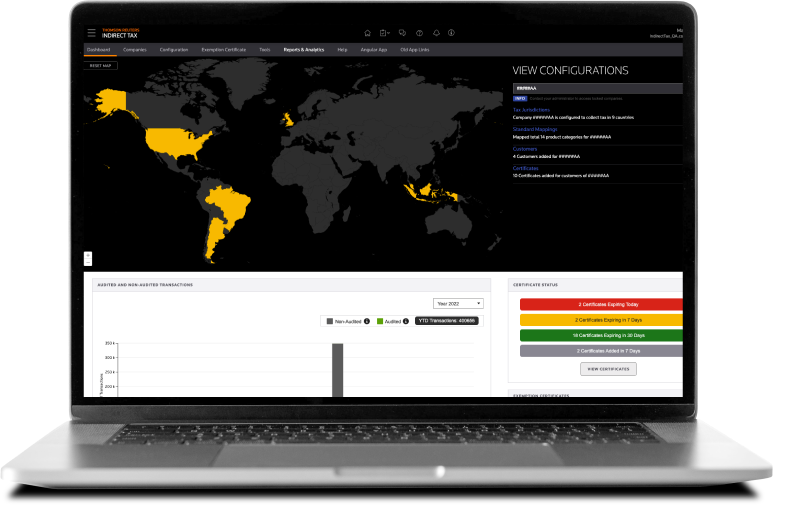
ONESOURCE Determination can automate tax calculation with technology designed to handle the most complex transactions in the oil and gas industry.
Obtain detailed insights on your most important data points, including identifying and extracting materials, drilling oil and gas fields, reviewing well data, and more.

Tax software for oil and gas companies
ONESOURCE Determination for the oil and gas industry
Schedule demo ↗