
As agentic AI takes over routine return preparation, firms can focus scarce talent on review and advisory work
Highlights
- By shifting routine 1040 preparation to AI agents, firms can expand capacity without adding headcount.
- New breakthroughs in agentic AI can complete simple tax prep and deliver returns that are ready for review.
- Tax professionals spend less time building returns and more time reviewing work, handling exceptions, and providing advisory services.
So far, tax firms have largely used AI as a supplementary tool to automate one-off tasks. That approach has real value: faster research, quicker document drafts, less manual data input and document indexing. But it still requires a human tax professional in the pilot seat.
A newer category of agentic-driven AI software removes that requirement. Some AI-native tax preparation platforms can execute the preparation stage of the 1040 workflow independently for simple returns.
For firms facing staffing shortages and margin pressure at once, the implications of being able to jump straight to review for a large bulk of returns are massive. Here’s why not all AI is created equal, and why that distinction can make all the difference.
Jump to ↓
What is AI-native tax preparation software?
AI-assisted vs. AI-native tax prep: What are the differences?
Preparers become reviewers, partners become advisors
Why generic AI struggles with intensive tax work
What should the standard be for AI-native tax prep?
What is AI-native tax preparation software?
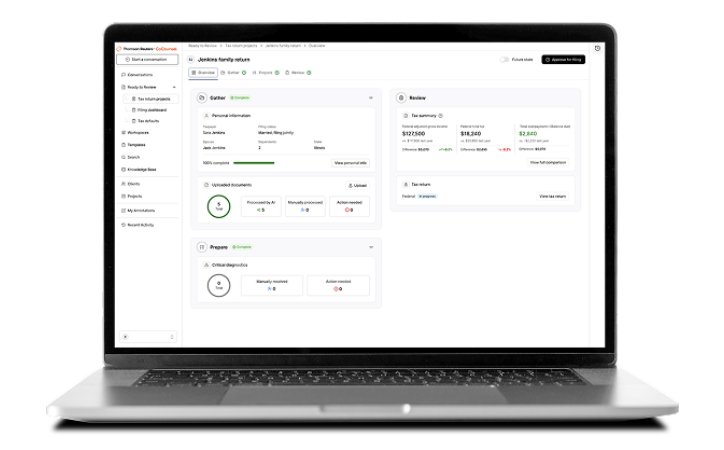
AI-native tax prep software is built around agentic AI as its core engine, not as a feature layered on top of legacy workflows. Instead of a preparer working through a return step by step with AI suggestions at their elbow, separate AI agents handle each stage of the workflow:
- A gather agent extracts data from source documents and prior returns, then categorizes and verifies it before pushing it into the tax engine
- A tax preparation agent runs that data through the engine, applies the relevant calculations (depreciation, amortization, required minimum distributions, qualified business income checks, and similar recurring work), and creates and solves diagnostics on the professional’s behalf
- The return reaches the preparer with discrepancies flagged and diagnostics resolved, leaving only the items that still need judgment
- Once reviewed, the return can be e-filed directly with the IRS from the same platform
That’s the core difference between AI-assisted and AI-native automation: one accelerates work for tax professionals, the other does the work and hands it to a human to check.
AI-assisted vs. AI-native tax prep: What are the differences?
Eliminating the most time-consuming stage of the tax workflow for simple returns completely transforms the calculus of how tax firms operate. Here’s what changes:
- Capacity: AI-assisted tools reduce the time each task takes. AI-native platforms reduce the number of tasks that require a preparer at all.
- Where staff time goes: AI-assisted work still consumes preparer hours on execution. AI-native work reallocates those hours toward review, exception-handling, and client conversations.
- Who’s in the pilot seat: AI-assisted prep keeps a human building the return with AI helping along the way. AI-native prep flips that; the agent builds it, and the human checks it.
For firms that can’t hire their way out of busy season, that shift is far more impactful than incremental efficiency boosts.
Preparers become reviewers, partners become advisors
Handing off a large volume of routine preparation completely restructures how tax practices can conduct routine business:
- Preparers spend their time validating completed drafts (checking accuracy, completeness, and supported positions), rather than assembling returns line by line.
- Managers and partners are freed from reviewing routine returns for basic errors, since diagnostics are already flagged and resolved before the return reaches them.
- That reclaimed time moves toward the work clients are actually asking for: planning conversations, entity structuring, and other advisory engagements that command premium fees.
Why generic AI struggles with intensive tax work
General-purpose AI models weren’t built for this level of automation; at least not with the accuracy standards that tax pros need. Everyday AI tools can usually scan documents and answer tax questions based on internet research, but they carry real limitations for multi-step, professional tax work. Here’s why:
- Consumer-grade AI models aren’t trained in authoritative, editor-reviewed tax content, so answers can be outdated, incomplete, or simply wrong, and they don’t provide full citations back to primary authority.
- Generic AI tools have no firm-specific governance, no role-based access controls, and no audit trail showing how a conclusion was reached. And client data entered into a consumer AI tool isn’t protected in the way regulated firms need it to be.
- These applications aren’t connected to an actual tax engine, so they can’t run a compliant calculation or file a return. A chatbot can describe a qualified business income limitation; it can’t apply it to a client’s return and e-file the result with the IRS.
Speed without a defensible answer creates liability that shows up during the next audit or client dispute.
What should the standard be for AI-native tax prep?
Agentic AI has only recently become capable of executing full workflows, instead of executing basic queries, which is why AI-native tax preparation is a genuinely new category rather than a rebrand of existing tools. The firms getting the most out of it are pairing agentic execution with a real tax engine, not just a language model.
That’s the standard Thomson Reuters Ready to Review, built on the CoCounsel platform, is designed to meet with Fiduciary-Grade AI™:
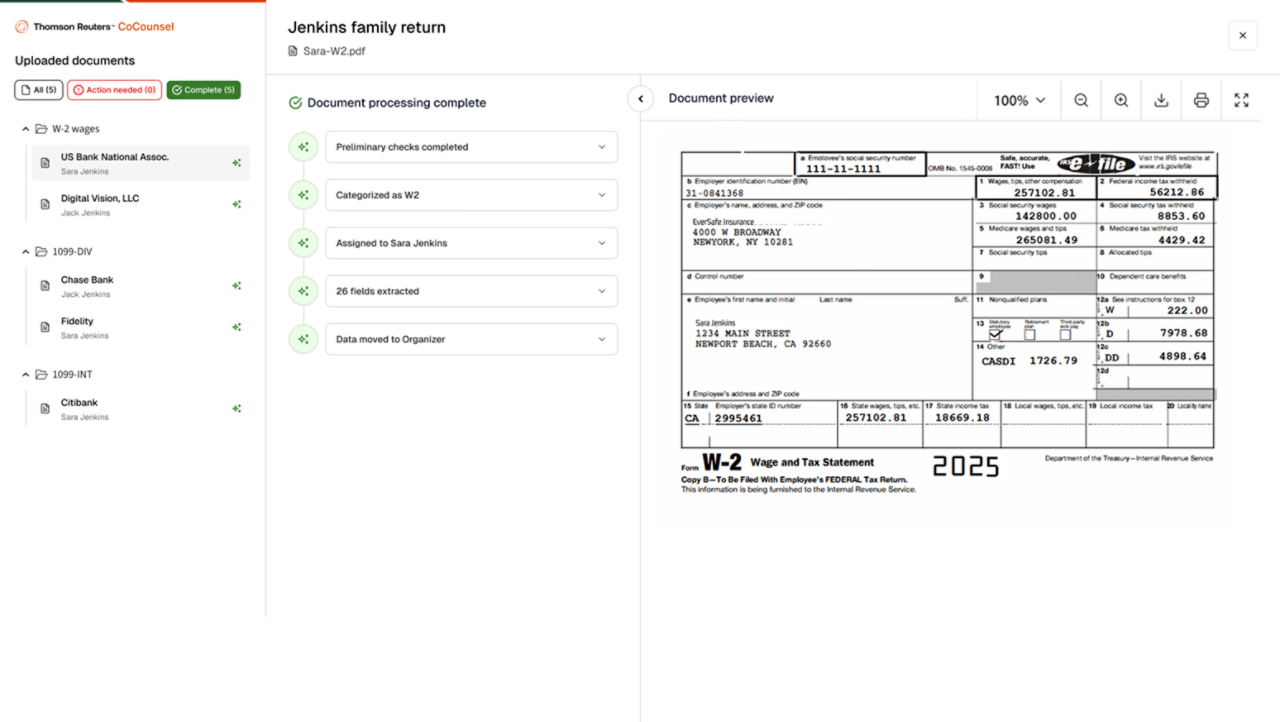
- A gather agent and a tax preparation agent automate the gather and prepare steps of the 1040 workflow, from source document extraction through diagnostics
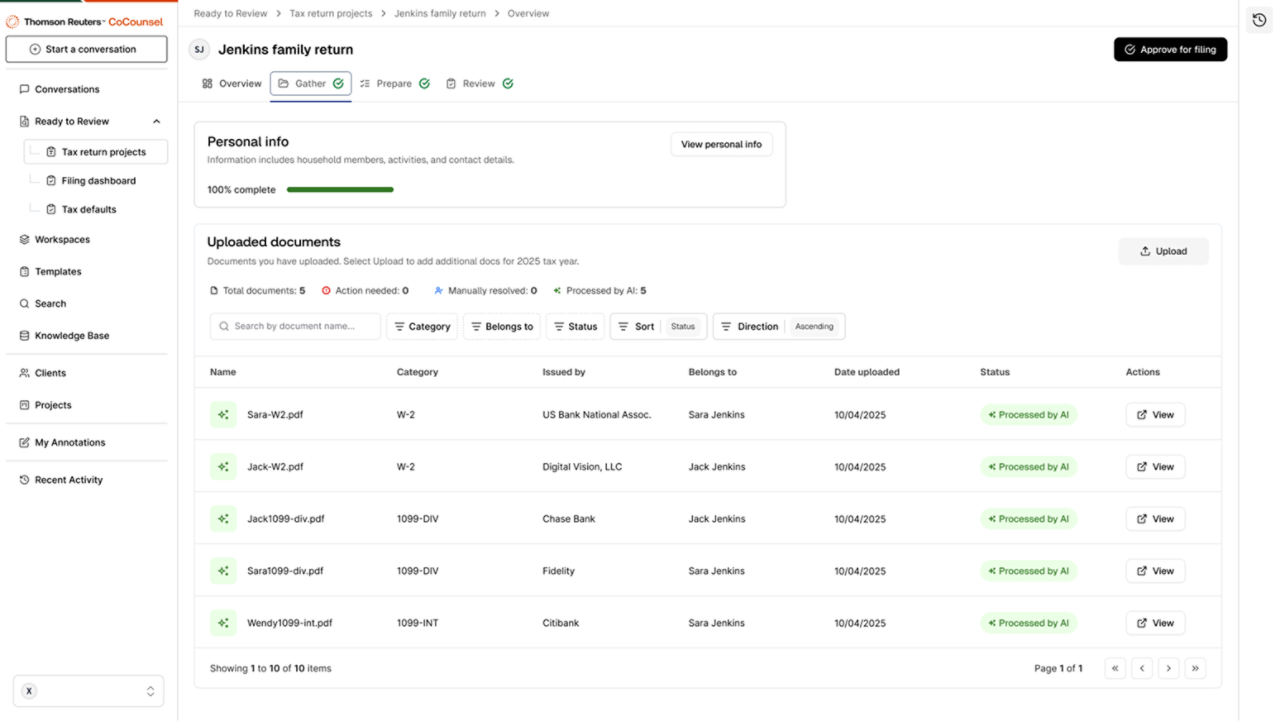
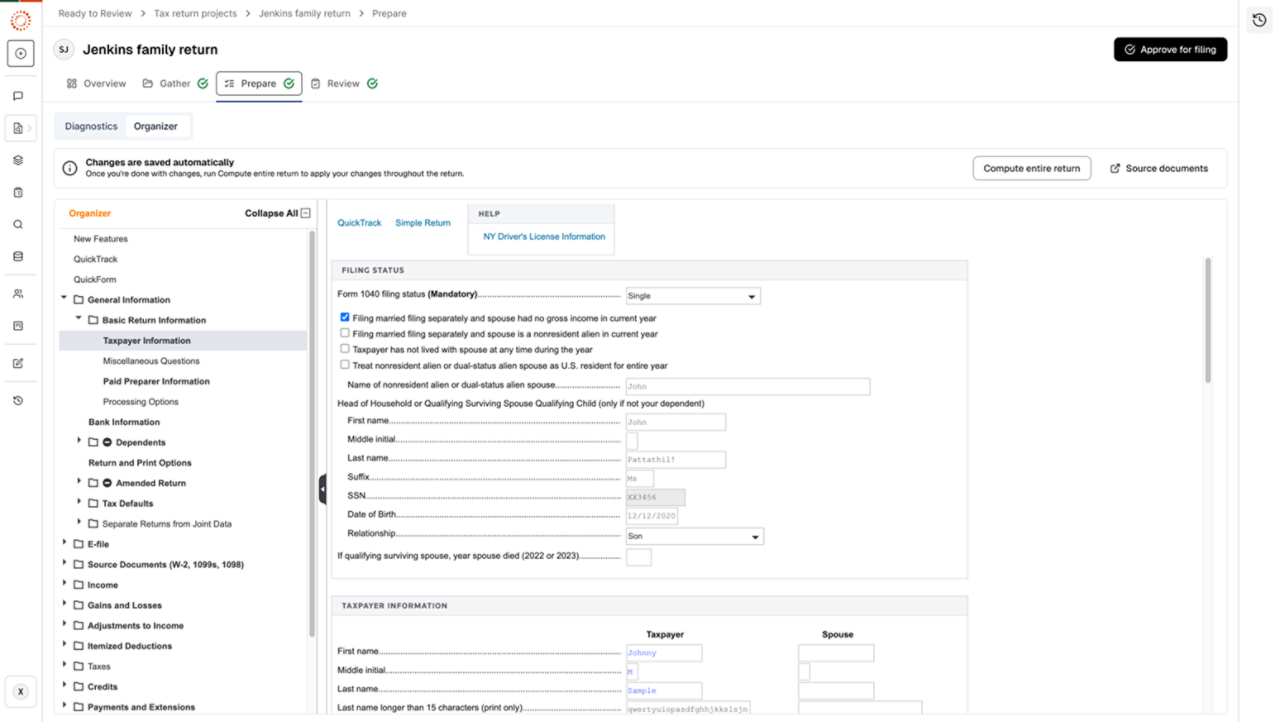
- Every calculation runs through Thomson Reuters GoSystem Tax RS, an IRS-approved e-file engine, so each completed return is also compliant and ready to file
- Full automation covers simple tax scenarios, with semi-automated support for returns that need a mix of AI and manual input
- A guardrail view shows how each agent reasoned through the return, so your team can see the work before signing off on it
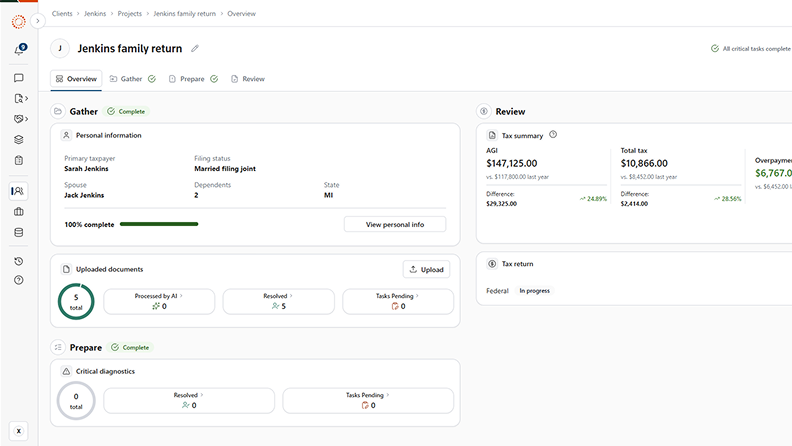
The result is a 1040 that reaches your team already gathered, prepared, and diagnosed, backed by more than 150 years of Thomson Reuters tax content. Your first touch on a return is the review, not the build.
“Reducing return preparation time by approximately an hour on each simple 1040 is significant in terms of efficiency gains. For firms like ours, these time savings will be a game changer.”
Partner, CLH
Ready to see the time savings for your firm? Request a free demo of Ready to Review today.
See Ready to Review in action!
Schedule a free, no-commitment demo with one of our agentic AI experts.
Get personalized demo ↗