Highlights
- AI accelerates tariff compliance by closing the speed gap between regulatory changes and team response.
- ONESOURCE Global Trade delivers 155 million annual updates with sub-one-day turnaround across 220+ jurisdictions.
- A 90-day roadmap prioritizes data consolidation, risk assessment, automated monitoring, and temporal infrastructure.
The first two installments in this series established the terrain. Part 1 mapped the legal landscape: which tariff authorities the U.S. government still has available, which are contested, and which have been removed. Part 2 examined the compliance demands those authorities create — the data depth, real-time velocity, and temporal range that most organizations’ existing systems weren’t built to deliver.
This installment addresses the response. What role does AI genuinely play in trade compliance today? What does a modern compliance technology stack actually look like? And for a manufacturer ready to act, what does a practical 90-day improvement roadmap look like in practice?
Jump to ↓
AI in tariff compliance: Closing the speed gap
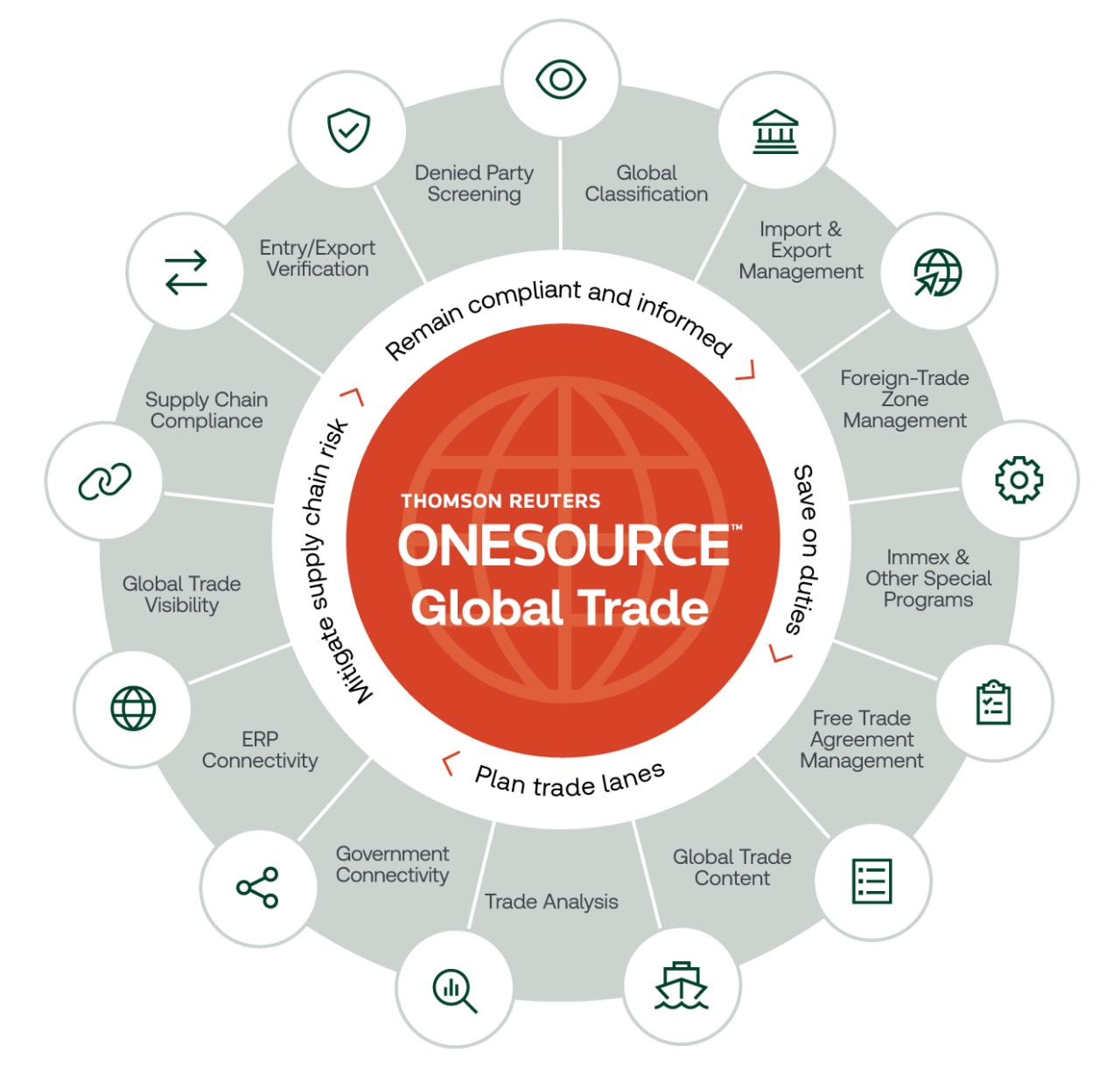
How Thomson Reuters addresses the full trade compliance challenge
Practical roadmap: 90 days toward a tariff-resilient compliance program
What tariff compliance leadership looks like in 2026
 |
|
AI in tariff compliance: Closing the speed gap
The most useful frame for understanding what AI does in tariff compliance is not complexity — it’s speed. The volume and pace of regulatory change that defined 2025 and continues into 2026 has created a gap between how fast the rules change and how fast compliance teams can analyze, interpret, and act on those changes. That is the gap AI is most capable of closing.
“AI in trade compliance needs a human in the loop,” explains Elizabeth Connell, Vice President of Product Management at Thomson Reuters. “It doesn’t replace trade professionals, but gives them tools to create and validate impact assessments at the speed they are now expected to deliver, and do scenario planning on how to react.”
The applications where AI delivers the clearest, most immediate value today:
- Regulatory synthesis: distilling executive orders, USTR notices, and Federal Register publications into actionable summaries that compliance teams can act on without parsing hundreds of pages of legal text first
- Classification assistance: AI-powered tools can suggest HS codes based on historical data and similarity analysis, generate General Rules of Interpretation-grounded rationales, and surface binding rulings — building the audit trail as classification decisions are made rather than assembling it under time pressure afterward
- Scenario planning and impact modeling: projecting the financial effect of a proposed tariff change across a company’s actual product portfolio and supply chain data before the change takes effect — so procurement and finance have lead time to act, not just respond
- Risk prioritization: automatically scoring product lines and transactions by exposure under active authorities — Sections 232 and 301, free trade agreement (FTA) eligibility gaps, partner government agency (PGA) requirements — so limited compliance resources concentrate on the highest-risk areas
Marianne Rowden, Consulting Attorney at Brownstein Hyatt Farber Schreck, LLP, has followed AI’s trajectory in trade compliance for over five years. She sees scenario planning as particularly well-matched to the current moment: “You could leverage AI to really understand impact, and do scenario planning on where I should go to react to something like this — navigating through the complexity and the speed in which the information is coming in. I think that’s a great area for AI.”
Where caution remains essential: final-decision automation without human review. The regulatory framework governing U.S. Customs and Border Protection’s (CBP) acceptance of AI-assisted customs decisions is still developing, and organizations deploying AI without experienced oversight introduce the kind of risk that trade professionals exist to prevent. The productive model is AI that accelerates expert judgment, not AI that bypasses it.
 |
|
How Thomson Reuters addresses the full trade compliance challenge
Real-time content powered by human expertise
Trade compliance technology is only as reliable as the content it runs on. ONESOURCE Global Trade Content delivers more than 155 million updates annually across 220+ countries and territories, with an average update time under one business day from publication. Behind that scale is a team of 150+ researchers monitoring more than 1,300 regulatory sources daily — human expertise that validates, contextualizes, and structures the content that powers automated compliance workflows.
For manufacturers managing exposure across multiple active tariff authorities simultaneously, this means tariff rates, classification schedules, FTA rules of origin, and denied party lists are updated continuously — without requiring internal compliance teams to monitor every regulatory channel themselves.
Consolidating global trade data into a single source of truth
For most manufacturers, trade-relevant data is fragmented: Enterprise resource planning (ERP) systems, logistics platforms, customs broker portals, supplier databases, and legacy spreadsheets each hold pieces of the picture, often in inconsistent formats with incomplete records. ONESOURCE Global Trade integrates with existing ERP infrastructure while providing the specialized classification and supply chain visibility capabilities that Sections 232 and 301 compliance now demand — without requiring a complete system replacement.
Point-in-time accuracy and forward-looking scenario modeling
Managing the temporal dimension of compliance — knowing what rate applied on a specific past date, staying current in real time, and modeling the impact of proposed changes before they take effect — requires a system that stores tariff data with timestamped precision across the full regulatory history.
ONESOURCE Global Trade’s historical data capabilities allow compliance teams to reconstruct the regulatory landscape as it existed at any prior date — supporting retroactive audit defense, Consolidated Administration and Processing of Entries (CAPE) refund claim preparation, and historical entry validation. Forward-looking scenario modeling gives procurement and finance teams the ability to evaluate the financial impact of proposed tariff changes before decisions must be made.
Practical roadmap: 90 days toward a tariff-resilient compliance program
Step 1: Lay the data foundation
Every compliance improvement initiative runs on the same substrate: organized, accessible, standardized trade data. Without it, AI tools produce unreliable outputs, risk assessments rest on incomplete pictures, and refund claims lack the supporting documentation CBP requires.
“In my mind, it starts with consolidating the data so it can be useful. The biggest challenge with global trade is the disparate systems that all of the information resides in,” Connell emphasizes. The first 30 days should focus on data inventory: where does trade-relevant data live, what format is it in, which system holds the authoritative record for each data type, and what gaps exist at the component and origin level. This groundwork is the precondition for every step that follows.
Step 2: Prioritize by financial exposure, not operational convenience
Comprehensive compliance across every tariff authority and product line is not achievable in 90 days. The goal of a short-horizon plan is triage: identify where the greatest financial risk lives and address it first.
As Rowden advises: “You have to set out priorities. The only way to do that is to do a risk analysis, perhaps using AI on your data, to see: Is it tariff classification? Is it country of origin? Is it a PGA regulatory issue? That is your biggest vulnerability. You should really order your program in years one, two, and three to address the biggest threats first.” AI-powered technology can help to create a structured risk assessment spanning Section 301 country exposure, Section 232 metal content, FTA eligibility, and PGA requirements — scored by financial impact rather than operational familiarity.
Step 3: Close the velocity gap with automated monitoring
With data consolidated and priorities established, the next step is ensuring changes across any active tariff authority surface automatically — continuously, not periodically. Given that the Thomson Reuters content team processed over 155 million tariff updates in 2025 alone, manual monitoring approaches cannot match the pace of the environment.
Automated alerting integrated into compliance workflows — so that regulatory changes trigger review and action for affected products rather than being noticed days later in a bulletin — is not a sophistication upgrade at this point. It is a baseline operational requirement.
Step 4: Build the retroactive and forward-looking record
The final component is building the temporal infrastructure that makes both audit defense and refund recovery possible. For manufacturers with International Emergency Economic Powers Act (IEEPA) entries, this carries direct financial significance: the CAPE refund process requires clean, date-stamped entry data. Organizations that have not yet organized that record set are leaving recoverable duties on the table, and the window for action continues to narrow.
The same historical data architecture that supports refund claims also underpins proactive planning under the durable authorities. A compliance program that can reconstruct what it knew, when, and what rates applied — and model what a proposed change would mean for current product lines — is one that can operate strategically rather than reactively.
What tariff compliance leadership looks like in 2026
The tariff environment of 2025 and 2026 has put a sharp edge on a question that has been building for years: is trade compliance a back-office function that reacts to regulatory change, or a strategic capability that gets ahead of it? The answer is now being tested at every port of entry and in every CBP audit.
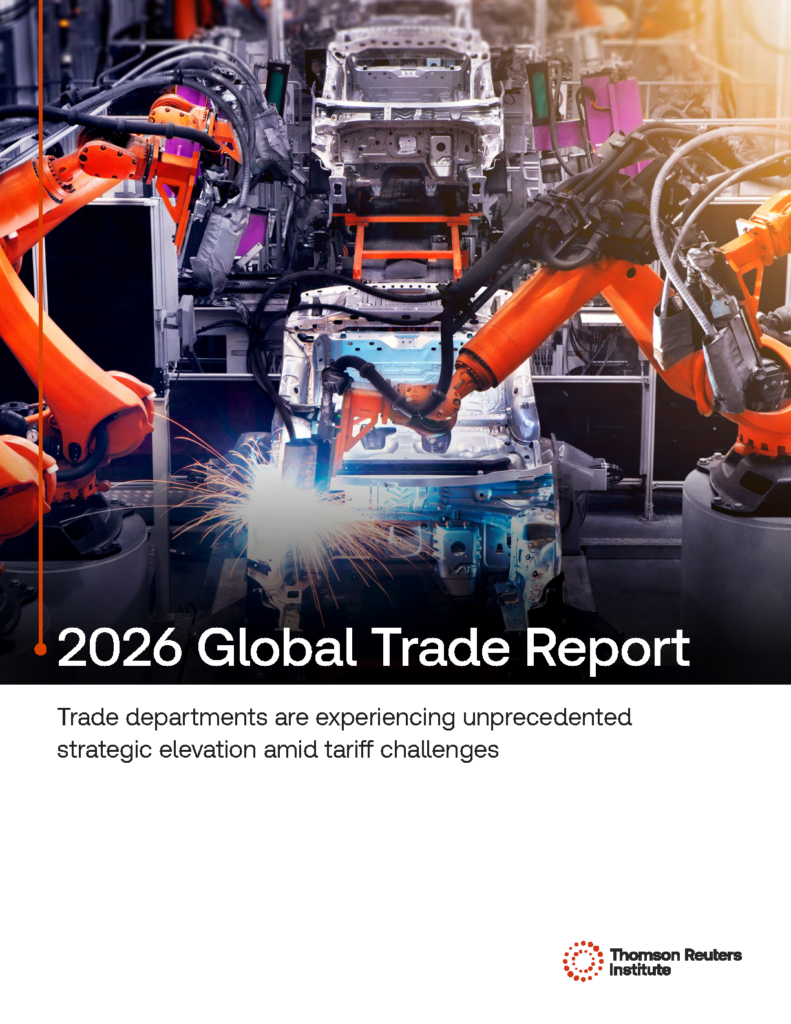
The Thomson Reuters Institute’s 2026 Global Trade Report found that only 7% of organizations are using software specifically to manage tariff changes — despite 72% naming tariff volatility as their primary challenge. That gap is where risk lives. Closing it is where competitive advantage is being built.
Platforms like ONESOURCE Global Trade bring together the real-time content, AI-assisted classification and analysis, and supply chain visibility that the current environment demands. But technology is the enabler, not the answer.
The manufacturers who navigate this environment most effectively will be those who have paired the right technology with the right expertise — and built a compliance program designed not just for the tariff landscape of today, but for the continued volatility that lies ahead.
 |
|