Highlights
- Section 232 reduced rates now depend on metal-level origin data that only your suppliers, and their suppliers, can provide.
- Missing documentation means paying full tariff, and unsupported lower-rate claims create exposure when CBP asks about reasonable care.
- A governed, automated supplier solicitation process protects your tariff position and frees trade teams for more strategic work.
Ask a trade compliance manager what changed under Section 232, and most won’t start with tariff rates. They’ll start with a question they’ve never had to ask a supplier before: where, exactly, was the metal in this product smelted, cast, melted, or poured?
That question didn’t exist a few years ago. Now it decides whether a shipment qualifies for a reduced duty rate or gets assessed at full value. And the answer doesn’t live in your ERP, your customs broker’s files, or anywhere else in your own systems. It lives with your suppliers, and, in a lot of cases, with their suppliers. Section 232 supplier data, in other words, isn’t something you already have. It’s something you have to go get.
Jump to ↓
The real problem: Supplier origin documentation
Building a governed process for section 232 tariff reduction
 |
|
The real problem: Supplier origin documentation
Trade professionals already knew 2025 was volatile. This year, they’re telling us it’s something else entirely. In the 2026 Global Trade Report from the Thomson Reuters Institute, 72% of trade professionals surveyed named U.S. tariff volatility the most impactful regulatory change they’re facing. That’s nearly double last year’s 41%. Three-quarters believe the current tariff environment isn’t a phase. It’s the new baseline for at least the next four years.
Section 232 is a big part of why. The 2026 restructuring didn’t just raise rates on steel, aluminum, and copper to as high as 50%. It rewired how importers prove they deserve anything less. Country of origin used to be enough. Now you need origin at the metal level. For steel, that’s the country of melt and pour; for aluminum and copper, it’s the country of smelt and cast. This means reaching past your direct suppliers and into a part of the supply chain most trade teams have never had a reason to map. To qualify for the lowest tariff tier, products need to be at least 85% U.S.-origin metal by weight, a threshold the government actually lowered in June 2026, from 95%, but one that still depends entirely on data only your suppliers can verify.
That shift shows up in how companies are responding. In the same survey, 65% of trade professionals said their organization is changing sourcing patterns to manage tariff exposure, and 57% are renegotiating supplier contracts. Trade teams are already deep in supplier conversations. The problem is what they’re being asked to extract from those conversations now: a data element most suppliers have never been asked to track, gathered at a scale most compliance teams have never had to manage.
Section 232 isn’t asking for this alone, either. Section 301 forced-labor tariffs that took effect this summer now cover roughly 99.4% of U.S. imports and demand the same kind of upstream supplier visibility, on a separate timeline, with separate documentation. Trade teams aren’t managing one new data request. They’re managing several at once.
Do it by email and spreadsheet — which is still how most companies do it — and the cracks show fast. Only 7% of trade professionals say their organization uses dedicated software to stay current on tariff changes. Meanwhile, 56% report a heavier workload this year and 49% report more stress on their teams, even before you add hundreds or thousands of individual supplier requests, follow-ups, and validations to the pile.
Get it wrong, and the cost isn’t abstract. Miss the documentation, and you pay full tariff on goods that might have qualified for a lower rate. Claim a lower rate you can’t fully substantiate, and you’re exposed the moment U.S. Customs and Border Protection (CBP) comes asking whether you exercised reasonable care, which is often after the goods are already sold with no way to recover the difference from a customer.
Building a governed process for section 232 tariff reduction
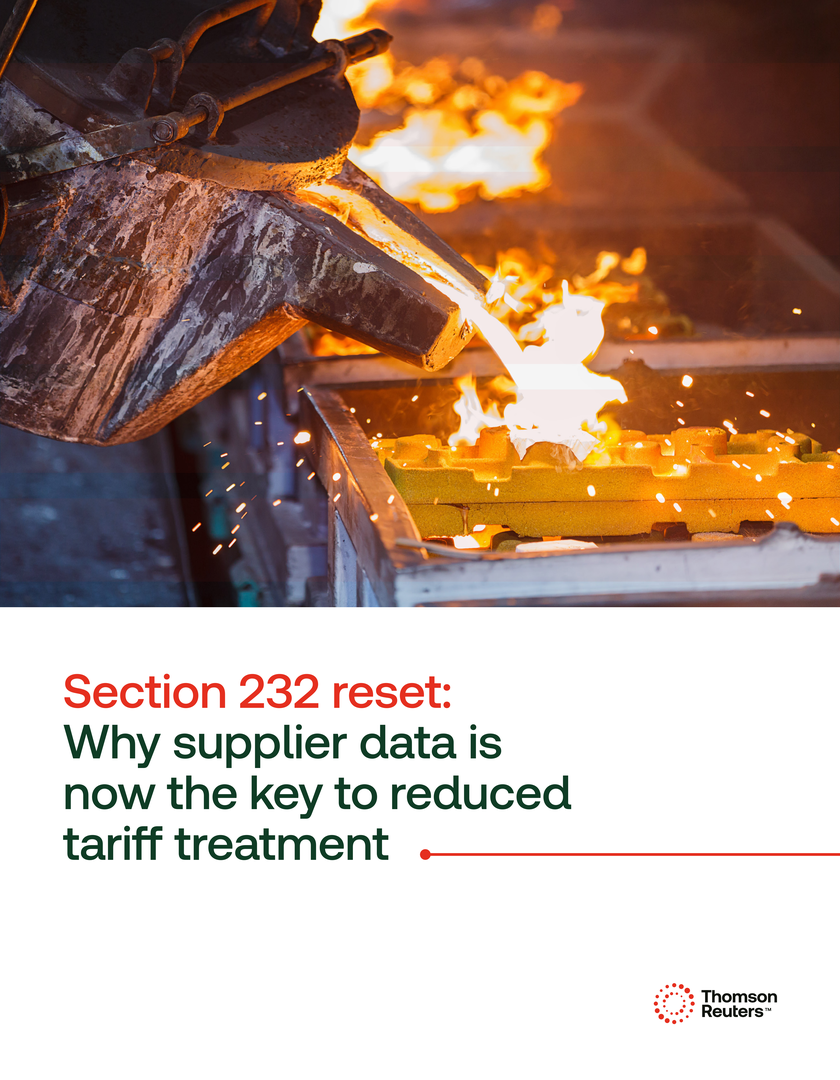
Our new white paper, Section 232 reset: Supplier data is key to reduced tariff treatment, walks through what changed in the April 2026 restructuring, the June 2026 executive order that raised the enforcement bar further, and what a defensible compliance program needs to look like now. It’s a useful read for anyone trying to make sense of a rulebook that keeps moving.
It’s also a case for treating supplier data as infrastructure, not a one-time scramble. That’s where ONESOURCE Global Trade comes in. Instead of chasing suppliers one email at a time, ONESOURCE FTA Management automates the solicitation itself: you import supplier records from your existing ERP, send structured questionnaires requesting metal origin and component-level detail, and let suppliers respond through a secure portal instead of a crowded inbox. That’s a supplier certification workflow, not a scramble. You can see who’s responded, who hasn’t, and what’s still missing, all in one place, with an audit trail ready for CBP before you ever need it.
The same information doesn’t just serve Section 232. Once it’s collected, it supports free trade agreement qualification, preferential tariff treatment, product classification, and sourcing decisions elsewhere in the business, so you’re not rebuilding the same supplier request every time a new trade requirement lands.
Georgia-Pacific is a good example of what that shift looks like in practice. The company moved from manual, disconnected trade processes to a centralized approach using ONESOURCE Global Classification AI and FTA Management, and cut the time spent on product classification by 50%. Its annual free trade agreement revalidation, which used to take five months, now takes one or two. As Myesha Cottom, senior director of international trade at Georgia-Pacific, put it: what used to be a season-long push across every business unit is now a matter of weeks.
The upside beyond compliance
There’s a bigger story underneath the documentation burden. The same Global Trade Report found that trade departments are gaining real influence inside their organizations: 43% of respondents report more say over procurement decisions, and 37% report more frequent involvement in executive decision-making, a number expected to climb further next year. Companies are recognizing trade as a strategic function, not just a back-office cost center.
That elevation depends on trade teams having time to advise the business, and time is exactly what a manual supplier solicitation process eats up. A governed, automated approach doesn’t just protect your Section 232 position. It’s what frees your team to spend less time managing spreadsheets and more time doing the strategic work that’s earning trade a seat at the table.
If you’re still collecting section 232 supplier data the old way, the tariff environment isn’t likely to slow down long enough to make that sustainable.
Read the white paper to see what a structured supplier solicitation process actually looks like, and what it would take to build one before your next audit, not after it.
 |
|