Better classification, faster research, stronger decisions
Highlights
- A connected ONESOURCE platform links classification, content, and duty tools into one shared data source.
- Shared data across modules has driven over $1 billion in annual customer duty savings.
- Teams running single ONESOURCE modules are often one step from closing costly compliance and visibility gaps.
Most compliance teams didn’t choose to work this way. One system handles classification. Another holds regulatory content. A separate research process fills the gaps between them, and a spreadsheet connects what the systems don’t. It works, mostly, until the day it doesn’t: a misclassified product, a missed tariff change, an auditor asking for a rationale nobody wrote down.
That fragmentation carries a real cost: product data entered twice, research that takes hours because it means checking five sites instead of one, and decisions that are hard to defend later because nobody can show their work. If you run trade compliance for a multinational, none of this is news. You’ve felt it in the time it takes to answer a simple question from your CFO, and in the extra hour spent reconstructing why a classification decision was made six months ago.
One global trade director described life before automation as a “patchwork of different systems” that created risk nobody could fully see. We hear a version of that story often.
It’s a connected platform; not one more tool bolted onto the stack.
Jump to ↓
How connected trade tools improve classification and compliance
A connected global trade compliance platform, not a pile of add-ons
Where disconnected trade workflows create compliance gaps
See the complete ONESOURCE Global Trade suite
 |
|
How connected trade tools improve classification and compliance
Here’s what that looks like in practice. A team using ONESOURCE Global Classification powered by CoCounsel to classify products against HS codes, paired with AI-powered research built on the same trade content, doesn’t just save time in two places. Classification decisions get sharper because the research behind them is one query away. Research gets faster because it draws on the same tariff and product data driving classification. Each tool makes the other more accurate, not only more efficient. It’s the difference between a classification question taking hours and taking minutes.
The results back this up. Across ONESOURCE’s duty and classification tools, customers have generated more than $1 billion in annual duty savings, with some saving as much as $250 million in a single year through foreign-trade zone strategies. Georgia-Pacific cut its product classification time in half after replacing manual, disconnected processes with Global Classification.
Independent analysts agree: IDC MarketScape named Thomson Reuters a Leader in two reports – IDC MarketScape: Worldwide Global Trade Management for Retailers and Importers 2025-2026 Vendor Assessment (doc #US51573724, December 2025) and the IDC MarketScape: Worldwide Global Trade Management Applications for Manufacturers and Exporters 2025 Vendor Assessment (doc #US53604225, December 2025), and Thomson Reuters shows up again in the Gartner Market Guide for Global Trade Management Software.
None of this happens by accident. We built classification data to feed directly into ONESOURCE Free Trade Agreement Management, foreign-trade zone strategies to run on that same product master, and denied-party screening to draw on the same content backbone. One team, one dataset, several problems solved at once. When your classification data, your duty analysis, and your screening results all come from the same source, cleaning up an error in one place cleans it up everywhere, instead of leaving three versions of the truth to reconcile later. It’s the same reason J.M. Huber’s own trade team points to pulling enterprise data into one environment as the biggest benefit of running its modules together rather than apart.
A connected global trade compliance platform, not a pile of add-ons
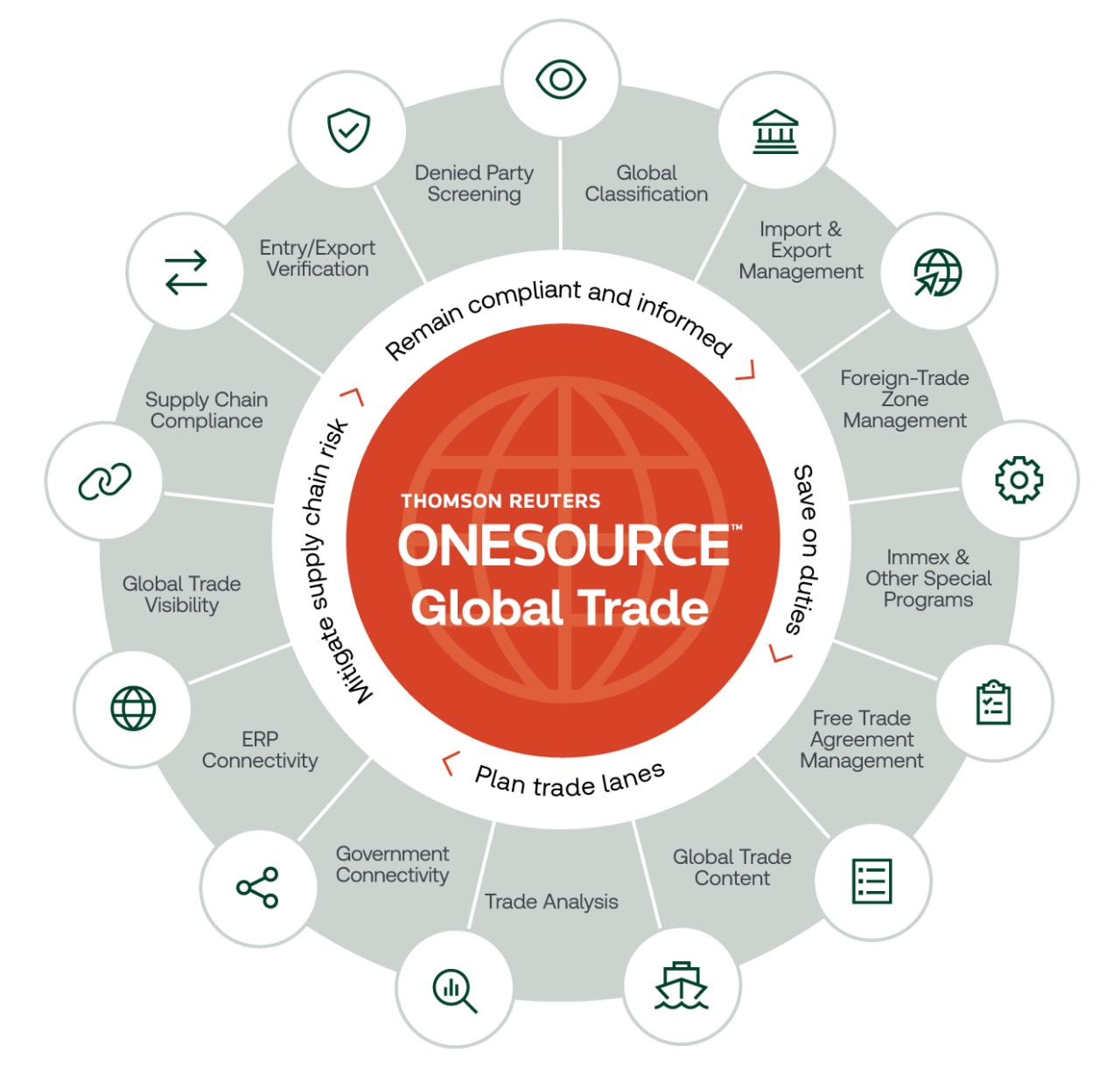
It’s worth naming what ONESOURCE Global Trade actually is at this point: not a collection of point solutions, but a connected trade compliance platform: Regulatory content refreshed in under 24 hours. AI that classifies products and shows its work, built to the same Thomson Reuters Fiduciary-Grade AI™ standard used across CoCounsel and ONESOURCE. Operational scale that holds up across more than 220 countries and territories. That currency isn’t limited to the trade team’s own screen, either: the same tariff, duty, and export control data can reach procurement, finance, and logistics tools directly, the moment a decision is being made rather than two weeks after.
That combination buys a compliance director something specific: a single source of truth for trade data instead of five, audit-ready records instead of an email thread, and a stack that scales when the business enters a new market or a new regulation lands overnight, rather than one that needs a new vendor every time. That’s what makes it an integrated trade compliance platform for multinational companies, not a bundle they’ve outgrown. Growth stops being something your trade infrastructure has to catch up to.
Where disconnected trade workflows create compliance gaps
For teams already running part of the ONESOURCE suite, the gap is often narrower than it looks.
A team running ONESOURCE Import Management is already handling the workflow a foreign-trade zone strategy is built to optimize: purchase order through customs entry. Without FTZ, that team stays compliant but leaves duty deferral and inverted-tariff savings unclaimed on volume it’s already processing. For a company importing $50 million in foreign parts at a 7.5% duty rate, that gap is worth about $225,000 a year.
A team running Free Trade Agreement Management alone is answering one question well: is this shipment eligible for preferential treatment? Duty optimization asks the next one: is this the best trade lane, and is a foreign-trade zone or another program worth more than the free trade agreement alone? Industry estimates suggest companies overpay 3% to 8% of total import duties due to classification and qualification errors, including missed free trade agreement claims. That gap tends to grow, not shrink, as sourcing shifts across new countries and new trade lanes, and some of it only surfaces after the fact, in the kind of large-scale refund processing CBP is now working through.
And a team already capturing duty optimization through FTA or FTZ is often one step from full visibility into that same data. Trade visibility and direct government filing connectivity round out exactly the workflow that team is already running, consolidating several trade processes into a single interface instead of scattering them across multiple systems, so that procurement, finance, and operations are working from the same numbers as the trade team, not a version pulled two weeks earlier.
Each of these gaps is already costing something: time, duty savings, or risk. Most teams just aren’t tracking it yet.
Building a more resilient trade compliance operation Tariff volatility isn’t a temporary condition. Most trade professionals expect it to persist for years, not months. Section 232 actions and continued use of IEEPA authority have raised the value of every preferential program a company qualifies for, while USMCA, CPTPP, RCEP, and EU trade agreements all draw on rules of origin that keep shifting. On the enforcement side, new executive action is resetting compliance deadlines and raising penalty floors for importers, which makes the cost of a fragmented compliance stack a lot more concrete than it used to be.
A connected suite absorbs that kind of volatility better than a patchwork of tools that each need separate updates and separate monitoring. When a tariff schedule changes, a team working from one shared source of content sees it once and acts on it once, instead of chasing the same update across four systems. That’s the real argument for the complete suite: not that any single tool is easier to use, but that the whole stack gets steadier as the environment around it gets less predictable.
See the complete ONESOURCE Global Trade suite
The tools most compliance teams already trust for classification, content, and duty savings were built to work as one platform, not as a shelf of separate products. See what the complete ONESOURCE Global Trade suite makes possible.
 |
|